AI SEO Content Optimization Roadmap
The Smart Scale Content Framework
How to optimize existing content, apply on-page AEO best practices, and build a content system that keeps earning citations in ChatGPT, Perplexity, Gemini, and Google’s AI Overviews.
Written by Julia Gordeeva, founder of WorkMatix and creator of the SEO-nergy methodology, with 18 years in B2B search marketing.
For twenty years, content strategy had a reliable formula: research keywords, write the best page, earn backlinks, rank. It worked because Google’s ranking system rewarded exactly those inputs.
AI search doesn’t work that way, and the data is genuinely uncomfortable for anyone who built a career on the old formula.
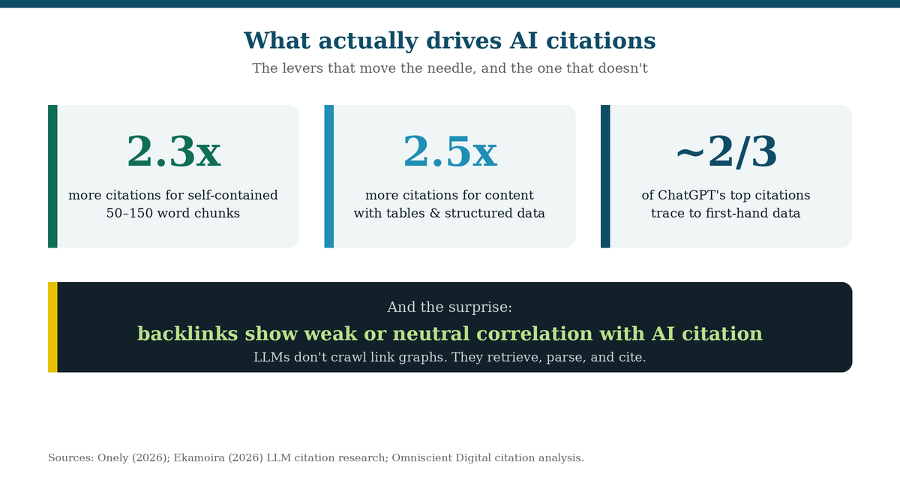
In 2026 research analyzing what large language models actually cite, backlinks showed weak or neutral correlation with AI visibility. Not negative. Just… not the lever. LLMs don’t crawl link graphs the way Google bot does. They retrieve, parse, and cite.
That single finding reframes everything. If you want to be the source an AI names when your buyer asks it for a recommendation, you’re not optimizing for a ranking algorithm anymore. You’re optimizing to be retrievable, parseable, and trustworthy to a system that reads your page, chunks it, and decides whether your answer is worth quoting.
This is the roadmap for doing that, on the content you already have and everything you publish next. It’s the public version of the Smart Scale Content Framework, the five-phase system WorkMatix uses to turn a pile of underperforming pages into content that compounds.
| If you only have two hours, start here. You do not need the whole framework to get a result this week. Pick your five most important pages. On each one, rewrite the first 50 words under every heading so they answer the question directly, add an FAQ block with three real questions your buyers ask, and stop. That is the highest-return two hours in this entire roadmap, and everything below makes it systematic rather than ad hoc. |
Quick Summary: How to Optimize Content for AI Engines
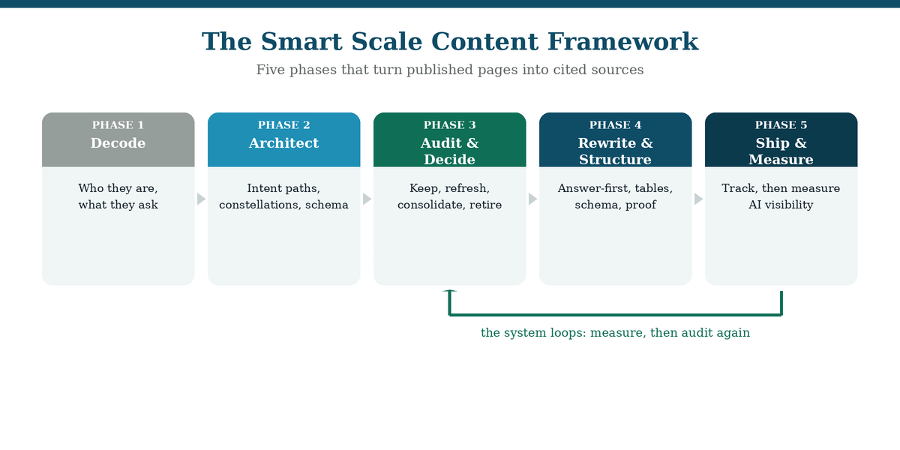
The Smart Scale Content Framework, in five phases
Phase 1, Decode. Understand who you’re writing for and what they actually search. Map semantic entities and real conversational prompts, not just keyword strings.
Phase 2, Architect. Turn that demand into a content strategy: intent pathways, topic constellations, and the schema each page type needs. Every page gets a reason to exist.
Phase 3, Audit & Decide. Score your existing content against that strategy on performance, intent alignment, freshness, and linking health. Then decide, page by page: keep, refresh, consolidate, or retire.
Phase 4, Rewrite & Structure. Rebuild each page around real intent using AI-readable structure: answer-first blocks, clean hierarchy, tables and lists, conversational coverage, schema, and visible expertise.
Phase 5, Ship & Measure. Run the project on one timeline and measure AI visibility before and after, across ChatGPT, Perplexity, Gemini, and AI Overviews. Then feed what you learn back into Phase 3.
The terms this roadmap uses
Generative Engine Optimization (GEO) is the practice of making your content visible and citable in AI-generated answers. Where traditional SEO earns rankings, GEO earns citations.
Answer Engine Optimization (AEO) is the practice of structuring content so answer engines can extract a clean, direct response to a specific question. GEO and AEO overlap heavily and are used together throughout this guide.
Retrieval-Augmented Generation (RAG) is the mechanism behind most AI answers. Rather than recalling facts from memory, the system retrieves live sources at answer time and generates a response from them. If your content isn’t retrievable and cleanly parseable, it cannot be cited.
Query fan-out is the process by which an AI model decomposes a single user prompt into multiple sub-queries, then searches for each one. To be cited, you need to be the best answer to those specific sub-questions, not just the broad topic.
Semantic entity is a distinct concept, person, product, or organization that a model recognizes and relates to other entities. Entity mapping means covering the concepts around a topic, not just variations of one keyword string.
Why strategy comes before the audit
Because auditing your content without a strategy gives you nothing to measure against. This is the most common sequencing mistake in content optimization, and it’s worth addressing before we start.
The instinct is to begin by looking at what you have. It feels productive. But browsing your existing content with no strategy in mind produces one of two outcomes: you make cosmetic judgments based on what looks dated, or, more often, you talk yourself into keeping pages because you remember how long they took to write. Without a benchmark, you’re biased toward preserving content that probably isn’t helping you.
So, the framework front-loads strategy. Phases 1 and 2 build the standard. Phase 3 measures your library against it. That order means every keep-or-kill decision has an objective basis, and it’s why the audit sits third rather than first.
Phase 1: Decode
Phase 1 answers who you’re writing for and what they actually search, in their words rather than yours. Everything downstream depends on getting this right, because AI systems retrieve content that matches how real people phrase real problems.
Start with the buyer, not the keyword. Before you touch a keyword tool, document the person: the situations that trigger their search, the language they use, the fears that stall their decision, and the proof they need before they’ll act. This is what turns generic content into content that matches a real query. If you’re serving multiple buyer types, and most B2B sites serve two to four, decode each one separately. You’ll merge them later.
Map entities, not keyword strings. Traditional keyword research optimizes for variations of a phrase. Entity mapping asks a different question: what are all the concepts, tools, methods, comparisons, and adjacent problems a model would associate with this topic? A model deciding whether to cite you is assessing whether your site demonstrably covers the subject, not whether you repeated a phrase enough times.
Capture conversational prompts, not just queries. This is where AI search diverges sharply from traditional SEO. People don’t type keywords into ChatGPT; they describe situations. “What software should a mid-sized B2B company use to automate payroll?” is a completely different retrieval target than “payroll software.” And the difference is measurable: research on model behavior found that prompts containing a year, a price constraint, or a comparison structure triggered live search 100% of the time. Content built to answer those specific, constrained questions is far more likely to enter the retrieval pipeline.
Understand query fan-out. When a model receives a prompt, it doesn’t run one search. It decomposes the question into several sub-queries and searches each. Practically, that means your goal isn’t to rank for one head term; it’s to be the best available answer to the cluster of sub-questions your topic generates.
Expect your tooling to shift. Keyword volume tools still matter, but they answer a narrower question than they used to. Add intent mapping and prompt discovery to the mix, and treat AI assistants themselves as research instruments, asking them your buyers’ questions and studying what they return and cite.
Deeper on this phase: The Ultimate SEO Guide to Discover Keywords and Topics in the AI Era, What Is Search Intent and Why Is It Important for SEO?, and AI Prompts for Semantic Keyword Research.
| Check yourself before moving on. Phase 1 is done when you can answer yes to three things: can you write down five questions your buyer asks in their own words, do you know which AI prompts would surface your category, and could you explain to someone else why a buyer starts searching in the first place? |
Phase 2: Architect
Phase 2 turns demand into a plan where every page has a defined job. This is the phase that prevents the most expensive content problem: publishing steadily while competing against yourself and leaving obvious gaps unfilled.
Map intent pathways. Group what you learned in Phase 1 into the journey stages your buyers actually move through and assign each stage the pages that serve it. Every page should trace back to a specific intent. If you can’t name the intent a page serves, that’s your first signal it shouldn’t exist.
Build topic constellations, not isolated posts. A constellation is a tightly connected set of content around a subject: the pillar that covers the whole territory and the clusters that go deep on each part. This structure does something specific for AI visibility, it demonstrates that your site has no obvious knowledge gaps on the topic. And topical authority is increasingly where smaller sites win. Research on 2026 citation behavior notes that a small site covering one subject exhaustively can outcompete a large general publication for citations in that niche. You don’t need to be the biggest domain. You need to be the most complete one on your subject.
Match format to intent. This is one of the highest-leverage decisions in the whole framework, because format mismatch loses citations regardless of writing quality. The data is unusually clear: query intent predicts which format gets cited better than industry or model choice does.
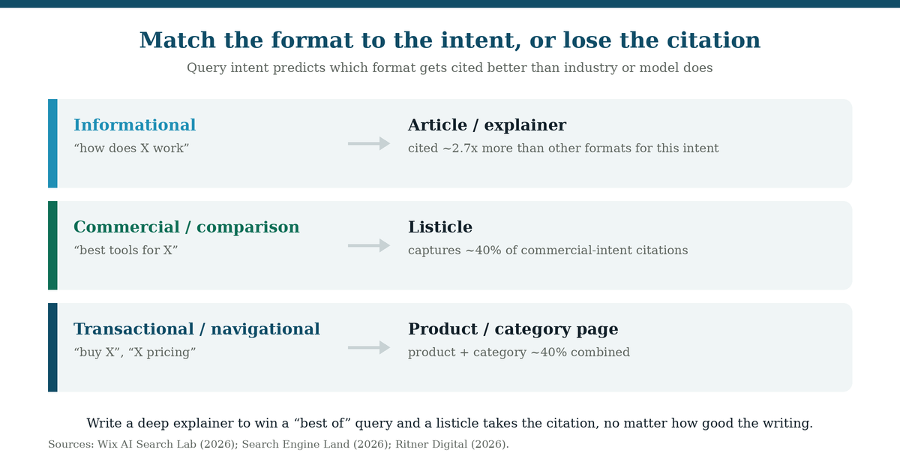
Articles dominate informational queries. Listicles capture roughly 40% of commercial-intent citations and are consistently the single most-cited format overall. Product and category pages win transactional and navigational queries. If you write a beautiful long-form explainer to win a “best tools for X” query, you’ll lose the citation to a listicle every time.
The same guidance as a lookup:
| If the query intent is… | The format that wins citations |
| Informational, learning about a topic | Article |
| Commercial, comparing options | Listicle |
| Specification or side-by-side detail | Table |
| Follow-up questions after an answer | FAQ block |
| Step-by-step execution | Numbered how-to |
Map schema by page type. Decide up front which structured data each page type needs, because schema is how you remove ambiguity for machines. Comprehensive structured data is associated with substantially higher appearance rates in AI recommendations. Doing this mapping now, at the architecture stage, means it gets built in rather than retrofitted.
Deeper on this phase: Developing Topic Clusters via Keyword & Intent Mapping.
Check yourself before moving on. Phase 2 is done when every planned page has a defined job, you know which format each one needs, and no two pages are targeting the same query.
Phase 3: Audit & Decide
Phase 3 measures everything you’ve already published against the strategy you just built, then forces a decision on each page. No sentimentality, no “we’ll get to it.”
Score every page on four dimensions. Performance (is it earning traffic, rankings, or conversions?), intent alignment (does it serve an intent your strategy actually cares about?), freshness (when was it last meaningfully updated?), and linking health (is it orphaned, over-linked, or competing with a similar one?). That last one matters more than most audits acknowledge, orphaned pages are invisible to both crawlers and readers, and internal linking gaps quietly waste authority you already have.
Then decide, page by page: keep, refresh, consolidate, or retire. Every page gets exactly one disposition. This is where a structured decision matrix earns its keep, because the alternative is an endless list of “maybe someday” pages that never get touched. Consolidation deserves special attention: merging several thin, overlapping articles into one dense reference page usually beats keeping them separate, both because it eliminates self-competition and because it produces the kind of comprehensive resource models prefer to cite.
Re-map against your constellations to find gaps and cannibalization. Overlay your surviving content on the topic constellations from Phase 2. Two things surface immediately: gaps where buyers expect content and you have none and overlaps where multiple pages chase the same intent. Both are fixable, and neither is visible without the map.
On freshness, one caution. Recency genuinely matters for AI citation, research indicates the large majority of AI bot traffic targets recently published or updated material, and a striking share of ChatGPT’s most-cited pages were updated within the last month. But models are getting better at detecting cosmetic updates. Changing “2025” to “2026” in a headline while the underlying facts stay identical doesn’t register as fresh. What signals genuine recency is substantive change: new data, revised claims, added context. Plan real refreshes, not date swaps.
Deeper on this phase: How to Do a Website Content Refresh (Step by Step Guide) and 8 Reasons a Small B2B Agency’s Content Is Invisible in AI Search.
Check yourself before moving on. Phase 3 is done when every existing page has exactly one disposition written next to it, and you could defend each decision to someone who disagreed.
Phase 4: Rewrite & Structure
Phase 4 is where each page gets rebuilt to be extractable, answerable, and trustworthy. Start every rewrite by documenting the current state, what the page is now, what it ranks for, what it’s meant to do, so you’re improving deliberately rather than starting over and losing what worked.
Structure for retrieval
Lead with the answer. Answer-first formatting places a direct, self-contained response in roughly the first 40 to 60 words of each section, before context, before setup. AI systems can extract that cleanly without parsing your introduction. Every H2 in this guide follows the pattern deliberately.
What that looks like in practice:
| Before | After |
| In today’s competitive landscape, understanding your customer has never been more important. Many businesses struggle to work out who they are really talking to, and the consequences of getting it wrong can be significant… | A B2B buyer persona built for SEO captures how someone searches, not just who they are. That means their trigger moments, their exact phrasing, and the questions they put to an AI assistant. |
| Nothing extractable. A model reading this has no answer to lift, so it summarises a competitor instead. | Self-contained, 38 words, answers the question in the first sentence. This is the block that gets quoted. |
Write in self-contained chunks. Research on citation behavior found that clear, self-contained blocks of roughly 50 to 150 words receive substantially more citations than long, unbroken prose, on the order of 2.3 times more. The reason is mechanical: RAG systems chunk your page, and a chunk that makes sense on its own is a chunk that can be quoted. If a paragraph only makes sense after reading the two before it, it’s hard to cite.
Use strict, meaningful hierarchy. H2s and H3s are semantic signposts telling a model which answer belongs to which question. Choose headings for meaning, not visual size, and phrase them as the questions your buyers actually ask.
Add tables and lists wherever the content allows. This is the highest-return formatting change available. Content with tables and structured data is cited materially more often than unstructured content, roughly 2.5 times by one analysis, and listicles are the single most-cited format in AI answers. Numbered lists create clean extraction boundaries; tables make relationships explicit. Both reduce the interpretation work a model has to do.
Cover the conversation
Write for how people actually ask. Rewrite thin, keyword-shaped headings into the full questions your buyers pose to an assistant. Cover the constrained variants too, the ones with a year, a budget, a company size, or a comparison, since those reliably trigger live retrieval.
Build a real FAQ layer. AI conversations are iterative: a user asks, gets an answer, then asks the obvious follow-up. An FAQ section that anticipates those follow-ups, marked up with schema, gives models clean question-answer pairs to lift. This is one of the most reliably cited structures on a page.
Earn the trust signals
Publish original data. This is the strongest content-level lever available. A large share of ChatGPT’s top citations trace back to first-hand data, by one analysis roughly two-thirds, and quantitative claims are cited meaningfully more often than qualitative ones. Original surveys, proprietary benchmarks, and documented client results make you the primary source rather than one more site summarizing someone else’s numbers.
Make expertise visible. Author bios, credentials, expert quotes, and links to authoritative sources aren’t decoration; they’re the signals models use to judge whether a source is safe to cite. Related research finds brand authority to be the strongest single predictor of citation, and that brands appearing across four or more platforms are substantially more likely to be cited than single-platform brands. Being corroborated elsewhere matters as much as what’s on your page.
One practical technical note: ChatGPT’s user-triggered fetcher does not render JavaScript, so content that only appears after JS execution may be invisible to it. Server-rendered HTML isn’t just a performance nicety anymore; it directly affects whether your content can be read at all.
Deeper on this phase: How to Master SEO Content Briefs, How to Build First-Party Data for AI Citations, and Why Isn’t My Business Showing Up in ChatGPT?
Check yourself before moving on. Phase 4 is done when each rewritten page answers its question in the first 50 words, uses headings that match real queries, and contains at least one table or list.
Phase 5: Ship & Measure
Phase 5 turns the plan into shipped pages and tells you whether any of it worked. Most content refreshes die here, not from bad strategy but from losing track of a hundred half-finished pages.
Run the whole project on one timeline. Track each page from decision through drafting, review, and publication. A refresh project has a lot of moving parts, and the failure mode is predictable: the first fifteen pages get done and the rest quietly stall.
Measure AI visibility before and after. This is the step almost nobody takes, and it’s the only way to know if the refresh worked. Take a baseline before you start: ask ChatGPT, Perplexity, Gemini, and Google’s AI Overviews the questions your buyers ask, and record whether you appear, how you’re described, and who gets cited instead. Re-run the same prompts after the refresh.
Track each platform separately. Cross-platform overlap is smaller than most people assume, one 2026 analysis found only about 11% of domains cited by ChatGPT were also cited by Perplexity. Appearing in one is not evidence you appear in the others.
Then loop back. Content optimization isn’t a project with an end date; it’s a system. Feed what you learn into the next audit cycle. High-traffic and data-heavy pages deserve review at least quarterly, since freshness genuinely affects retrieval.
Deeper on this phase: Tracking Search Visibility in AI Overviews & LLMs.
Check yourself before moving on. Phase 5 is done when you have a before and after reading for the same set of prompts, and a date in the calendar for the next cycle.
What this looks like when it’s working
You stop publishing into the void. Instead of adding pages to a library nobody retrieves, you have a defined constellation where each page has a job, formats match intent, and the whole set demonstrates real depth on your subject.
Your old content stops being dead weight. The pages worth saving get genuinely better, the redundant ones get merged into something stronger, and the ones that were never going to work stop consuming attention.
And you can answer the question that started all of this: when a buyer asks an AI for a recommendation in your category, does your name come up? With a baseline and a tracker, that stops being a guess.
The Smart Scale Content Framework is the system WorkMatix built for exactly this work: decoding buyers, architecting content strategy, auditing and deciding, rewriting for retrieval, and measuring AI visibility as a real metric. It’s available as a guided engagement and as a self-directed toolkit, because the right level of support depends on your time and how you like to work.
What is AI content optimization?
AI content optimization, often called GEO or AEO, is the practice of structuring and writing content so AI systems can retrieve, parse, and cite it in generated answers. It emphasizes extractable structure, answer-first formatting, original data, semantic clarity, and freshness, rather than the backlink-and-keyword levers traditional SEO relies on.
How do I get my content cited by ChatGPT and Perplexity?
Lead each section with a direct answer in the first 40 to 60 words, write in self-contained chunks, use tables and lists, match format to query intent, publish original data and statistics, make expertise visible, keep content substantively updated, and implement schema. Then measure per platform, since citation overlap between engines is limited.
Do backlinks still matter for AI search?
Research in 2026 found backlinks show weak or neutral correlation with LLM citation, because models don’t crawl link graphs the way search engines do. Backlinks still support traditional rankings, which indirectly influence retrieval, but they are not the primary lever for AI visibility. Structure, original data, entity clarity, and multi-platform presence matter more.
What content format gets cited most by AI?
It depends on query intent, which predicts citation better than industry or model. Listicles are the most-cited format overall and dominate commercial and comparison queries; articles lead for informational queries; product and category pages win transactional ones. Matching format to intent matters more than length or polish.
How often should I refresh content for AI search?
Review high-traffic and data-heavy pages at least quarterly. AI systems show a strong recency preference, but models increasingly detect cosmetic updates, so a refresh must involve substantive change (new data, revised claims, added context) rather than swapping the year in a headline.
Should I optimize old content or write new content?
Usually old content first, provided you audit it against a real strategy rather than gut feel. Consolidating thin overlapping pages into dense reference pages typically produces faster gains than publishing more, because it removes self-competition and creates the comprehensive resources models prefer to cite.
Where do you want to start?
Find Your Situation
Live Group SEO Trainings for Business Owners & Marketing Teams
Website Content Optimization Service for SEO & AI Search
Customized SEO Coaching Program
DIY SEO Templates & Workbooks
“Your architecture is fine. Your content is the problem. The system to fix what’s on the page so it ranks in Google and gets cited by AI.“
SEO-nergy Methodology Toolkit
Website Content Refresh Edition
A complete, fill-in-the-blanks system that takes you from “our content is underperforming” to a measured, refreshed site, without a rebuild. Every workbook feeds the next.
Built on the proprietary SEO-nergy methodology: optimizing for how people search, how your site is built, how search engines and AI work, and how it all connects.
– Most Popular SEO + AI Search Resources –
-
DIY SEO Toolkit vs 1:1 SEO Coaching: Which SEO-nergy Path Fits You?
Four ways to use the same methodology, from fully self-directed to fully guided. A practical guide to picking the one that fits your budget, your time, and how you like…