
1:1 coaching and group training both teach SEO, but they’re built to do different jobs. A data-backed guide to choosing the right one for how you work and what you need, for consultants, agency owners, and service-based businesses. WorkMatix offers both formats, and the honest answer depends on whether you are learning alone or with a team.
You’ve decided free YouTube and a half-finished course aren’t getting you there. Good. That’s the hard part.
Now you hit the next fork: do you want a coach working one-on-one on your specific site, or a training program that teaches you the whole system alongside other people?
They sound similar. They’re not. And picking the wrong one for your situation is how people end up paying for something that technically taught them a lot but didn’t actually get them where they needed to go.
Here’s the honest difference, backed by what the research actually shows, so you can choose based on your situation rather than whichever sounds more premium.
Key takeaways
- They’re built for different jobs. In a randomized controlled study, individual coaching was superior for goal attainment and satisfaction, while group training was superior for acquiring knowledge and skills. Neither “won.” They did different things.
- Coaching is personalized; training is systematized. Coaching has no fixed curriculum and bends entirely to your situation. Training moves a group through a shared, proven curriculum together.
- Training is usually more affordable, with group formats estimated to run 15 to 20% cheaper to deliver than individual coaching and priced accordingly.
- The best results often come from combining them: learn the system in training, then use coaching to apply it to your specific case. Many people do both, in that order.
- The right choice depends on you, your goals, your schedule, your budget, and whether your need is specific to your site or shared with others learning the same thing.
What’s the actual difference between an SEO coach and SEO training?
An SEO coach works one-on-one around your specific situation, with no fixed curriculum. SEO training moves you through a structured, shared curriculum, usually alongside other learners. That single distinction drives everything else.
Here’s how one training organization framed the difference, and it applies cleanly to SEO: a group training program is built around a shared curriculum, where everyone works through the same content, at the same pace, in the same setting. One-to-one coaching works differently. There is no fixed curriculum. The sessions are built entirely around the individual, their specific situation, the challenges they are dealing with right now, and the development goals most relevant to them.
For SEO specifically, that means:
A coach looks at your website, your data, your industry, and answers “why isn’t this page ranking, and what should I do next?” The agenda is whatever you’re stuck on.
Training teaches you the whole framework, how search intent works, how to research keywords, how to structure content for humans and AI, so you leave with a complete mental model you can apply again and again, not just a fix for one problem.
Both are valuable. They’re just aimed at different targets.
Does coaching or training actually work better?
Here’s what the research says It depends on what you mean by “better,” and there’s a clean study that pulls the two apart. Researchers ran a randomized controlled trial (the gold standard) comparing individual coaching, group training, and self-coaching. The result is the most useful finding for your decision:
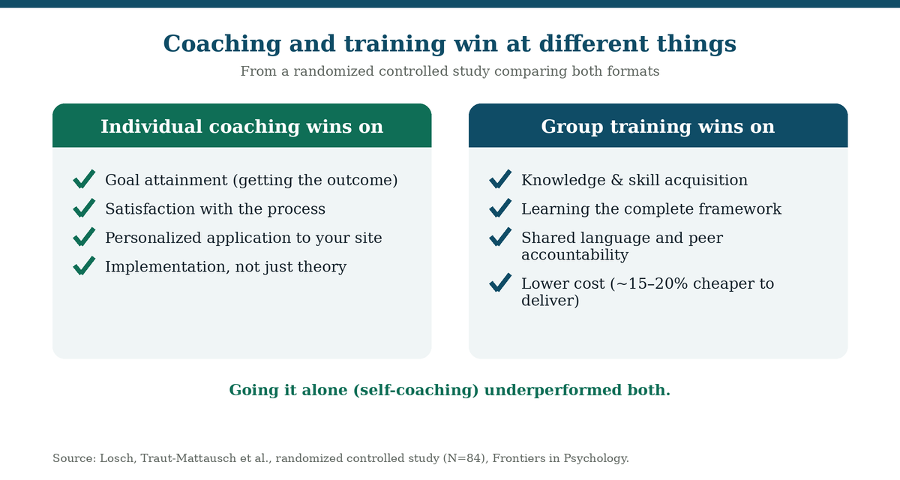
Both formats are effective; they excel at different things.
Individual coaching created a high degree of satisfaction and was superior in helping participants attain their goals, whereas group training successfully promoted the acquisition of relevant knowledge. Both were effective; they simply excelled at different things.
There’s a third finding in that same study worth flagging, because it’s the option that many people actually default to. Independently performing exercises without being supported by a coach was not sufficient for high goal attainment. In plain terms: going it alone, the free-course-and-willpower route, underperformed both coaching and training. That’s the path most people take, and the data says it’s the weakest of the three.
So, the honest scoreboard looks like this: if your goal is to know the system, training does that well and efficiently. If your goal is to achieve a specific outcome on your specific site, coaching has the edge. And doing neither, just grinding through material alone, tends to underdeliver on both.
Which is more affordable, SEO coaching or SEO training?
Training is generally the more budget-friendly option, because the cost of the instructor is shared across a group rather than dedicated to you alone.
Research on coaching delivery estimates that group formats run roughly 15 to 20% cheaper to deliver than individual coaching while maintaining substantial impact. In practice, the gap you see as a buyer is often wider than that, because 1:1 time is the most expensive thing a practitioner sells.
But price is the wrong place to end the analysis. As one coaching comparison put it bluntly: paying less for a program you eventually quit is rarely a bargain. The real question isn’t “which is cheaper?” It’s “which one will actually get me the outcome, given how I work?” A cheaper option you abandon costs more than a pricier one you finish.
When should you choose SEO training?
Choose training when you need to learn the whole system, you benefit from structure and peers, and your challenge is shared rather than unique to you. It shines in specific situations.
You want the complete framework, not just a fix. Training gives you a mental model you can reuse on your own site and, if you’re a consultant, across every client. You’re buying capability, not a one-time answer.
You’re motivated by structure and other people. A group moving through material together creates something solo study can’t. As the research notes, group formats build peer learning, collective accountability, and a common language the group takes back with them. If accountability is your weak point, the cohort is a feature.
Your questions are foundational. When you’re still building baseline knowledge, the questions you have are the same ones everyone else in the room has. A shared curriculum answers them efficiently, and you learn from other people’s questions too.
Budget matters and you’re comparison-shopping. Training gives you a structured path at a lower price point than dedicated 1:1 time.
This is exactly the thinking behind a group cohort like the Intent-to-Roadmap Blueprint Group program: structured, peer-based learning that walks you through the full methodology and hands you the templates to keep. It’s built for the “teach me the system, with people, at a fair price” situation.
When should you choose an SEO coach?
Choose coaching when your situation is specific, you need a particular outcome, and generic answers won’t cut it. The research is clear that this is where 1:1 earns its premium.
Your problem is unique to your site. As one analysis found, individual coaching was superior for goal attainment when the development need was specific to the person rather than shared across a group. If your question is “why is my site doing this,” a shared curriculum can’t answer it as well as someone looking directly at your situation.
You need an outcome, not just understanding. Coaching’s edge in the research was goal attainment, actually getting the thing done, not just learning about it. As one summary put it, the biggest benefit of coaching compared to traditional training is implementation.
You want flexibility and focus. Coaching bends to your schedule and spends 100% of the time on your development, not a group’s average need. For a busy owner, that efficiency can be worth the premium.
You’re stuck applying something you already sort of understand. This is the classic coaching moment: you don’t need the whole framework re-taught; you need someone to unblock the specific thing in front of you.
A structured coaching path like the Intent-to-Roadmap Blueprint 1:1 program fits here, personalized application of the methodology to your specific website, with support between sessions.
The honest answer: it’s often both, in order
Here’s what the research quietly points to, and what many people actually do. These formats aren’t rivals. They’re a sequence.
Training builds the foundation, the shared language, the complete framework, the “now I understand how this all fits together.” Then coaching takes that foundation and applies it to your specific, messy, real-world site. As one guide observed, workshops serve as introductions while coaching drives mastery, and workshop impact fades without follow-up support to reinforce it.
So, if you can only pick one, choose based on your bigger gap: if you don’t yet understand the system, start with SEO training. If you understand it but can’t execute on your own site, choose 1on1 SEO coaching. And if budget and time allow, learn the system in a group, then bring in coaching for the parts that are specific to you. That order, framework first, personalization second, is how a lot of people get the most from both.
One consultant described the exact moment why this matters: “I’ve got a good content marketing groove, regular blogs, podcasts, videos, but I have no idea if they’re actually reaching my target audience.” If that sounds like you, maybe you need someone to look at your specific situation and tell you what’s landing and what isn’t. That’s a coaching problem, not a training gap.
Frequently asked questions
What’s the difference between an SEO coach and SEO training?
A coach works one-on-one around your specific website with no fixed curriculum. Training moves you through a structured, shared curriculum, usually with other learners, so you leave with the complete framework. Coaching personalizes; training systematizes.
Is coaching or training more effective for learning SEO?
Research shows they excel at different things: individual coaching is superior for goal attainment and satisfaction, while group training is superior for acquiring knowledge and skills. Choose based on whether you need a specific outcome (coaching) or the whole system (training).
Is SEO training cheaper than coaching?
SEO training is usually cheaper than coaching. Group formats are estimated to cost 15 to 20% less to deliver than individual coaching and are typically priced lower because the instructor’s time is shared. But a cheaper program you don’t finish costs more than a pricier one you do.
Can I do both training and coaching?
Yes, and many people do, in that order: learn the system through training, then use coaching to apply it to your specific site. Training builds the foundation; coaching drives implementation and mastery.
I already publish content regularly. Do I need training or coaching?
If you’re already executing but can’t tell what’s working, you likely don’t need the full framework re-taught, you need personalized diagnosis. That points toward coaching rather than foundational training.
Whichever format you choose, Google’s SEO Starter Guide is the free baseline worth reading first so you arrive with better questions.