SEO-nergy Methodology Toolkit Edition
Website Strategic Foundation:
SEO Content Mapping Templates for AI Search
The complete three-step SEO-nergy methodology: decode your buyer, map their search journey across Google and AI, and build a content roadmap where every page is written to be found and to be quoted.
You know the site needs work. You do not know what to fix first
Every option sounds plausible. Rewrite the homepage. Add a blog. Fix the navigation. Build the pages a competitor has. So, the work happens in whichever order feels urgent, and none of it compounds, because each piece was decided on its own.
Most SEO strategies fail at the handoffs. The persona document never informs the keyword list, the keyword list never shapes the site architecture, and the content calendar gets filled from a competitor gap analysis that has nothing to do with either.
What is missing is an SEO content mapping template: one document that links the buyer, the searches and the pages into a single plan.
Turn audience research into a website that ranks in Google and gets cited by AI
Search performance is not produced by individual actions. It is produced by alignment between four things: how people search, how your site is built, how search engines and AI systems evaluate it, and how your marketing connects. Improve one in isolation and the others pull against it. Here is what rarely gets said out loud: your website is a salesperson working every hour of the week. It handles the first three conversations before anyone contacts you. If it cannot answer the questions your buyers are actually asking, you lose them without ever knowing they were there.
The Website Strategic Foundation Toolkit for SEO & AI Search is the complete three-step method where each step produces the input for the next: your buyer’s search behavior becomes your keyword and prompt map, and that map becomes a documented content structure with a brief for every page.
Website Strategic Foundation Toolkit
AI SEO Content Mapping System
The Strategic Foundation Edition is the entry-level toolkit of the SEO-nergy methodology, developed by Julia Gordeeva over 18 years of B2B search marketing.
It walks you through three steps, in order, each one feeding the next, until you’ve gone from ‘who is my buyer’ to a complete, execution-ready content roadmap.
This is where that search intent alignment gets decided, before anything gets built.
You start from your buyer, then reconstruct the search journey they move through, mapping the questions, keywords and prompts used at each stage.
From that single foundation, two critical engines are built at once: topical authority and a frictionless buyer’s search journey.
Topical authority helps search engines and AI systems discover contextually relevant content to treat you as a source on a subject rather than a page that mentions it. That is what makes you quotable rather than merely present.
This system also maps the complete buyer’s search journey. Someone arriving on an early research question is seamlessly guided to your product comparisons, then to your social proof, and finally to your contact form.
No doubling back. No leaving to find answers elsewhere that you already have on-site.
What comes out is an SEO content map for the entire site
Which pages should exist. What each one has to win. What belongs in the navigation and what to call it. How pages link and why. The decisions you would otherwise make on instinct, made once, on evidence, and written down.
That SEO content roadmap serves three audiences from one set of decisions:
- Found in Google. You capture traditional search traffic.
- Cited by AI. Your data is structured cleanly enough for AI assistants to quote.
- Trusted by Humans. Your copy is instantly readable for the person who lands on it.
What makes this toolkit different: four parts working as one
Four parts working as one is the whole point of SEO-nergy. Search performance isn’t a pile of tactics. It’s four moving parts, buyer behavior, website structure, content, and AI readiness, working as one. When they align, your visibility stops being a guessing game and starts to compound.
Why does a connected system beat better individual tactics?
Because the gaps between disconnected parts are where SEO work dies. A great persona that never reaches your keyword research, keywords that never shape your content plan, a content plan that ignores how AI reads a page, each handoff is a place strategy leaks out. This edition removes the handoffs. One step feeds the next by design, so nothing gets lost between them.
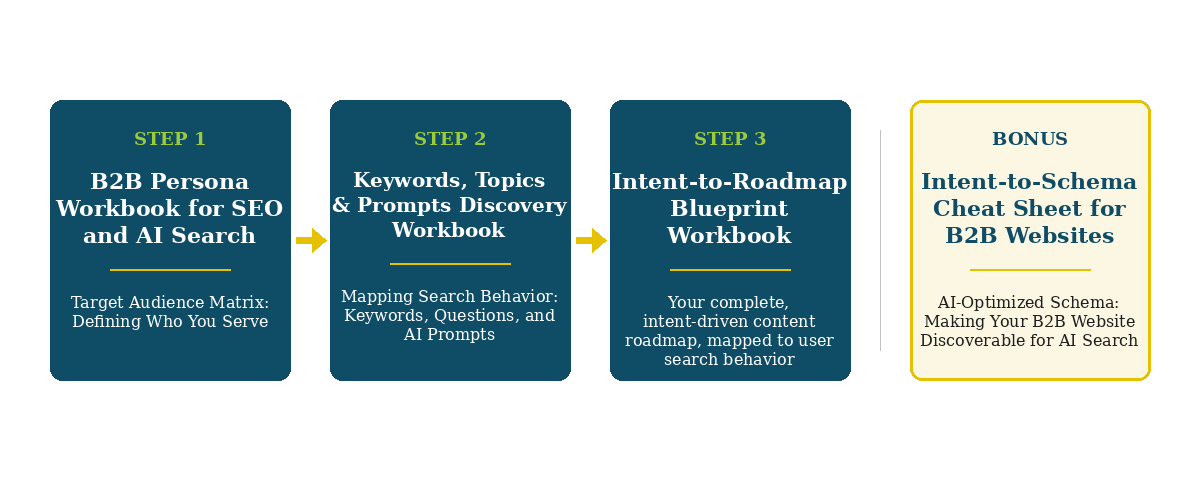
Website Strategic Foundation Toolkit
From-Question-to-Purchase Journey
The Strategic Foundation Edition is one connected method, persona to keywords and prompts to a full content blueprint, each step handing off cleanly to the next. You’re not guessing. You’re following a path that’s already been walked.
Three workbooks that actually connect
Persona, then keywords and prompts, then the blueprint. Each one opens with the last one’s output.
The Search Journey Canvas
A visual map of how your buyer moves through Information Search, Consideration, and Decision.
The Content Mapping Matrix
Where search queries, questions, and AI prompts turn into a list of pages that should exist.
Topic Constellation and Intent Path
Your pillar and cluster structure, plus the sequences visitors move through.
An Intent-to-Page Brief for every page
Strategy, SEO, and schema in one spec a writer or developer can build from.
The Intent-to-Schema Cheat Sheet included (bonus)
Every B2B page type matched to the markup that makes it readable by AI systems.
Your Investment – $115
One-time. The complete three-step method, yours to keep and reuse on every project and every client. Instant download. Word, Excel and PDF guides.
Who this is for
You’re a Head of Marketing or a marketing lead at a B2B company with a real marketing function but limited SEO depth. You want a defensible strategy you can build in-house, not another agency invoice, and a documented method your team can follow instead of reinventing the approach every quarter.
Or you’re an independent marketing pro, a consultant, content strategist, fractional CMO, or copywriter, who wants a complete, repeatable methodology instead of stitching one together from scattered sources every time you start.
Either way, you want the full framework, not a single piece of it. You’re not assembling a strategy from parts that don’t fit. You’re following a path that’s already been walked.
Which edition do you need?
Start here if you want the method itself. The Strategic Foundation Edition is the core three-step methodology, and it’s the foundation inside every other edition. If you’re rebuilding or migrating your whole site, the Website Redesign Edition adds the full redesign and migration stack on top of this foundation. If your structure is fine but your existing content has gone stale, the Website Content Refresh Edition adds the audit-and-rebuild stack.
| Quick guide Want the core three-step methodology → Website Strategic Foundation Edition (this one) Rebuilding or migrating the whole site → Website Redesign SEO Toolkit for AI Search Structure’s fine, content needs to come back to life → AI SEO Toolkit for Website Content Refresh B2B Persona Workbook → Persona Template Built for SEO and AI search |
What’s inside SEO Content Mapping Template Bundle:
B2B Persona Workbook for SEO and AI Search. Fillable, with its companion Walkthrough Guide.
Keywords, Topics & Prompts Discovery Workbook. Fillable, with the AI Prompt Builder and its companion Walkthrough Guide.
Intent-to-Roadmap Blueprint Workbook. The five core frameworks in one workbook, with its companion Walkthrough Guide.
Intent-to-Schema Cheat Sheet for B2B Websites (PDF bonus). Every B2B page type matched to the schema it needs for AI search visibility.
Start Here Guide (PDF). Exactly what’s inside and the order to use it.
Opens in Word and Excel. No special software, no subscription.
| You’re never staring at a blank field Each of the three workbooks ships with its own companion. Walkthrough Guide: strategic commentary, a worked example, and the common mistakes that quietly derail most SEO projects. Open the guide alongside the workbook, and you’ve got guided support at every step. “Working With AI” is a free companion guide for anyone who plans to use AI on this work. It covers what to give an AI once your workbooks are filled, which tasks to hand it and which to keep for yourself, and four questions that catch a confidently wrong answer. After the purchase, you will get the instructions on how to get it. |
The steps to build the execution-ready content roadmap
Step 1: Decode your buyer
The B2B Persona Workbook builds a structured profile grounded in consumer psychology and optimized for both search mechanics. It surfaces the situations that trigger a search, the goals your audience has, and the fears that stall their decisions.
Step 2: Map the search journey
The Keywords, Topics & Prompts Discovery Workbook takes that persona and translates it into real search triggers, research questions, short keyword phrases, and the longer conversational prompts people now feed into ChatGPT, Perplexity and Gemini, across every stage of the journey. It includes an AI Prompt Builder for composing realistic prompts from your persona details.
Step 3: Build the content roadmap
The Intent-to-Roadmap Blueprint synthesizes everything into an end-to-end content strategy: a Search Journey Canvas, mapped intent pathways, structured topic constellations, and execution-ready page briefs. Every page gets a reason to exist and a job to do.
It holds five proprietary frameworks plus a built-in coverage check, all in one workbook, all connected.
• Search Journey Canvas. A visual storyboard of how a real buyer moves through their search journey, from recognizing a need through to purchase.
• Content Mapping Matrix. Maps user behavior across the three journey stages onto your business goals and KPIs.
• Intent Path. Traces how users move from page to page across their journey.
• Topic Constellation. The pillar and cluster structure that builds topical authority across humans, search engines and AI systems.
• Intent-to-Page Brief. A page-level specification that bridges a mapped intent to a ship-ready page, with strategy, SEO and technical checklists.
The Content Mapping Matrix inside it is the SEO content mapping template itself: one row per page, carrying the intent it serves and the stage it sits in.
Bonus: Intent-to-Schema Cheat Sheet
Matches every B2B page type to the schema markup it needs to show up in AI search. You consult it as you spec each page brief in Step 3, so your content is not just well written, it is machine-readable.
How to create a content map, step by step
1. Document the buyer. Who initiates, what triggers the search, and what has to be true before they act.
2. Collect the language. Search triggers, stage-by-stage questions, short keyword phrases and longer conversational prompts, gathered per journey stage rather than in one undifferentiated list.
3. Lay out the journey. Mark what the buyer is thinking, doing and asking at each stage, from the first sign of a problem through to a decision.
4. Assign one intent per page. Every query gets a home, and no two pages compete for the same one. This is the step that prevents you outranking yourself later.
5. Group pages into topics. A pillar page carries the subject; cluster pages carry its parts; every cluster links up and the pillar links down. That structure is what builds authority on a subject rather than a page.
6. Brief each page before anyone writes. What it answers in the first two sentences, which searches it wins, what the reader can do afterwards, and what it links to.
7. Check coverage. Walk the journey again and look for stages with no page attached, which are the gaps worth filling first.
Questions to Answer Before You Pick This Strategic Foundation Toolkit for SEO & AI Search
Most of these come down to one thing: which edition fits the project actually in front of you.
Who is this for, compared to the other editions?
This toolkit if you need the SEO content map: what to build, in what order, aimed at what. If your site structure is fine and you need a documented plan, this is the edition. If a rebuild or a content overhaul is underway, buy that edition instead, because each already contains this one. The AI SEO Toolkit for Content Refresh if the pages exist and are underperforming. It contains all of this plus the audit and pruning layer. The Website Redesign SEO Toolkit if URLs are changing. It contains Strategic Foundation plus the migration work: inventory, architecture, redirects and launch audits.
Does this include the Persona Workbook?
Yes, in full. If you already bought the Persona Workbook separately, you are not buying it twice in spirit, you are adding the two steps that make it operational.
Do I need to finish all three workbooks?
They work best in sequence, because each one consumes the previous output. That said, take what fits your project. The method is in the order the questions are asked, not in filling every cell.
What do I actually produce?
A documented content structure: which pages should exist, what each must answer, how they link to each other, and what schema each needs. It is the document you would otherwise pay a consultant to produce.
Is this useful if I already have a lot of content?
Yes, as a benchmark. You compare what you have against what the method says should exist, and the gaps become your priority list. If your main problem is existing content that has drifted, the Content Refresh Edition adds the audit and pruning layer on top of this.
Can I use it for client work?
Yes. Buy once, use it on every engagement. Several consultants use the completed workbooks as a client-facing deliverable, which is part of why the templates are formatted the way they are.
From students and coaching clients…
What is SEO content mapping?
Content mapping is the practice of matching every page on your site to one stage of your buyer’s journey and one search intent. Instead of a list of topics somebody liked the sound of, you get a plan where each page has a single job and a reason to exist.
It is not the same as keyword research, and the two get confused constantly. Keyword research tells you which terms have demand. Content mapping decides which page owns which term, what that page has to answer, and where it sits in the path a buyer walks. Research produces a list; mapping produces a structure.
The output is usually one row per page, carrying the intent it serves, the stage it belongs to, the questions it must answer, and the pages it links to on either side.
How AI changed the buyer search journey, and what that does to content mapping
Buyers used to move through your site. Now a good deal of the early journey happens before they arrive, in a conversation with an assistant that summarizes several sources and names a few.
That changes what a content map has to do. A page is no longer only competing for a click; it is competing to be the source an AI system quotes and attributes. Thin pages that repeat what everyone else says give a machine no reason to pick them.
It also changes the shape of the queries. People type short phrases into a search box and write longer conversational prompts to an assistant, and those two produce different content needs. A map built only on short keyword phrases misses half of what your buyer is actually asking.
The practical consequence is that depth beats coverage. A smaller number of connected pages that genuinely answer something will out-earn a larger number that each mention it.
What you need before you can build an SEO content map
Three inputs, in this order. A documented buyer, so you know who the pages are for. The language that buyer uses, in both short search phrases and longer conversational prompts. And an honest list of what you already publish, so you are mapping a real site rather than an imagined one.
You do not need traffic data to start, though it helps you prioritize. You do need to have talked to customers relatively recently, because the whole map rests on the language in step two.
The toolkit that ends the arguing, and makes AI worth using
Working through the sequence forces you to decide things you have been carrying loosely: who the buyer is, which searches matter, what each page is for. Those decisions existed before, in fragments, in different people’s heads. Now they exist in one place.
That is what stops the arguing about what belongs on a page. It is also what you hand to a writer, a developer or a new hire instead of an hour of your time.
The same document does something else, and it is the reason this layer is worth buying before anything else. It is the context file. Most people find AI disappointing because they ask it to do strategic work with no strategic input, and it answers with the industry average because that is all it has.
Give it your persona, your mapped journey and your page briefs, and the output changes character. Drafts, briefs and metadata that used to take a week take an afternoon, because the thinking behind them is already done and written down.
Note the order. The workbooks make AI useful, not the other way round. Filling them in is the work; what comes after the work is what gets faster.
A worked example, from a real content map
Here are rows from the map behind this site, for a buyer we call Maryanne: Head of Marketing at a B2B services company, 180 employees, reporting to a CEO, running a website redesign. One row per search opportunity, tagged with the action behind it.
Stage 1: Information Search & Exploration | Informational Intent
She knows something is wrong and has not yet decided what to do. Three rows, three different actions, which is what stops them collapsing into one page.
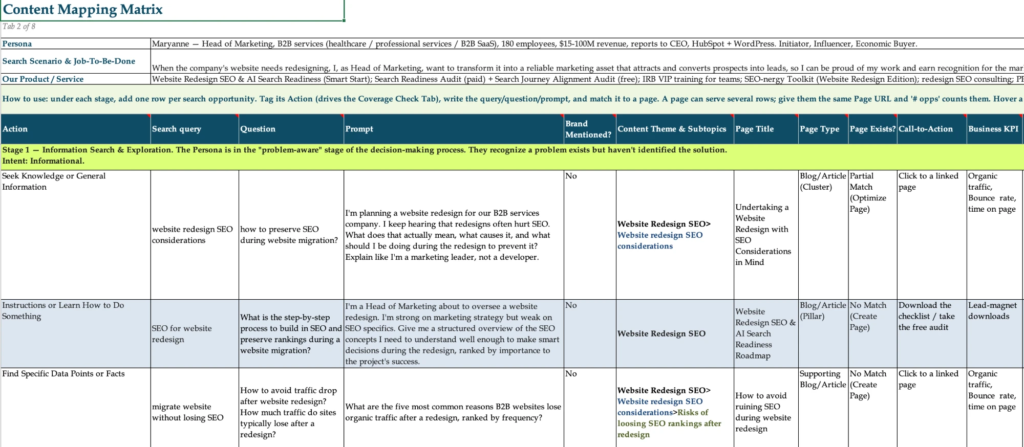
Seeking general knowledge. Query: website redesign SEO considerations. Question: how do I preserve SEO during a website migration? That maps to a cluster article, “Undertaking a Website Redesign with SEO Considerations in Mind.” A page already existed, so the decision was optimize rather than create. Measured on organic traffic and time on page.
Learning how to do something. Query: SEO for website redesign. Question: what is the step-by-step process to build in SEO and preserve rankings? Same subject, different action, so it needs a different page: the pillar, “Website Redesign SEO & AI Search Readiness Roadmap.” Nothing existed, so it was created. The call to action is the free checklist, measured on lead-magnet downloads.
Finding a specific fact. Query: migrate website without losing SEO. Question: how much traffic do sites typically lose after a redesign? That becomes a supporting article, “How to avoid ruining SEO during website redesign.”
Stage 2: Consideration, Comparison and Evaluation | Comparative & Evaluative Intent
She now knows the solutions exist and is working out which one fits. The actions change, and so does the content that serves them.
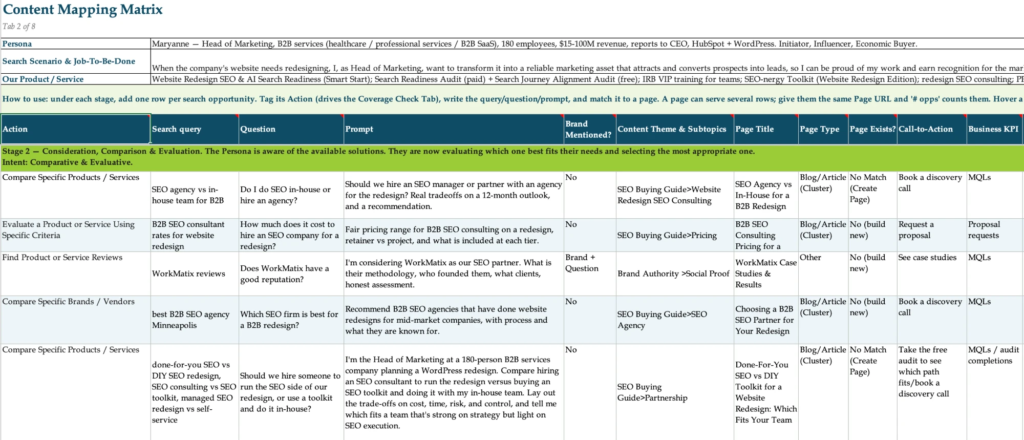
Comparing services. Query: SEO agency vs in-house team for B2B. That maps to “SEO Agency vs In-House for a B2B Redesign,” a cluster article. The call to action moves from a link to a discovery call, and the measure moves from traffic to MQLs.
Evaluating against criteria. Query: B2B SEO consultant rates for website redesign. Question: how much does it cost to hire an SEO company for a redesign? That becomes a pricing article, measured on proposal requests. Publishing real ranges is uncomfortable and it is what the searcher came for.
Looking for reviews. Query: WorkMatix reviews. This is the first row where the brand appears in the query, which changes the job: the page has to be case studies and results, not a pitch.
Comparing formats. Query: done-for-you SEO vs DIY SEO redesign. That becomes “Done-For-You SEO vs DIY Toolkit for a Website Redesign: Which Fits Your Team,” with the free audit as the call to action.
Stage 3: Decision (purchase or action) | Transactional Intent
She has decided what she needs and is acting. The queries get short and specific, and most of them carry the brand.
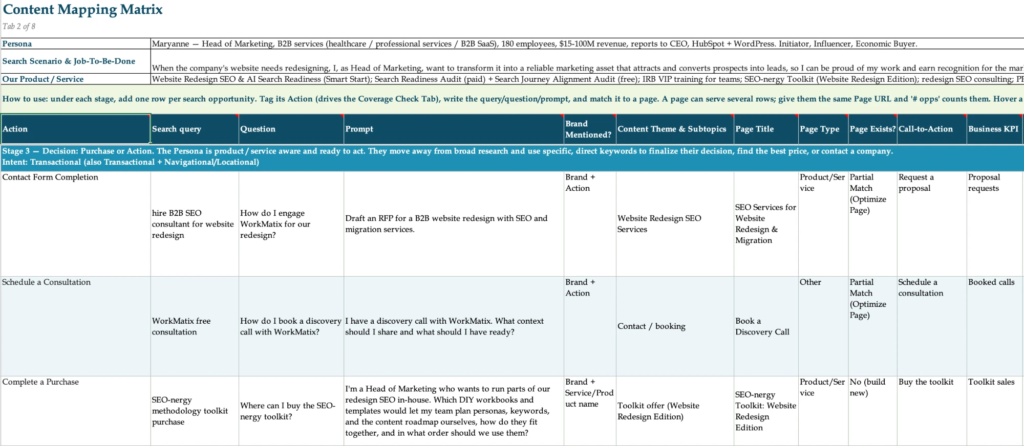
Completing a form. Query: hire B2B SEO consultant for website redesign. That maps to the service page, which already existed and needed optimizing rather than building. Measured on proposal requests.
Scheduling a call. Query: WorkMatix free consultation. Question: how do I book a discovery call? That is the booking page, measured on booked calls.
Buying. Query: SEO-nergy methodology toolkit purchase. That is the product page, measured on sales.
What the map shows that a topic list cannot
Follow one subject across all three stages and you get eight pages, not one. Each answers a different action, and none of them competes with another for the same search.
Notice also where the brand enters. It is absent through all of Stage 1, arrives in Stage 2 as reviews and comparisons, and is in most Stage 3 queries. That tells you which pages are allowed to sell and which have to earn trust first, which is a decision most sites make backwards.
Without the map, those eight pages become two or three that half-answer everything, and the specific queries go to whoever wrote the specific answer.
How to tell whether the SEO content map is working
Four signals, checked quarterly rather than weekly, because content moves slowly enough that anything more frequent is noise.
Coverage: every stage of the journey has at least one page, and no stage has three fighting each other.
Rankings: the pages you assigned to a term are the ones actually ranking for it, rather than a different page you never intended.
Movement: visitors arriving on early-stage pages go on to reach the comparison and decision pages, rather than leaving from where they landed.
Citation: your pages get named when someone asks an AI assistant a question you have answered.
Revisit the map when any of those slips, when you add a service, or when your buyer changes. Once or twice a year is normal for a stable business.
The Author of the Methodology
This is the method Julia Gordeeva runs on real client engagements, packaged rather than simplified. Over eighteen years in B2B search she watched the same three artifacts get produced by three different people who never spoke to each other, and concluded that the problem was never the quality of any one document. It was that nothing connected them. The Website Strategic Foundation is what that connection looks like when it is written down.
Would you rather build this with guidance?
The Strategic Foundation is the same method taught in the Intent-to-Roadmap Blueprint trainings, where you build it in a live cohort or with your team on your own site. If you would rather work through it alongside other people than alone at your desk, that is the version to look at.