
Can you learn modern SEO from free courses and YouTube, or is a live, practitioner-led workshop worth paying for? A data-backed comparison for consultants, agency owners, and service-based businesses.
There has never been more free SEO education available. SEMRush Academy, Ahrefs Academy, HubSpot Academy, thousands of YouTube tutorials, and now ChatGPT will explain anything you ask, on demand, for free.
So why would anyone pay to sit in a live workshop?
It’s a fair question, and the honest answer isn’t “because free stuff is bad.” Free resources are genuinely good. The honest answer is that free and live solve different problems, and if you pick the wrong one for your situation, you either waste money or waste something more expensive: months of your time going in circles.
Let’s compare them properly, with real numbers, including where the free options clearly win.
Key takeaways
- Self-paced online courses finish at dramatically low rates, commonly cited between 3% and 15%, while cohort and live formats with instructor and peer interaction routinely reach 64% to over 85%. The format, not the content, drives whether you finish.
- The information isn’t the hard part. The follow-through is. Live formats build in the accountability, feedback, and fixed schedule that solo study strips away.
- SEO changes constantly. Google makes an estimated 9 changes a day and launched over 4,700 changes in a single year, so a tutorial recorded 18 months ago can be quietly outdated.
- Free resources win on cost, flexibility, and self-contained tasks. Use them when your questions are narrow and you have time and discipline.
- Live, practitioner-led workshops win on situation-specific answers, real-time Q&A, current material, and accountability, which matter most when your own website keeps losing to client work.
Can I learn SEO for free? Yes, and here’s where free genuinely wins
You can absolutely learn SEO concepts for free, and for some situations free is the right call. It’s worth being honest about that before we talk limits.
Breadth and structure at zero cost. SEMRush Academy and Ahrefs Academy are professionally produced, genuinely good, and free. YouTube has a tutorial for almost any specific task. ChatGPT will define any term and outline any process the moment you ask.
Total flexibility. You learn at 11pm in your pajamas, pause, rewind, and skip. For a consultant with an unpredictable calendar, that flexibility isn’t a small thing. Self-paced learning exists precisely because live schedules don’t fit every life, a parent with irregular childcare or someone juggling client fire drills can’t always commit to “every Tuesday at 2pm.”
Great for narrow, self-contained tasks. “How do I set up Google Search Console?” has a clean, universal answer that a good video delivers perfectly. When the task is concrete and the answer doesn’t depend on your specific situation, free content is often all you need.
If your questions look like that, use the free stuff and save your money. But most real questions don’t look like that, and the data on what happens next is sobering.
Why don’t I ever finish the free courses I start?
Because self-paced learning removes almost every force that helps humans finish things, and the completion data is stark.
Across major platforms, the average completion rate for free massive open online courses sits stubbornly low at 5 to 15%, and other analyses put self-paced completion as low as 3 to 15%. One widely cited figure pegs the median at around 12.6%. Put plainly: a self-paced course with an 8% completion rate means 92% of learners never finish what they started. Now compare that to formats with structure and live interaction. The contrast is not subtle:
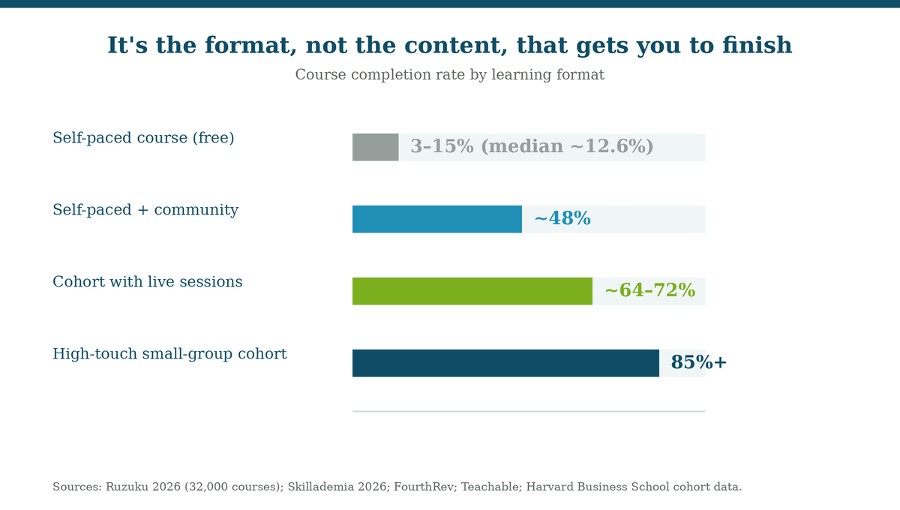
Completion rate climbs sharply as structure, feedback, and live interaction are added.
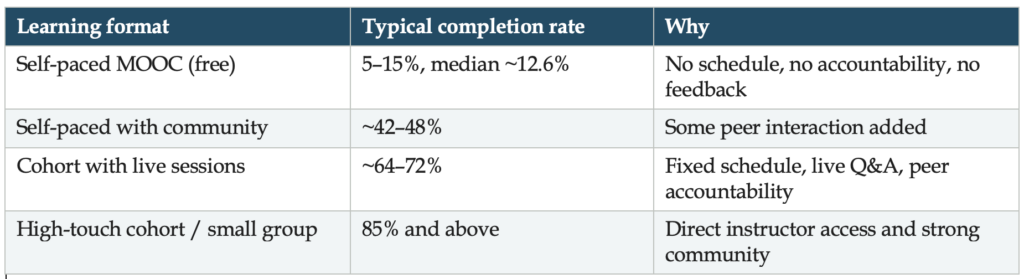
On one platform’s data across 32,000 courses, cohort-based courses hit 64.2% completion versus 48.2% for self-paced, and adding live discussion pushed it to 65.5%. Harvard Business School’s cohort model reports completion around 85%. The researchers are consistent about the cause: the gap reflects how the model supports the way professionals learn, more than the quality of the content.
Read that last part again, because it’s the whole point. The difference isn’t smarter material. It’s that peer accountability, live instructor interaction, and fixed deadlines are the things that get busy professionals to the finish line, and free self-paced content strips all three away.
For a consultant or agency owner, this lands hard. Your own website is permanently deprioritized behind client work. Free resources ask you to supply 100% of the discipline yourself, at the exact moment you have the least to spare.
Isn’t free content just as good as a paid workshop?
Not quite, and the gaps aren’t obvious until you’re deep in it. Four of them matter most.
Free content can’t see your website. A YouTube video was made for a general audience, not your site, your industry, or your situation. It can’t tell you why your content isn’t ranking or which of your pages to fix first. You’re left translating generic advice into your specific case, which is exactly where most people stall.
You can’t tell when it’s stale, and SEO moves fast. This is the sharpest risk right now. Google reportedly makes an average of nine changes a day to its algorithm, over 3,200 a year, and by one accounting launched 4,725 changes to search in 2022 alone, on top of three to four broad core updates a year. Add the shift to AI search, ChatGPT, Perplexity, and Google’s AI Overviews, and a tutorial recorded 18 months ago may predate the current rules entirely. A random YouTube result gives you no reliable signal about whether it’s current or three years out of date.
It can’t answer your follow-up. The moment you think “yes, but what about my situation?”, the video is over. ChatGPT will answer, but it doesn’t know your business, can’t push back on a bad assumption, and will confidently give plausible advice that’s subtly wrong for your context. There’s no one to catch the mistake.
It doesn’t hold you accountable. This is the quiet killer we just saw in the numbers. Nothing external holds the work in place, so it slips behind everything else and never gets done.
What does a live, expert-led workshop actually add?
A live workshop isn’t “the free content, but you paid for it.” The format itself does things a recording structurally can’t. Here’s what you’re buying.
Real-time Q&A. You ask your specific question and get a specific answer, in the moment, from a practitioner who can see the nuance. This alone closes the “yes, but my situation” gap that free content leaves wide open.
Live office hours. When you get stuck applying something, you get help while the work is in front of you, which is when help is worth the most.
Accountability and peer support. A live cohort creates gentle pressure to actually do the work, the same mechanism that moves completion from ~12% to 64% and beyond. You show up, others show up, and progress becomes something you’re on the hook for.
Fresh material, not stale recordings. A live workshop reflects what’s working now. At WorkMatix, the material is updated as the landscape shifts, so you’re learning current AI-search practice, not a video made before AI Overviews existed and never touched since. With free content, you often can’t tell how old the advice is. With a live session, recency is built in.
A practitioner, not a theorist. The person teaching does this work with real clients, so you get judgment (“here’s when this rule breaks”), not just rules.
A connected system, not scattered tips. Free content comes in fragments: a video here, an article there, a ChatGPT answer somewhere else. None of them connect. This is where one idea from modern SEO matters: your site has to work as one aligned system, where content, structure, and search behavior reinforce each other, and it has to satisfy three audiences at once, human visitors, traditional search engines, and AI systems. Scattered free tips can’t teach that, because the pieces never connect into a whole. A good workshop hands you the whole.
Which WorkMatix workshop fits which situation?
The SEO-nergy workshops are built on the methodology Julia Gordeeva developed over 18 years of practice, and every session runs on real websites and real search data so you leave with something you can apply the same day. Here’s the range, mentioned briefly so you can see where each fits.
Single-session fundamentals are for getting current fast on one thing: a “Truth Bomb” session on futureproofing for AI search, a Website Clinic that gives you honest feedback and a 7-day action plan, and a Google Search Console beginner’s session.
The Intent-to-Roadmap Blueprint, Group Cohort is the flagship in cohort form: structured peer learning for small business owners and independent professionals, applied to your own business, with the full SEO-nergy Template Toolkit included. It runs live, in person and online, at $249. The cohort format is exactly the accountability structure the completion data rewards.
The Intent-to-Roadmap Blueprint, VIP (Company-Tailored) is for teams: a private, fully customized program for in-house marketing teams or agency teams running a real project together, built around your specific website and goals rather than a hypothetical, at $4,500.
All three run on the same underlying SEO-nergy methodology. The difference is who you learn with and how customized it gets.
So, which should you choose? Free online resources or a workshop?
Here’s the honest decision rule.
Choose free SEO resources when your questions are general and self-contained, you genuinely have time to learn, you enjoy self-directed study, and you have the discipline to finish without anyone holding you to it. If that’s you, the free academies and a good YouTube playlist go a long way. Don’t pay for what you’ll happily do yourself.
Choose a live SEO workshop when you need answers specific to your situation, you want to know the material is current rather than quietly outdated, you learn better with real-time Q&A and support, or, honestly, you know that without accountability the free course will sit unfinished like the last one did. For a busy consultant or agency owner whose own site never reaches the top of the list, that structure isn’t a luxury. It’s the thing that gets it done.
The trap isn’t choosing free over paid. It’s choosing free because it’s free, then spending six months half-learning in fragments when a focused workshop would have gotten you there in a fraction of the time, with material you could actually trust to be current.
Frequently asked questions
Can I really learn AI SEO for free?
You can learn the concepts for free. What’s harder to get for free is guidance specific to your website, confidence that the advice is current, and the accountability to actually finish, which matters given that self-paced completion rates commonly sit between 3% and 15%.
Are SEMRush Academy and Ahrefs Academy worth using?
Yes. They’re well-made and free, and they’re a solid way to learn fundamentals and how to use those specific tools. They pair well with a workshop: use them for breadth, use a workshop for situation-specific application and current AI-search practice.
Why does “fresh material” matter so much in SEO?
Because search changes constantly. Google reportedly makes around nine algorithm changes a day and several broad core updates a year, and AI search is rewriting discovery on top of that. Advice recorded before these shifts can be outdated in ways you can’t easily detect. Live, regularly updated training reflects what works now.
What’s the difference between the Group Cohort and VIP training?
The Group Cohort is peer learning for individuals and small businesses at $249, applied to your own business. The VIP training is a $4,500 private engagement for a marketing or agency team, customized to your company’s live project. Same methodology, different level of customization.
I’m short on time. Isn’t a workshop a bigger commitment than a video?
It’s a bigger scheduled commitment but often a smaller total one. A focused workshop compresses what would otherwise be months of fragmented self-study, and the accountability means you actually finish instead of stalling halfway, which is what happens to the large majority of self-paced learners.
Want to see the live workshop options and upcoming dates? Explore the SEO-nergy workshops and trainings. Not sure whether free resources, a workshop, or coaching fits where you are? The comparison in the next article may help.