Partner with a Website Redesign SEO Consultant to Lead Your Migration
Website Redesign SEO Consulting for B2B Brands and Service Businesses
Hire an SEO website redesign consultant to preserve search visibility, improve rankings, and build a stronger SEO foundation for the new site.
Launch the new site without losing the rankings the old one earned
Hiring a website redesign SEO consultant early is what turns that from a hope into a plan. The decisions that protect your rankings get made before design is signed off, not after.
A website redesign is the highest risk SEO moment a company goes through, because URLs, content, structure, and internal links all change at once, and the damage usually shows up weeks after everyone has moved on.
Most website redesigns fail their SEO before they ever launch.
Your team has design covered. You have a developer or agency lined up. You’ve picked a CMS. The wireframes look good. Launch is scheduled.
But there’s a gap nobody’s filling: the SEO strategy work that has to happen alongside design and development — not after.
Skip this layer, and you join the redesigns that lose 30-70% of their organic traffic on launch day. Pretty new site. Lost search visibility. Months of recovery work that never quite gets back to where you started.
This is preventable. But not by adding “SEO” as a checkbox at the end of the project. It’s prevented by integrating SEO strategy from week one: through every decision about content, architecture, URLs, redirects, and post-launch optimization.
What a website redesign SEO consultant actually does
A website redesign SEO consultant makes the search decisions that get baked into a rebuild: which pages survive, how the new structure is organized, what each page has to rank for, and where every old URL points afterwards.
That is a different job from an SEO agency running monthly retainers, and different again from the design team. Some agencies bolt SEO onto a design that is already signed off. An SEO consultant works before that, while architecture and URLs are still decisions rather than rebuilds. In practice it means four things. Auditing what the current site earns, so nothing valuable is retired by accident. Setting the objectives the redesign is measured against. Specifying the architecture, URLs and page briefs your designers and developers build from. And QA before and after launch, so a regression is caught in days rather than quarters.
Website Redesign SEO & Site Migration Consulting
A four-stage SEO partnership across the full redesign lifecycle
Best fit: small-to-midsize B2B companies who have design and development resources but need expert SEO strategy, deliverables, and ongoing guidance.
WorkMatix plans the search and AI readiness side of your redesign before the first wireframe is created, so the new site launches with its equity intact and its architecture built around how buyers actually search rather than how the company is organized internally.
You get a mapped URL and redirect plan, a content structure tied to real intent, page-level briefs your team can build against, and a launch checklist your developer can execute. The goal is not simply to avoid a traffic drop. It is to come out of the redesign ranking better than you went in.
What we do before a redesign starts
Five things, and every one of them is cheaper during the redesign than at any later point.
• Inventory every existing page with its traffic, rankings and backlinks, so the keep, merge, retire and redirect decisions are made on evidence.
• Baseline your metrics while the old site is still live. Once it is gone you cannot reconstruct what you had, and you will be asked.
• Agree what the redesign is for in business terms rather than design terms, so success is defined before anyone can argue about it afterwards.
• Anchor your site architecture in user search behavior rather than internal organizational charts. Prioritizing external buyer intent over internal corporate structures is a fundamental pivot. This single structural decision yields a far greater impact on long-term organic discoverability than any tactical optimization you attempt to deploy post-launch.
• Create the redirect map as the URLs change, not at the end. A map built from memory in launch week is where equity disappears.
That’s what our proprietary Smart Start SEO Framework for website redesign delivers.
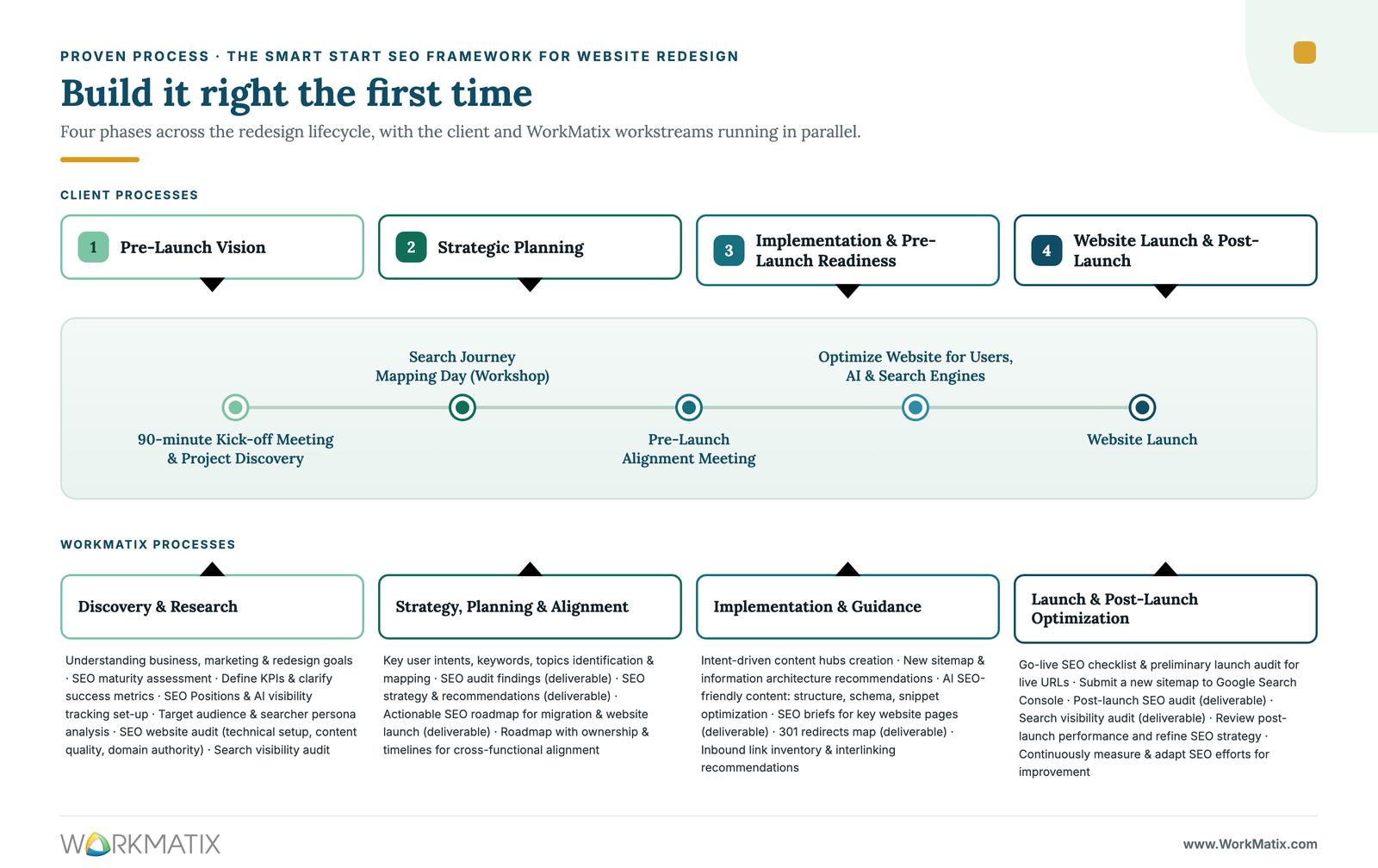
The Smart Start SEO Framework: Four Stages, One Outcome
Our Process for Integrating SEO during Website Redesign
Smart Start runs across four sequential stages, each with specific deliverables and outcomes. We work alongside your team through every stage, not handing off a strategy deck and disappearing.
The framework isn’t generic. It’s the proprietary methodology Julia Gordeeva has refined across 18 years of B2B search marketing: packaged as a systematic four-stage engagement that meets you wherever you are in the redesign process.
Stage 1: Discovery & Research
Where we ground the redesign in real audience and search data, not assumptions.
Before anyone designs a single page, we establish the foundation: what’s working, what’s not, and what your audience actually needs from your website.
Client side:
90-minute kickoff meeting and project discovery
Outcome: A complete picture of where your search performance stands today and what success looks like after launch, agreed on by everyone before strategic work begins.
Stage 2: Strategy, Planning & Alignment
Where audience and search insights become a concrete website roadmap.
This is where the redesign gets its strategic spine. Without this stage, redesigns drift, design teams make architectural choices in isolation, content teams write what feels right, and SEO becomes an afterthought during QA.
Client side:
Search Journey Mapping Day (workshop) with key stakeholders
Outcome: A clear, shared roadmap that aligns your design, development, content, and SEO work, so everyone is building toward the same outcome instead of optimizing for different things.
Stage 3: Implementation & Guidance
Where strategy translates into specific page-by-page direction your team can execute.
This is the longest stage of the engagement. As your design and development team builds the new site, we provide the SEO strategy and deliverables that guide every page-level decision and we stay involved to answer questions, review work, and adjust as real-world implementation surfaces unexpected issues.
Client side:
Pre-launch alignment meeting
Outcome: Your team has the specific SEO direction needed to execute design, development, and content work, page by page, with no guesswork.
Stage 4: Launch & Post-Launch Optimization
Where the redesign goes live without losing what you built and starts improving from day one.
Most agencies disappear at launch. We stay through the first 90 days post-launch, monitoring, auditing, and optimizing. Launch isn’t the finish line, it’s when the real work of validating the strategy begins.
Client side:
Website launch coordination
Outcome: A successful launch that preserves and improves search performance, plus an ongoing optimization rhythm your team can carry forward.
What You Walk Away With
Across the four stages, Smart Start produces 15+ specific deliverables, not just slide decks and recommendations.
Strategy & Audit Deliverables
SEO website audit report (technical, content, domain authority)
SEO maturity assessment
Search visibility audit
SEO strategy and recommendations document
Implementation Deliverables
Actionable SEO roadmap with ownership and timelines
SEO briefs for key website pages
New sitemap and information architecture
301 redirects map
Inbound link inventory and interlinking plan
Launch Deliverables
Go-live SEO checklist
Pre-launch audit
Post-launch SEO audit
Post-launch search visibility audit
KPI tracking setup and baseline metrics
Common Website Migration Scenarios We Support
The Smart Start SEO framework works across every type of major website transition:
Website Redesigns
Updating the visual design or structure of an existing website while preserving SEO performance.
CMS Platform Migrations
Moving from one content management system to another: Wix to WordPress, Squarespace to Webflow, custom CMS to standard platforms.
Domain Changes
Rebranding or moving a website to a new domain, without losing the search equity built up under the old domain.
Website Consolidation
Combining multiple websites or subdomains into a single platform.
AI Search-Driven Refreshes
Restructuring content for visibility in ChatGPT, Perplexity, Gemini, and Google AI Overviews, increasingly relevant for B2B buyers using AI search to research solutions.
Each scenario has different SEO risks and opportunities. We tailor the four-stage framework to your specific situation.
Who the Smart Start SEO Framework for Website Redesign Is Built For
The Smart Start is purpose-built for one specific situation:
You’re a small-to-midsize B2B company (50-500 employees) running a website redesign, migration, or major rebuild. Your website is a primary conversion engine, meaningful revenue depends on the site working well.
You have:
- A design and development team (in-house, agency, or both) who can build what’s specified
- A content team or writers (in-house or contracted) who can produce content from clear briefs
- Budget allocated to the redesign, including SEO as a strategic line item
- Decision-makers engaged in the project — not waiting weeks between approvals
What you don’t have:
- Deep in-house SEO expertise across technical, content, and AI search
- Time for your marketing team to build the SEO strategy from scratch alongside their other work
- Confidence that your design and development partners will get the SEO right on their own
Smart Start fills that gap. We bring the SEO strategy, the deliverables, and the hands-on guidance. Your team brings the design, development, and content execution. Together you launch a redesign that improves search performance instead of risking it.
Who The “Smart Start SEO Framework” Is Not For
The Smart Start framework isn’t the right fit for every situation. We say this honestly because mismatched engagements cost both of us time:
- Companies smaller than 50 employees without dedicated marketing or design resources — for you, the 1-on-1 SEO Coaching or SEO-nergy Toolkit: Website Redesign SEO Toolkit gives you the same methodology in self-paced form
- Enterprise teams (1,000+ employees) with multiple stakeholders, procurement processes, and 6+ month decision cycles — we work better with mid-market teams who can move
- B2C consumer goods or e-commerce companies — the Smart Start is built for multi-stage B2B buying journeys, check out our signature “Intent-to-Roadmap” SEO group trainings
- “Done-for-you” buyers who want SEO copy written, pages built, and technical work executed, the Smart Start provides strategy and deliverables; but your team or the web design studio needs to handle the execution
If your situation doesn’t fit, we’ll tell you on the discovery call and point you toward what does fit, sometimes that’s another partner, sometimes it’s our DIY SEO Toolkit, sometimes it’s the Intent-to-Roadmap Blueprint VIP for content overhauls.
What does a B2B SEO engagement actually include?
A B2B SEO engagement with WorkMatix produces strategy and documents your team can execute, not vague advice or a monthly report. Every engagement runs through the same shape, adapted to your project.
- Discovery and audit. We baseline where you stand: technical health, content and intent alignment, search and AI visibility, and the searcher behind every important query.
- Strategy and roadmap. We turn that into a prioritized plan, what to fix, in what order, and why, so effort goes to the highest-leverage work first.
- Deliverables you can act on. SEO briefs, a content and architecture plan, a 301-redirect map for migrations, and launch checklists. Documents, not slides.
- Guidance through execution. We stay involved while your team builds, reviewing work and adjusting as real implementation surfaces issues.
You keep the strategy and the capability. Your developers implement; we make sure the plan is right before they do.
Pricing
Every engagement is quoted rather than priced from a list, because the work is scoped to what your site already is. Two projects with the same page count can need very different amounts of work depending on how much of the existing structure and content survives the audit. Five things move the number: how many page templates the new site needs, how many existing URLs have to be audited and redirected, how much content is rewritten rather than migrated, whether your team writes from briefs or we produce the content, and whether AI search readiness is in scope alongside classic SEO.
What website redesign SEO consulting engagements produce
Every redesign engagement produces the same artifacts: an inventory of what the current site earns, an architecture mapped to real searches, a page-by-page brief, a redirect map your developer can deploy, and a before-and-after audit that shows what happened.
Those are the documents the work is judged on. If you want to see how a project runs before you talk to anyone, the case studies page walks through them: Case Studies and Client Testimonials.
Why Work With WorkMatix?
Eighteen years of B2B search marketing practice, with a methodology proven across SaaS, professional services, healthcare, and B2B services companies.
Strategic deliverables, not just slide decks. Smart Start ships 15+ concrete deliverables: audits, roadmaps, briefs, redirect maps, checklists. Your team can execute on day one.
Hands-on partnership through launch and beyond. We don’t disappear at the end of Stage 2. We stay involved through implementation, launch, and 90 days post-launch.
AI search readiness baked in. Every deliverable is structured for the era of AI search, not just for traditional Google search.
A methodology your team learns as we go. Smart Start engagements transfer expertise to your team, building internal SEO capability instead of long-term dependency on outside agencies.
Schedule a Website Migration SEO Consultation
Before launching your redesigned website, speak with an SEO expert to ensure the transition is handled correctly.
Would you like to integrate SEO into your new website? If you’re looking to boost traffic to your site, convert website visitors into customers, and gain a great ROI, contact us to learn more.
We’ll help you design a migration strategy that protects your search performance and positions your new website for long-term success.
If Google traffic is important to your business, then integrating an SEO professional versed in website redesign SEO and is a must to significantly minimize the risk of traffic loss and migrate your website without losing SEO.
How much a redesign affects your SEO
A redesign that changes URLs and structure will move your rankings. The honest range is short-term movement that settles within four to eight weeks when the migration is handled properly, and permanent loss when it is not.
What causes permanent loss is specific and preventable: a page that disappears without a redirect, a redirect chain that dilutes the signal, a new structure that no longer matches what people search for, or content rewritten so heavily that the page stops answering the query it used to win.
The redirect map is only half the technical handover. Your robots.txt and XML sitemap both change with the new structure, and both get specified before launch rather than discovered after.
No SEO partner yet? Start here
If the redesign is approved and nobody owns the SEO side, the first step is not hiring. It is finding out what you currently have to protect.
The free Search Journey Alignment Audit shows how your existing pages line up against how your buyers actually search. The paid SEO and AI Search Readiness Audit goes further and produces the page-by-page list. Either one tells you whether you need a consultant, a toolkit, or nothing yet.
Testimonials | What Our Consulting Clients are Saying…
Who You Will Actually Be Working With
A great time to hire SEO professional is when you’re planning to launch or re-design you website. That way you can ensure that it is designed to be smart & user-friendly from the bottom up.
A redesign is a high-visibility bet, and you deserve to know who is standing behind the search side of it. Julia Gordeeva has spent eighteen years in B2B search and has seen enough redesigns go sideways to know exactly where the damage usually starts.
She works directly on your project rather than passing it to an account team, which means the person who maps your URLs is the same person who sits in the meeting when your CEO asks about the traffic.
Not QUITE READY?
Prefer to Learn It Rather Than Hand It Over
Not everyone wants an agency running their campaigns, and that is a legitimate choice. If you would rather understand how search works well enough to make these decisions yourself, WorkMatix teaches the same SEO-nergy methodology through coaching, live workshops, and team training. Some clients start there and bring us in later for the parts they would rather not do in-house. Others learn it once and never need us again, which is a fine outcome too.
Common Questions About Website Redesign SEO & Migration
When should I bring you in, and is it too late if design has started?
The best time is before wireframes, because that is when architecture and URL decisions are still cheap to change. It is not too late once design has started, and most engagements begin mid-project. It becomes genuinely expensive after the site is built, when fixing structure means rebuilding pages, and it becomes damage control after launch. If you are already live and traffic has dropped, that is a recovery engagement rather than a redesign one.
Do you build the website, or work with my developer?
We do not build the site. We produce the strategy, the specifications, and the QA, and your designer or developer implements them. That separation is deliberate: you keep the team that knows your brand, and you get search expertise that most design agencies do not have in-house. We work directly with your developer throughout, including handing over the redirect map and reviewing staging before go-live.
Will my rankings drop after the redesign?
Some short-term fluctuation is normal as search engines re-crawl and re-evaluate the new site, usually settling within a few weeks. What is not normal, and what this engagement exists to prevent, is a lasting drop caused by broken redirects, lost content, or an architecture that buried the pages that were ranking. With the redirect map executed correctly and content preserved where it was performing, most sites recover quickly and then improve.
What is the Intent-to-Roadmap Blueprint?
The Intent-to-Roadmap Blueprint is the core deliverable: a documented plan that connects your buyer’s search behavior to a specific site structure and a page-by-page build spec. It covers which pages you need, what each one must answer, how they link to each other, and what schema each requires. Your team can build from it directly, and it remains useful after launch as the reference for what the site was designed to do.
How long does the engagement take?
It runs alongside your redesign timeline rather than adding to it, typically spanning several months from discovery through post-launch review. The heaviest work happens early, during discovery, strategy, and architecture, before your team is building. Post-launch we verify redirects, audit the live URLs, and compare performance against the baseline we captured at the start.
Does this cover AI search, or only Google?
Both, and AI readiness is built in from the start rather than added at the end. The same structural work that makes a page rank well also makes it quotable by AI systems: clear heading hierarchy, self-contained answers, and schema that tells a machine what the page is. Redesigning without accounting for AI search means rebuilding for it within a year or two.
How much does a website redesign affect SEO?
A redesign that changes URLs and structure will move your rankings, and the size of that move depends almost entirely on preparation. Handled properly, expect short-term fluctuation that settles within four to eight weeks. Handled badly, expect permanent loss on any page that disappeared without a redirect, or that now sits in a structure no longer matching how people search.
What should I do before the redesign starts?
Inventory every page with its traffic, rankings and backlinks, and baseline your metrics while the old site is still live. Those two artifacts are what let you make keep-or-retire decisions on evidence, and prove afterwards whether the launch worked.
We do not have an SEO company yet. Is it too early to talk?
No, and earlier is cheaper. The most valuable decisions in a redesign, architecture, URLs and what each page is for, are made before design starts. If you are not ready to engage anyone, take the free Search Journey Alignment Audit first and find out what you have to protect.