SEO-nergy Methodology Toolkit Edition
AI SEO Toolkit for Website Content Refresh
Your master blueprint for transforming existing content into a high-authority asset engine. This comprehensive, 11-workbook system is engineered to help your brand get found by traditional algorithms and actively cited by generative AI engines. Map your current content, decide what each page deserves, restructure your topics, and rewrite the content around real buyer intent. Then track the rollout and measure whether AI systems cite you.
You Have the Content. It is Not Bringing Anyone In.
Make the Content You Already Have Earn Its Keep
You do not have a content problem, you have a content graveyard. Pages that ranked three years ago and slid, posts that compete with each other for the same term, thin pages that should have been merged long ago, and content written for a version of search that no longer exists.
Pages that took real work sit there getting a handful of visits a month. Some of it is genuinely good and none of it ranks. Ask ChatGPT a question your content answers well, and it cites somebody else.
Publishing more on top of that pile will not fix it, but most people keep publishing anyway. The hard part is not the writing. It is knowing where to start. Which pages deserve the effort, which are quietly competing with each other, which should be merged, and which are better deleted. This AI SEO toolkit for content refresh makes it systematic. Audit every page, give each one a verdict, rebuild the ones worth keeping around real search intent, and prove the lift afterward.
AI SEO Content refresh toolkit
What makes this edition different
Turn stale website copy into cited content with the AI SEO Content Refresh Toolkit. It is the exact step-by-step workflow WorkMatix uses to maximize the organic footprint:
- Audit your existing content inventory.
- Structure topics for modern search engines.
- Brief high-performance rewrites seamlessly.
- Track your work as your AI search visibility climbs.
What exactly is the SEO Content Refresh Toolkit?
The AI SEO toolkit for content refresh is a comprehensive, fill-in-the-blanks system that takes you from “our content is underperforming” to a measurably optimized website, without the cost of a rebuild.
By utilizing a interconnected workbook ecosystem where each deliverable informs the next, your team eliminates wasted discovery time and bypasses the blank-page hurdle entirely.
What you are buying is the order of operations. Eleven workbooks that make those calls for you by giving you the criteria, so keep, refresh, merge and retire stop being judgment calls and start being obvious ones.
You audit and score every page against the same standard. You map your topics to find the gaps and the overlaps. Every page you keep gets a brief that records its current state first, so you can see what actually changed. A tracker follows the work from decision through to published, and a second one tracks whether you are appearing in ChatGPT, Perplexity, Gemini and AI Overviews, which is the part almost nobody measures and the reason a refresh now is different from a refresh three years ago.
All of it works forward from one decision: who you are writing for and the language they use. Settle that once and every later question has an answer that is not a preference.
It runs on the SEO-nergy methodology, a four-part alignment system built over eighteen years of B2B search marketing. It aligns user search behavior, website architecture, content strategy and AI search readiness into one connected system, rather than treating each as a separate job.
What you have at the end is fewer pages, each one earning something, mapped to real demand, structured to be quoted, and a record of what you changed and what it did.
This edition leverages the Smart Scale Content Framework: five phases from decode to ship, built to make your existing library perform, not to pile more on top.
Why it beats updating your old posts at random
Refreshing content at random rarely moves anything. This makes the decision for every page, keep, refresh, prune, consolidate or expand, with the reasoning recorded so you can defend it later.
A content audit template is what makes those calls consistent rather than instinctive, because every page is scored against the same criteria.
It also fixes the internal linking that amplifies or kills every rewrite, and measures the result in both classic search and AI. Consolidation alone, merging thin overlapping pages into one strong page, is often the single biggest win, and most people never do it.
This is how you stop publishing into the void and start compounding what you’ve already built.
Audit it, decide on it, and rebuild what is worth keeping. Every page gets a verdict, the strong ones get rebuilt, and you can prove the difference afterward.
A verdict for every page
Keep, refresh, consolidate, or retire, with the reasoning recorded so you can defend it later.
Find where you compete with yourself
Cannibalization is invisible until you map it, and it is often why neither page ranks.
Rebuild for humans and AI
Answer-first structure and schema, so pages get quoted rather than skimmed past.
Priority order, not everything at once
Fix the pages closest to revenue first, so results arrive before the project finishes.
Prove it worked
Before-and-after metrics, including whether AI systems started citing you.
A repeatable quarterly discipline
The first pass is the heavy one. After that it becomes a short cycle you actually run.
Your Investment – $139
One-time. Yours to keep and reuse on every project. Applies as credit toward the Intent-to-Roadmap Blueprint 1:1 Coaching Program within 90 days. Instant download. Word, Excel and PDF guides.
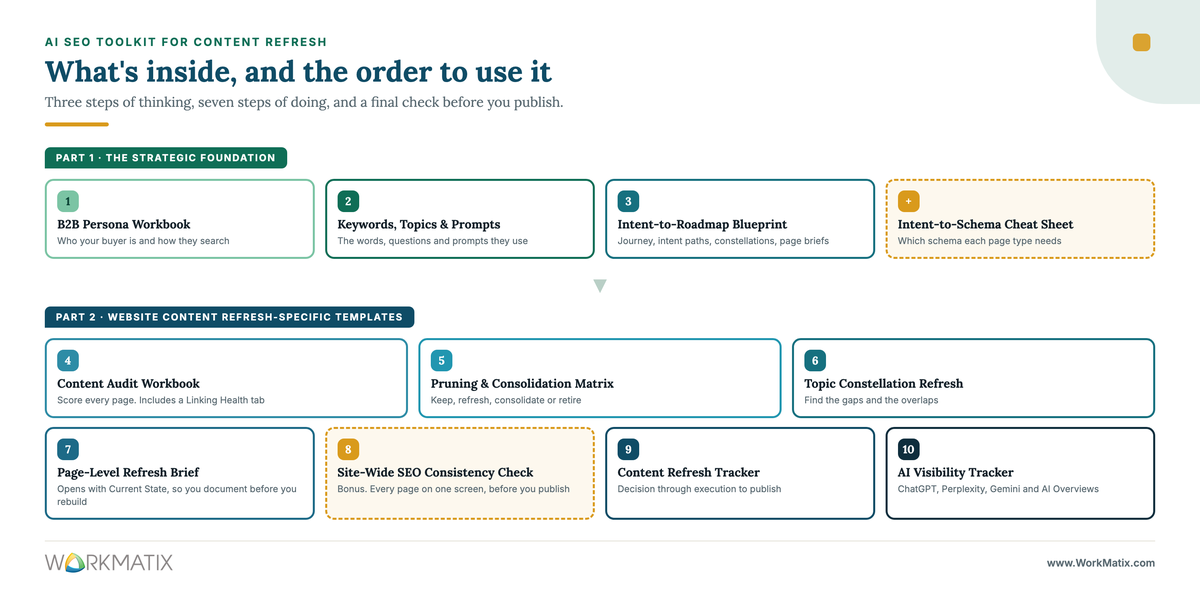
What’s inside Website Content Refresh Bundle: 2 Layers
Layer one: Website Strategic Foundation (SEO + AI) Toolkit
You can’t fix content until you know who it’s for and what they search. The foundation is a three-step sequence, each step feeding the next.
- Step 1. B2B Persona Workbook. Defines who you serve and how they search, so the refresh aims at real buyers.
- Step 2. Keywords, Topics & Prompts Discovery Workbook. Turns that persona into real search demand across Google and AI.
- Step 3. Intent-to-Roadmap Blueprint. Synthesizes it into a content strategy where every page has a reason to exist.
- Bonus, Intent-to-Schema Cheat Sheet. Maps each page type to the markup it needs to surface in AI search.
- Walkthrough guides for every workbook, plus a Start Here guide.
This is the same foundation that anchors every SEO-nergy edition. It’s the benchmark you measure your existing content against.
Layer two: Content Refresh-Specific Templates
The content refresh workbooks is what’s specific to this edition: the templates that carry you from ‘I have a pile of old content’ to ‘every page is doing a job.’
- Content Audit Workbook, with Linking Health tab. Score every page on performance, intent and freshness, and surface the orphan pages and internal-linking gaps quietly holding you back.
- Content Pruning & Consolidation Decision Matrix. A clear keep, refresh, consolidate or retire call for every page, with the rationale and the redirect or merge target recorded.
- Topic Constellation Refresh Worksheet. Find the content gaps and the cannibalization against your topic map. Competing with yourself is invisible until you map it.
- Page-Level Refresh Brief. Spec each rebuild, starting with a Current State section that captures what exists before you rewrite it around real intent.
- Content Refresh Tracker. Run the whole project on one timeline, decision to publish, with before and after metrics so you can prove it worked.
- AI Visibility Tracker. See how your refreshed pages surface across ChatGPT, Perplexity, Gemini and AI Overviews, with baseline and after rounds.
- Site-Wide SEO Consistency Check. Every page on one screen before you publish. This is where the duplicates that built up over the years finally show themselves, including the pages that have been quietly competing with each other. One sitting.
| You can run this yourself No server config, no code, no waiting on a developer. This is content strategy, which is work you already do. It’s a sequence of fillable workbooks you move through in focused sessions, at whatever pace your client schedule allows. You bring the marketing judgment. The toolkit supplies the SEO and AI search structure, and the order to do it in. You open the next workbook, it tells you what is due, and you do that. Content work stops being a question of where to start and becomes a queue you move through. What you need Microsoft Excel or Google Sheets, and Microsoft Word or Google Docs. A site crawler and access to Google Search Console and Google Analytics for the performance data. To test AI visibility, access to the AI tools your buyers use. No special software, no subscriptions. |
Who this is for
You’re an independent consultant, a small B2B agency owner, or a service-based business owner sitting on years of content that used to work and doesn’t anymore. Your own website is the project that always gets deprioritized, because client work comes first. You don’t need a redesign. You need the content layer fixed, and you need a system efficient enough that you’ll actually finish it.
Why a documented method beats good judgment when you work with hundreds of pages
Judgment is fine on page one. By page forty it drifts, because you are tired and because the criteria you were using at the start were never written down.
A structured audit fixes this by making your criteria explicit. When every page is scored using the exact same logic, actions like keep, refresh, merge, and retire stop being loose opinions. They become defensible strategy calls you can confidently justify to yourself or stakeholders six months from now.
Explicit criteria have a massive secondary benefit: they provide the precise constraints an AI assistant needs to execute without hallucinating.
Feed the AI your scoring rules, your buyer persona, and the page source. It will draft the rewrites, metadata, and briefs at a pace no human can match.
Keep the high-level judgment for yourself. Deciding what to retire requires looking at traffic, backlinks, and organizational context that an assistant cannot see (even though it will answer confidently anyway). Hand over the heavy volume work instead.
That division of labor is the entire core of this methodology: you make the decision, the system records the logic, and everything downstream moves faster because the choice already exists.
Which edition do you need?
The right edition depends on the state of your site. The Strategic Foundation Edition is the core three-step methodology, and it’s the foundation inside every other edition. If you’re rebuilding or migrating your whole site, the Website Redesign Edition adds the full redesign and migration stack on top of the strategic foundation. If your structure is fine but your existing content has gone stale, the Website Content Refresh Edition adds the audit-and-rebuild stack.
Take the toolkit if you will do the work yourself and want the method, the order and the judgment calls already framed.
Take 1:1 coaching if you want someone reviewing your decisions as you make them, particularly the pruning ones, which are hardest to reverse.
Neither if you want the content rewritten for you. That is a consulting engagement, not a toolkit.
| Quick guide Want the core three-step methodology → Website Strategic Foundation (SEO + AI) Toolkit Rebuilding or migrating the whole site → Website Redesign Edition Structure’s fine, content needs to come back to life → Website Content Refresh Edition (this one) |
Would you rather work through it with guidance?
Deciding what to cut is the hardest part of a content refresh, and it is the part people stall on. The full price of this edition applies as credit toward the Intent-to-Roadmap Blueprint 1:1 Coaching Program if you upgrade within 90 days, so you can start alone and bring someone in at the point it gets difficult.
From students and coaching clients…
About Julia
Julia Gordeeva built this edition after watching the same conversation happen repeatedly: a business with years of published content, a genuine publishing habit, and no idea which of it was working.
Eighteen years in B2B search taught her that the answer is almost never to publish more. It is to go back through what exists with a method for deciding, which is uncomfortable and considerably more profitable.
Questions Consultants Ask Before They Buy
Mostly about time, and whether this is different from the courses that did not help. Both are fair.
How long does a content refresh actually take? I barely have time for my own site.
A content refresh takes as long as your content backlog is deep, but the work is broken into sessions rather than one long project. The website optimization process is phased: you audit once, decide once, then rewrite in priority order, a few pages at a time. The audit is the biggest single piece; after that you work page by page, at whatever pace your week allows. The consistency check at the end is a single sitting.
You’re fixing what already exists, not launching a new content, so the work shrinks as you go instead of growing. You can do it around client work, in the gaps.
I already publish regularly. Isn’t that enough?
Publishing without knowing what works is a treadmill. Regular content only compounds if it’s aligned to what buyers actually search and connected so pages reinforce each other. The audit shows you which of your existing posts reach buyers and which just sit there, so your effort finally goes where it pays off instead of into the pile.
Will this actually help me get leads, or just improve ‘SEO’?
The point is leads, not vanity rankings. A page brings in leads when it matches what a buyer searches, answers it better than the alternatives, and points them toward working with you. The refresh realigns your pages to real search intent and fixes the internal links and calls to action that turn a reader into an inquiry.
I’m a marketer, not an SEO. Can I actually do this?
Yes, it’s a system to follow, not a skill you need first. Every step is a fillable workbook with a companion walkthrough guide. You bring the marketing judgment you already have; the toolkit supplies the SEO and AI-search structure and the exact order to work in. No code, no technical implementation.
I’ve bought SEO courses and tools before that didn’t move the needle. Why is this different?
Courses teach concepts; this gets applied to your actual site. You don’t finish with notes and good intentions. You finish with your own pages audited, decided on, and rewritten around real intent. The value is practical and immediate, which is exactly what you need when time is the thing you’re short on.
These are the working files, already structured, with a decision waiting in each one. You are not learning a framework and then building it yourself; you are filling in the framework.
Is it worth the price?
The edition costs a fraction of one client you’re not currently winning. The content you already paid to create is underperforming; this is what makes it generate leads instead of sitting there. One-time price, yours to keep and reuse across every project you take on.
What if most of my content should be deleted?
Finding that most of it should go is a useful result, not a failure. Fewer strong pages outperform many weak ones, in Google and more so in AI search, where thin overlapping content gives a system no reason to pick you. The pruning matrix records the reasoning so the decision is defensible later.
Do I have to create a pile of new content?
No, you compound what you already have. Most of the value in a refresh is hidden in pages you’ve already published: fixing their intent alignment, merging the ones that compete with each other, cutting the dead weight, and connecting them so they reinforce each other instead of splitting your authority