
It’s usually not that AI can’t find you. It’s that it finds you and chooses someone else. Eight content reasons why, and what each one looks like fixed. WorkMatix sees the same eight causes on nearly every content audit, which is why the SEO-nergy methodology fixes them in a fixed order rather than whichever is noticed first.
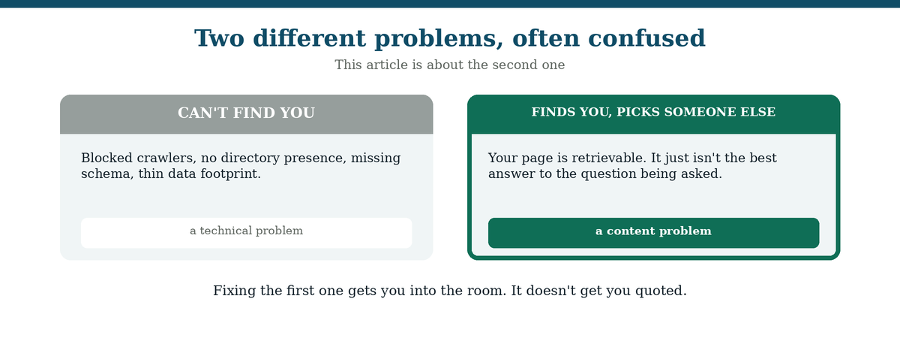
Fixing the first gets you into the room. It doesn’t get you quoted.
There are two versions of AI invisibility, and they need different fixes.
The first is technical. Your site blocks the crawlers, you have no presence on the platforms AI systems draw from, your data isn’t structured, so the machine genuinely cannot see you. That’s a real problem with a fairly mechanical solution, and it’s covered in a separate guide on why a business doesn’t show up in ChatGPT.
The second is the one this article is about, and it’s more common among agencies that have been publishing consistently. Your content is crawlable. It’s indexed. An AI system can read every word of it. And when someone asks a question, you have written about, it cites a competitor instead.
That’s not a technical failure. It’s a content one, and every reason below is a decision that can be made differently.
A note before we start
If you run a small agency, your own site is almost certainly the least-attended thing you own. Client work is billable and urgent; your own marketing is neither. So none of what follows is a verdict on your competence. Most of it is the entirely rational result of doing paid work first for several years.
The eight reasons, at a glance
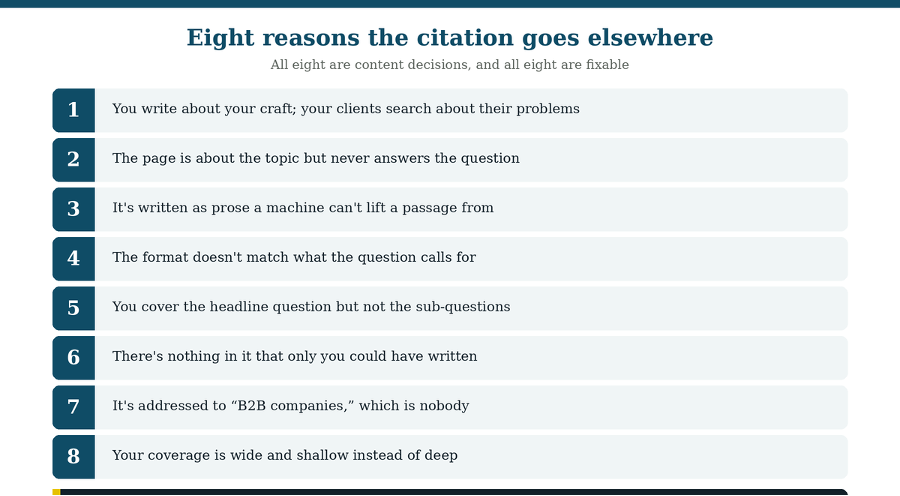
All eight are content decisions, and all eight are fixable.
1. You write about your craft; your clients search about their problems
Agencies publish about branding, design systems, and creative process. Their clients search about revenue, hiring, growth, and risk. The two rarely meet, and the citation goes to whoever addressed the client’s framing rather than the practitioner’s.
Why this happens: It’s natural to write about what you know deeply and enjoy discussing. Craft content also performs well with peers, other agencies, designers, people in your industry, which creates a feedback loop that feels like it’s working. It’s just that peers aren’t your buyers.
The fix: Take one recent client engagement and write down the problem in the client’s words, before they knew an agency was the answer. “Our website looks nothing like the company we’ve become since the raise” is a page. “Brand architecture for scaling companies” is a page for other brand strategists.
2. The page is about the topic but never answers the question
A page can cover a subject thoroughly and never state a direct answer to anything. AI systems extract answers, so a page that circles a topic without landing on one has nothing to lift.
Why this happens: Most of us were taught to write with a build: context, then nuance, then the point. It reads well and it’s how good essays work. Retrieval systems don’t read to the end.
The fix: Put a direct answer in the first 40 to 60 words of every section, before the context. Then elaborate underneath. You lose nothing for human readers, who mostly skim anyway, and you gain a passage that can be quoted.
3. It’s written as prose a machine can’t lift a passage from
Long, flowing paragraphs where each one depends on the one before are hard to extract from. Retrieval systems break a page into chunks, and a chunk that only makes sense in sequence isn’t quotable.
Why this happens: Continuous prose is what good writing looks like in most contexts. Nobody told you your blog needed to survive being cut into pieces.
The fix: Write in self-contained blocks of roughly 50 to 150 words that stand on their own. Research on citation behavior found blocks in that range are cited substantially more often than long unbroken prose. Add lists and tables where the content allows, structured content is cited materially more often than the same information in paragraphs.
4. The format doesn’t match what the question calls for
Query intent predicts which format gets cited better than topic or industry does, and format mismatch loses the citation regardless of writing quality. A beautiful essay written to answer a “best options” question loses to a competent listicle every time.
Why this happens: Agencies are, reasonably, allergic to listicles. They feel low-effort and off-brand for a studio that sells taste. So, the instinct is to write something better, which often means writing something in the wrong shape.
The fix: Match the format to the question. Informational questions want explainers. Comparison and “best of” questions want structured comparisons, tables, and lists. Transactional questions want clear service pages. You can make a comparison page well designed and well written; what you can’t do is win a comparison query with an essay.
5. You cover the headline question but not the sub-questions
When someone asks an AI a question, the system typically breaks it into several searches and runs each one. A page that answers one of those and ignores the rest competes for a fraction of the citation.
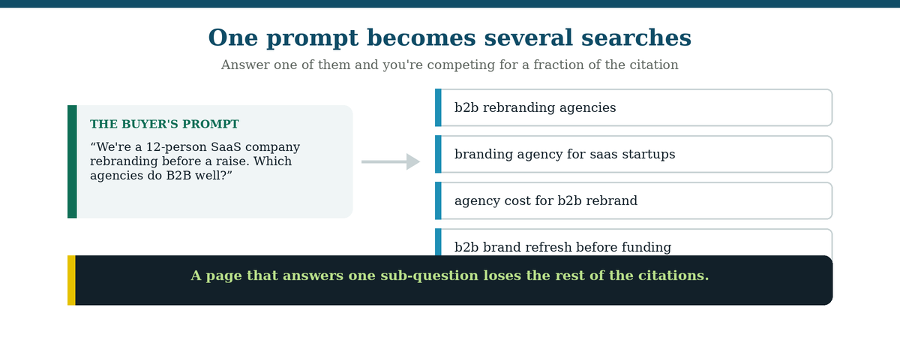
Answer one sub-question and you’re competing for a fraction of the citation.
Why this happens: This mechanism is invisible from the outside. You see one question; the model generates several. Nothing in a keyword tool tells you this is happening, and analyses of ChatGPT’s behavior find those internal queries have been getting longer and more specific over time.
The fix: For each page, write out the sub-questions a real buyer would have around that topic, cost, timeline, alternatives, risks, what happens if we do nothing, and make sure the page addresses them. Depth on a narrow question beats breadth on a vague one.
6. There’s nothing in it that only you could have written
Content assembled from what’s already published gives a model no reason to prefer you, because it can get the same information from its existing sources. First-hand material is the strongest content-level lever available.
Why this happens: Original data feels like something bigger companies do: surveys, research reports, benchmark studies. Most small agencies conclude they don’t have any. They usually do; it just doesn’t look like research.
The fix: Your engagements are data. How long a rebrand actually takes. What clients consistently underestimate. The three objections that come up in every sales call. Before-and-after numbers from a project, with permission. Analyses of AI citation behavior find a large share of top citations trace to first-hand information, and quantitative claims get cited more than qualitative ones. Ten documented projects is a dataset.
7. It’s addressed to “B2B companies,” which is nobody
Content written for a category can’t answer a question asked from a situation. Buyers describe their circumstances to AI assistants in detail, and generalized content matches none of it.
Why this happens: Specificity feels like exclusion. If you name a company size, an industry, or a stage, you worry you’re turning away everyone else, which is frightening when the pipeline is thin. So the copy broadens until it’s safe and meaningless.
The fix: Write for one situation at a time. “A 12-person SaaS company rebranding before a funding round” is a page. Other people will read it and recognize themselves, or they won’t, and they weren’t going to hire you anyway. Constraints, budget, headcount, timeline, are what make an answer feel written for the reader.
8. Your coverage is wide and shallow instead of deep
Publishing one page each about many topics signals breadth; covering one subject completely signals authority. AI systems assess whether a site genuinely covers a subject, and a single page is thin evidence.
Why this happens: Agencies serve varied clients, so the content follows: a post about branding, one about web design, one about social, one about a conference you attended. It reflects the business honestly. It just doesn’t demonstrate depth anywhere.
The fix: Pick the one subject you most want to be known for and cover it properly: a pillar page plus the cluster pages answering each sub-question, all interlinked. Research on citation behavior indicates a small site covering one topic exhaustively can outcompete a much larger general publication in that niche. You don’t have to beat everyone at everything. You have to be the most complete source on one thing.
The pattern underneath all eight
Seven of these eight reasons come from writing for the wrong reader. Peers instead of buyers, the category instead of the situation, your own expertise instead of their problem.
That’s worth sitting with, because it means the fix isn’t primarily technical or even about volume. It’s about who you picture when you write. Most agency content is unconsciously addressed to someone who already understands the discipline, which is to say, someone who will never hire you.
The eighth reason, shallow coverage, is the structural one, and it’s the one that compounds. Depth takes longer than breadth and pays for longer too.
Where to start if you can only do one thing
Start by finding out what AI systems currently say about your category, and who they cite. It takes twenty minutes and it makes the rest of this concrete rather than theoretical.
Ask ChatGPT, Perplexity, and Gemini the questions your clients ask before they hire an agency. Not “best branding agency,” which is too broad to be useful, but the situational ones: how a company at a certain size should approach a rebrand, what it costs, what goes wrong. Record who gets cited and read what those pages do that yours doesn’t.
Check each platform separately. Citation overlap between them is smaller than most people expect; one 2026 analysis found only about 11% of domains cited by ChatGPT also appeared in Perplexity’s citations. Being present in one is no guarantee about the others. That exercise usually surfaces the same conclusion: the sites getting cited aren’t better designed or more prolific. They answered the specific question directly, in a format that matched it, with something concrete in it.
Frequently asked questions
Why is my agency’s content not showing up in AI search?
There are two causes. Technical invisibility means AI systems can’t access or parse your site, from blocked crawlers, missing structured data, or a thin third-party footprint. Content invisibility means they can read your pages but choose others, usually because the content doesn’t answer questions directly, doesn’t match the format the question calls for, or contains nothing unique to you.
How do I get my content cited by ChatGPT or Perplexity?
Answer the question directly in the first 40 to 60 words of each section, write in self-contained blocks, use lists and tables where they fit, match format to query intent, include original first-hand data, write for one specific situation rather than a category, and cover one subject in real depth rather than many shallowly.
Does my small agency need original research to get cited?
You need first-hand material, which isn’t the same as a formal research report. Your project timelines, recurring client objections, documented before-and-after results, and patterns across engagements are all original data. A large share of AI citations trace back to first-hand information rather than summarized secondary sources.
Should I write for other agencies or for my clients?
Your clients. Craft content performs well with peers, which creates a misleading sense of traction, but peers don’t hire you. Write about the problems your clients have before they know an agency is the answer, in the language they’d use to describe them.
Is it better to publish more content or improve what I have?
Usually improve what you have, especially if the issues above apply. Adding pages to a library with structural problems reproduces the problems at greater volume. Fixing format, structure, specificity, and depth on existing pages tends to move visibility faster than publishing more of the same.
How long does it take to see results from fixing this?
Expect weeks to months rather than days. AI systems recrawl and re-evaluate on their own schedules, and citation shifts typically lag the changes that caused them. Capture a baseline of who’s currently cited so you can tell whether anything actually moved.
If most of these describe your existing content, a structured refresh is the efficient way through them. The AI SEO Toolkit for Content Refresh is built for exactly this: auditing what you have, deciding what to keep, merge, or retire, rebuilding pages around real buyer questions, and tracking with the AI Visibility Tracker whether your citations actually change.
Each of these eight causes has a fix, and the fixes have an order. The AI SEO Content Optimization Roadmap puts them in the sequence that stops you doing the cheap work last.
Google’s documentation on AI features in Search states what it looks for when generating an answer, which is the shortest version of this list from the engine’s side.