
A diagnostic guide for B2B service businesses, consultants, and agency owners who searched for themselves in an AI chatbot and found nothing.
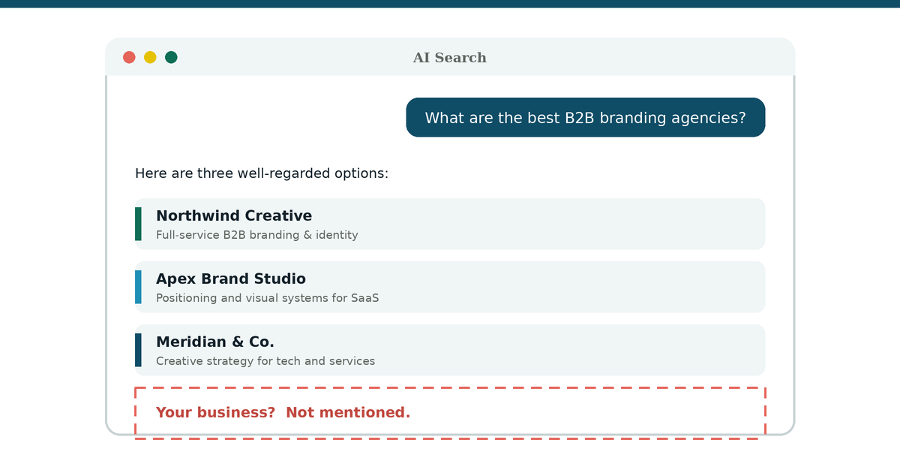
The moment that sends people looking for answers: the AI lists competitors, but not you.
You did the thing everyone does eventually. You opened ChatGPT and asked it about your own business or asked it to recommend a company that does exactly what you do.
And you weren’t there.
It named competitors. It described your category confidently. It just didn’t mention you. If you sell visibility for a living, that stings twice.
Here’s the reassuring part: this is a fixable problem, and it’s usually not about the quality of your work. It’s about your data footprint, how, and whether, AI systems can find and verify you. This post diagnoses exactly why ChatGPT is ignoring your business, explains how it actually finds companies, and gives you a five-step plan to get into the answer.
Key takeaways
- ChatGPT doesn’t “know” businesses; it retrieves them. It pulls from a live search index and structured data at answer time. If you’re not in those sources clearly, you don’t exist to it.
- The most common silent killer is a blocked crawler. One 2026 audit found 41% of B2B sites still block at least one major AI bot, often by accident, from a copied 2023 robots.txt file.
- AI runs on consensus. If few third-party sites, directories, or mentions corroborate your business, the model treats you as unverified and leaves you out.
- This is a real audience, not a fringe one. ChatGPT reached about 900 million weekly active users by early 2026, and roughly 37% of consumers now start a search with an AI tool.
- The fix is a footprint, not a trick. Unblock the bots, feed the databases, structure your data, earn mentions, and write the way people actually ask.
Why doesn’t ChatGPT know my business exists?
Because ChatGPT doesn’t recall businesses from memory the way it recites facts, it retrieves them at answer time from sources it can access and trust. If your business isn’t clearly present in those sources, the model has nothing to pull, so it either skips you or, worse, guesses. There are four common reasons you’re invisible.
Reason 1: You’re in a data desert. AI doesn’t invent recommendations; it synthesizes them from established third-party sources, directories, review sites, industry lists, and the broader web. If your footprint on those platforms is thin or inconsistent, the model has no raw material to work with. A beautiful website nobody else references is, to an AI, an unverified claim.
Reason 2: Your site is quietly blocking the crawlers. This is the one that catches the most people, because it’s invisible from the front end. OpenAI runs three separate crawlers, and they do different jobs. If your robots.txt file blocks the wrong one, you vanish from ChatGPT’s search answers without any warning. A 2026 audit found that 41% of B2B sites still block at least one major AI bot, usually a leftover from the 2023 to 2024 “block everything” panic, and that each blocked bot costs an estimated 18 to 34% of potential AI citations on that engine.
Reason 3: Nobody else mentions you. AI models lean on consensus. When multiple independent sources, blogs, news, directories, forums, roundups, describe your business the same way, the model gains confidence and includes you. When no one but you talks about your brand, you read as unverified. Silence is a signal, and it’s the wrong one.Reason 4: Your data isn’t structured. Even when an AI crawler reaches your page, it has to parse what your business is, does, and offers. If that information is buried in prose and images with no structured markup, the machine has to guess at your services, location, and specialties. Clean structured data removes the guesswork.
How does ChatGPT actually find and recommend businesses?
ChatGPT finds businesses through retrieval: when a question needs current or specific information, it runs a live search, pulls relevant pages and data, and synthesizes an answer from what it retrieves. Understanding that one mechanic changes how you think about visibility.
The simplest way to picture it: ChatGPT is a very well-read student taking an open-book test. It’s brilliant at reasoning, but for a question like “who are the best B2B branding agencies,” it doesn’t rely on memory. It opens the book, its live search index and connected data sources, and answers from what’s written there. If your business isn’t in the book, or is in it unclearly, no amount of the model’s intelligence will surface you. This retrieval-plus-generation approach is often called RAG (Retrieval-Augmented Generation), and the practical takeaway is blunt: your job is to make sure you’re clearly written into the book.
Where does it pull from? For live answers, ChatGPT draws on its own web search index and real-time fetching of pages, alongside established sources across the web, business directories, review platforms, industry roundups, and reputable editorial content. The exact mix shifts as the systems evolve, but the principle is stable: the more places you appear clearly and consistently, the more confidently an AI can retrieve and recommend you. Optimizing for this is what people now call Generative Engine Optimization (GEO) or Answer Engine Optimization (AEO), the AI-era companions to traditional SEO.
This is also where an idea from modern search strategy matters. You’re no longer optimizing for one audience. You’re building for three audiences at once: human visitors who read your site, traditional search engines that rank it, and AI systems that retrieve and cite it. They overlap, but they’re not identical, and a site built only for the first two can be invisible to the third.
Five steps to get your business into ChatGPT
Fixing AI invisibility is a footprint project, not a single switch. Here’s the sequence, ordered so each step reinforces the next.
Step 1: Unblock the AI crawlers
Start here, because it’s the highest-impact fix and the most commonly broken. OpenAI documents three distinct user agents, and they are not interchangeable:
- GPTBot collects public content that may be used to train OpenAI’s models.
- OAI-SearchBot is what surfaces your site in ChatGPT’s search answers. Sites opted out of OAI-SearchBot will not be shown in ChatGPT search answers.
- ChatGPT-User fetches a page when a user’s action in ChatGPT sends it to your site.
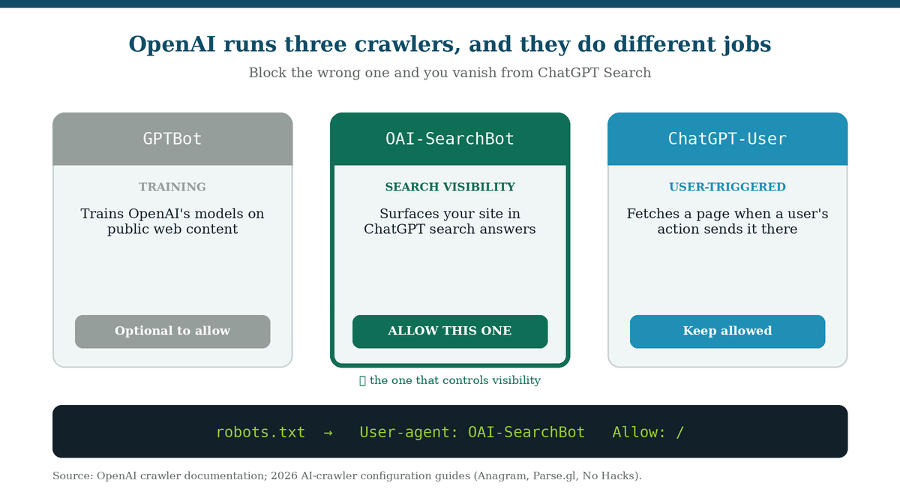
Three crawlers, three jobs. OAI-SearchBot is the one that controls whether you appear in ChatGPT search.
The critical one for visibility is OAI-SearchBot. Check your robots.txt file (at yourdomain.com/robots.txt) and make sure you’re not blocking it. A visibility-oriented allow-list looks like this, adapt it to your own policy rather than pasting blindly:
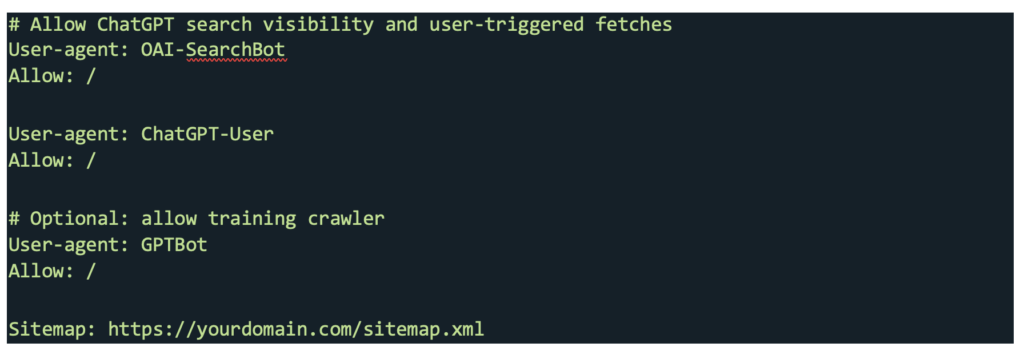
A caution worth knowing: many CMS, hosting, and CDN platforms inject restrictive defaults during setup, so you can be blocking these bots without ever having chosen to. After changing robots.txt, allow roughly a day for systems to pick up the update. In one cohort, sites that unblocked the major AI crawlers saw a substantial lift in AI-attributed traffic within 90 days.
Step 2: Feed the foundational databases
AI answers about businesses draw heavily on established directories and profiles. If you haven’t claimed and completed yours, do it. Prioritize the ones with broad reach and clean, structured data: your Google Business Profile, Bing Places, and the major industry-specific directories relevant to B2B services. Keep your name, category, services, and description consistent across all of them, because inconsistency reads as uncertainty to a system looking for consensus. For B2B specifically, industry directories, professional association listings, and reputable review platforms often matter more than consumer map apps.
Step 3: Structure your data with schema markup
Schema markup is code that labels your content so machines can parse it without guessing. It’s how you tell an AI, unambiguously, “this is my organization, these are my services, this is where I am, this is what I charge.” Adding structured JSON-LD data to your key pages makes your site machine-readable. A simplified example of Organization schema, again, illustrative, adapt it to your real details:
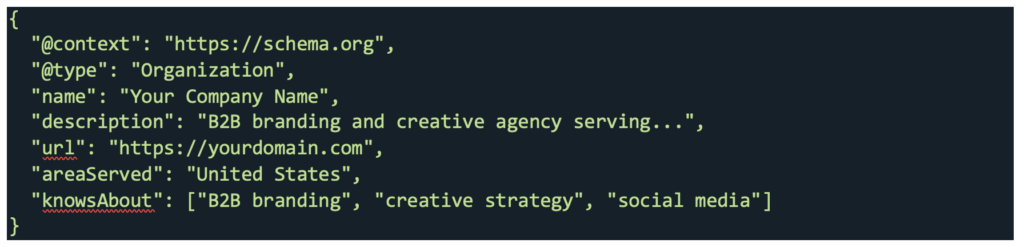
The goal isn’t to game anything. It’s to remove ambiguity so an AI can retrieve you confidently. This is one place where matching your page’s structure to its intent, what searchers actually want from it, pays off directly in machine-readability.
Step 4: Build mentions and digital PR (this is the GEO core)
This is the step that separates businesses AI knows from businesses AI merely can reach. Because models synthesize from consensus, being named across independent sources is what turns you from “a site that exists” into “an authority the AI cites.” Practically, that means getting featured in the “top 10” and “best of” roundups for your category, contributing to industry publications, earning mentions in relevant articles and forums, and generally showing up in the places a model looks when it assembles an answer. This is the heart of Generative Engine Optimization: you’re not optimizing a page, you’re building a web of corroboration the AI can draw on. It’s slower than the technical fixes, and it’s the most durable advantage.
Step 5: Write for conversational, intent-driven queries
People don’t type keywords into ChatGPT. They ask full, natural questions: “who’s a good B2B branding agency for a SaaS company,” not “b2b branding agency.” So the content that gets retrieved is content that directly answers those real questions. Write pages and posts that mirror how your buyers actually phrase their problems, lead each one with a clear, direct answer, and structure it so a machine can lift a clean summary. This is the same principle as the piece you’re reading: a question as a heading, a direct answer underneath, and specifics below that.
A quick reality check on scale
If any part of you suspects this is a niche concern, the numbers say otherwise. ChatGPT reached roughly 900 million weekly active users by February 2026, and about 37% of consumers now begin their searches with an AI tool rather than a traditional search engine. For B2B specifically, ChatGPT has become a mainstream channel for professional research and vendor evaluation. When a prospective client asks an AI to shortlist agencies or consultants, that shortlist is a buying signal. Being absent from it isn’t neutral; it’s lost pipeline you’ll never see, because you never knew the conversation happened.
Frequently asked questions
Why doesn’t ChatGPT show my business?
Usually one of four reasons: your site blocks the AI crawler that powers ChatGPT search (OAI-SearchBot), you have a thin or inconsistent presence on third-party directories, few independent sources mention your brand, or your data isn’t structured with schema markup. AI retrieves businesses from trusted sources at answer time, so if you’re not clearly in those sources, you’re invisible.
How do I know if I’m blocking ChatGPT’s crawler?
Check your robots.txt file at yourdomain.com/robots.txt and look for any rule disallowing OAI-SearchBot. Blocking OAI-SearchBot removes you from ChatGPT search answers even if regular Google crawling is fine. Many sites block it accidentally through platform defaults or an outdated robots.txt copied from 2023.
SEO vs AEO vs GEO: what the difference actually is?
SEO (Search Engine Optimization) ranks web pages in traditional search lists. AEO (Answer Engine Optimization) structures content for direct snippets and voice replies. GEO (Generative Engine Optimization) targets AI chat tools so your brand gets cited inside conversational summaries. They complement traditional SEO rather than replacing it: SEO earns rankings, GEO/AEO earns citations.
How long does it take to appear in ChatGPT after fixing this?
Technical fixes like unblocking crawlers can update within about a day for the crawler itself, but building the directory presence and third-party mentions that AI relies on for confident recommendations is a longer effort, typically weeks to months. It compounds over time.
Is this different from regular SEO?
It overlaps but isn’t identical. Traditional SEO optimizes for ranking in search engine results. GEO/AEO optimizes for being retrieved and cited in AI answers, which weighs crawler access, structured data, and third-party consensus more heavily. The strongest approach treats human readers, search engines, and AI systems as three audiences and builds for all three at once.
Want to see how your site looks to all three audiences, humans, search engines, and AI systems, and where the gaps are? WorkMatix runs a free Search Journey Alignment Audit built on the SEO-nergy methodology, a practical starting point for making your site findable in the AI era.
Being absent from AI answers is a symptom with several possible causes. The AI SEO Content Optimization Roadmap works through them in the order worth checking. Anthropic documents how its crawler works and how site owners can control it, and OpenAI and Google publish equivalents, so start by confirming you are not blocking them.
If your pages are readable to people but not to AI systems, Content Optimization for SEO & AI Search rebuilds them so they can be quoted and attributed.