
Four ways to use the same SEO-nergy methodology, from fully self-directed to fully guided. A practical guide to picking the one that fits your budget, your time, and how you like to work, for consultants, agency owners, and service-based businesses.
The WorkMatix’ signature SEO-nergy methodology is offered four ways along a spectrum from independent to guided.
By now you’ve probably realized the issue was never a shortage of SEO information. It’s that the information doesn’t apply itself. The real question is how much structure and guidance you need to actually get it done, and what you’re willing to spend to get there.
Good news: there isn’t one right answer. There’s a right answer for your situation. The same SEO-nergy methodology comes in four forms; from a do-it-yourself toolkit you run at your own pace to fully guided 1:1 coaching. This guide helps you pick.
Let’s map the options honestly, backed by what the research says about who succeeds with self-directed learning and who needs a hand.
Key takeaways
- The methodology is the same; the amount of guidance is the variable. DIY toolkit, group training, structured coaching program, and 1:1 sessions all run on SEO-nergy. You’re choosing a support level, not a different system.
- DIY is an opportunity-cost decision, not a capability one. Most owners can learn SEO; the real question is whether your hours are worth more spent learning it or spent on billable work. Analyses estimate DIY SEO takes 15 to 25 hours a week to move the needle.
- The most common SEO mistake is a sequencing error, not a tactical one. People optimize keywords before the site can be crawled or build content before it has a reason to exist. A structured toolkit enforces the right order.
- Going fully alone underperforms. In a controlled study, self-directed effort without support was not sufficient for high goal attainment. A good toolkit narrows that gap; guidance closes it further.
- Pick by your real constraint: budget, time, learning style, and whether your need is general (learn the system) or specific (fix my site).
First, what all four paths have in common
Every path here runs on the same underlying methodology, so you’re not choosing between different SEO philosophies. You’re choosing how much of it you do alone versus with help.
SEO-nergy is built around a simple idea: your website has to work as one aligned system, and it has to satisfy three audiences at once, human visitors, traditional search engines, and AI systems like ChatGPT, Perplexity, and Google’s AI Overviews. Content, structure, and search behavior have to reinforce each other rather than being separate chores. That’s true whether you apply it from a workbook or with a coach beside you.
It also means order matters. As one 2026 analysis put it, the most common small-business SEO mistake isn’t a tactical error, it’s a sequencing error: people optimize keywords before Google can crawl the site or build content before the pages have a reason to exist. A limited budget spent in the wrong order produces dramatically worse results than the same budget spent in the right order. Every SEO-nergy path enforces that sequence, persona and intent first, then architecture, then content. The paths differ only in how much support you get walking through it.
Path 1: The DIY SEO-nergy Toolkit
The toolkit is the methodology as fillable workbooks and templates you run yourself, at your own pace, without a coaching relationship. It’s the most independent and most affordable path.
It starts with the B2B Persona Workbook for SEO and AI Search, the foundational step that decodes who you’re building for and how they search. From there, three editions extend the system depending on your project:
- Website Strategic Foundation Toolkit (SEO & AI) the core three-step methodology: persona, then keywords/topics/prompts, then the Intent-to-Roadmap Blueprint, plus the Intent-to-Schema Cheat Sheet.
- AI SEO Toolkit for Content Refresh everything in Foundation, plus the templates to audit, prune, and rebuild your existing content.
- Website Redesign SEO Toolkit for AI Search everything in Foundation, plus the full stack for an SEO-led redesign or migration.
The toolkit is for the situation the research actually supports for self-direction: you’re reasonably tech-comfortable, you enjoy working through a system, and you have the time. It’s an opportunity-cost decision. As one 2026 guide framed it, the DIY-versus-guided choice “is fundamentally an opportunity cost calculation, not a capability question.” Most owners can learn this. The question is whether your hours are worth more here or on billable work.
What a toolkit gives you that free content doesn’t: sequence and structure. You’re not assembling scattered tips; you’re following an ordered system that prevents the sequencing mistakes that sink most DIY efforts. What it doesn’t give you is someone to answer, “but what about my specific situation?” That’s where the guided paths come in.
Path 2: “Intent-to-Roadmap Blueprint” Group SEO Training (cohort)
Group training teaches you the whole methodology alongside other people, on a shared schedule, with live sessions. It adds the accountability and peer learning that self-paced work strips away.
The “Intent-to-Roadmap Blueprint” SEO Group program is structured, cohort-based learning: you move through the full methodology with a small group, apply it to your own business, and keep the templates. If your honest weak point is finishing things alone, this is the path where the structure does that work for you. It’s also a strong fit when your questions are still foundational, everyone in the room is learning the same system, so a shared curriculum is efficient.
Path 3: “Intent-to-Roadmap Blueprint” 1:1 SEO Coaching Program
The SEO coaching program is the full methodology applied to your specific site, guided end to end, with personal support between sessions. It’s the most hands-on path short of hiring the work out entirely.
This is the Intent-to-Roadmap Blueprint delivered one-on-one: the same three stages (Decode, Architect, Accelerate), but built entirely around your website, your data, and your goals, with bi-weekly strategy sessions and direct support between them. It fits when you want the whole system and you want it personalized, not a cohort’s average path, but yours specifically.
Path 4: 1:1 SEO Coaching sessions
Standalone 1:1 SEO sessions are for when you don’t need the whole framework re-taught, you need expert eyes on a specific problem, right now. It’s the most flexible, most targeted path.
This is the right call when you’re already executing but stuck: a stalled content strategy, a Search Console report you can’t read, a page that won’t rank and you can’t tell why. You bring the specific problem; you get situation-specific guidance and a plan. It’s coaching’s core strength; the research consistently finds individual coaching superior for goal attainment and implementation when the need is specific to you rather than shared across a group.
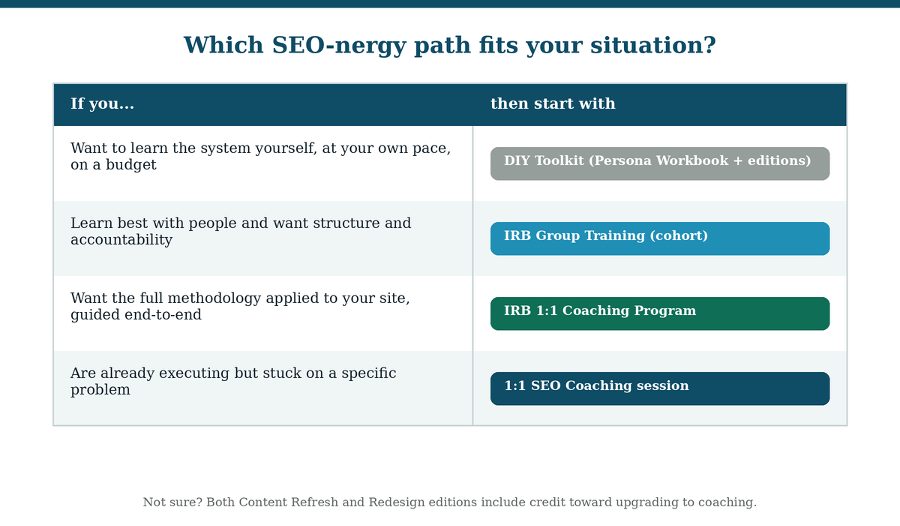
So which path fits you?
Match your situation to the path, using your real constraint (budget, time, learning style, and whether your need is general or specific) as the deciding factor.
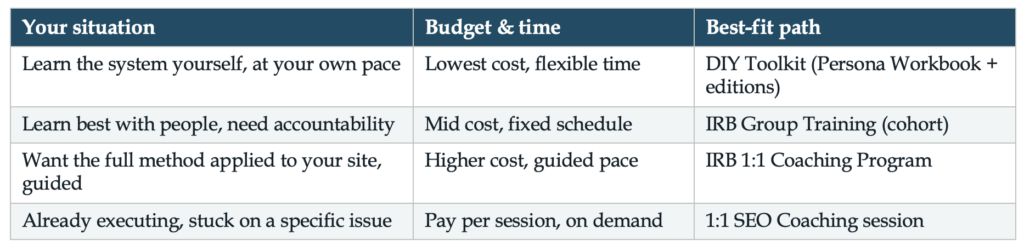
One honest note that runs through all of this: these paths aren’t mutually exclusive, and they’re often a sequence. Many people start with the toolkit or a cohort to learn the system, then bring in coaching for the parts specific to their site. To make that easy, both the Content Refresh and Website Redesign editions include credit toward upgrading to the coaching program, so starting DIY doesn’t lock you out of guidance later.
A note on doing it fully alone
It’s worth being honest about the fully solo, no-toolkit, no-guidance route, because it’s the most common one and the weakest. In a randomized controlled study, self-directed effort without support was not sufficient for high goal attainment. And in SEO specifically, going it alone from scattered free content is where the sequencing mistakes happen, keywords before crawlability, content before strategy, that quietly waste months.
A consultant put the underlying frustration well: “I’ve got a good content marketing groove, regular blogs, podcasts, videos, but I have no idea if they’re actually reaching my target audience.” That’s not a knowledge gap. It’s a structure-and-feedback gap. The toolkit gives you the structure. Coaching adds the feedback. Doing neither leaves you exactly where that quote lives: busy, and unsure any of it is landing.
Frequently asked questions
What’s the difference between the DIY toolkit and coaching?
Same methodology, different support level. The toolkit is fillable templates you run yourself at your own pace and lowest cost. Coaching applies the same system to your specific site with expert guidance. Many people start with the toolkit and add coaching later.
Is the DIY toolkit enough on its own?
For a tech-comfortable owner who enjoys working through a system and has the time, yes, it provides the structure and correct sequence that most DIY SEO lacks. If you get stuck on something specific to your site, that’s the moment coaching earns its cost.
Where should I start if I’m on a tight budget?
The B2B Persona Workbook is the foundational first step and the lowest-cost entry point. From there you can add the edition that matches your project (Foundation, Content Refresh, or Redesign), or upgrade to coaching when you need it.
Can I move from DIY to coaching later?
Yes. The Content Refresh and Website Redesign editions include credit toward the coaching program, so beginning DIY doesn’t lock you out of guidance.
How do I know if I need the whole system or just a session?
If you don’t yet understand how the pieces fit together, you want the system (toolkit, cohort, or coaching program). If you already understand it and you’re stuck on one specific thing, a single 1:1 session is the efficient choice.
Ready to pick a path? Start with the foundational B2B Persona Workbook, explore the Website Strategic Foundation Toolkit (SEO + AI), or see the 1:1 SEO coaching options. Google’s SEO Starter Guide is free and worth reading before either path, since both assume you know what the fundamentals are.