
Your buyers no longer type keywords into a box. They describe their situation to an assistant, and that changes what your content has to answer. These prompts come out of how WorkMatix runs keyword research, where the filled workbook goes into the prompt before the question does.
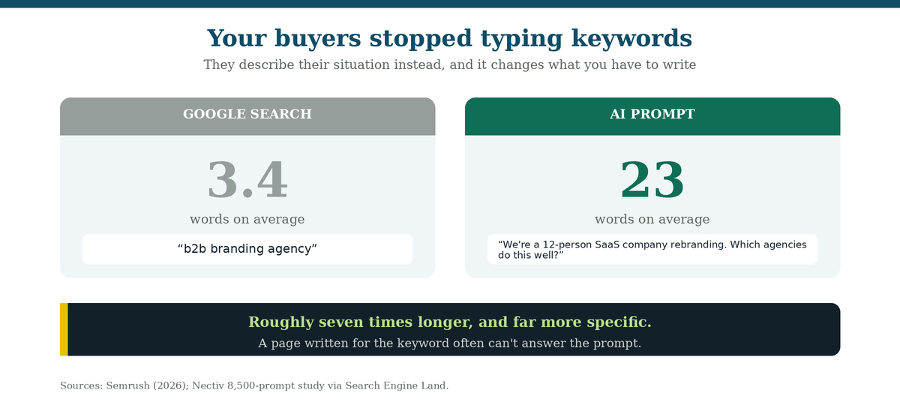
Roughly seven times longer, and far more specific.
Keyword research has a blind spot now, and it’s getting wider.
For twenty years the unit of analysis was the query: a short string someone typed into a box. Tools were built around it, volume was measured against it, and content was written to match it. That still works for the searches that still look like that.
But a growing share of your buyers aren’t typing queries anymore. They’re describing their situation to an assistant, in full sentences, with constraints and context attached. Research puts the average ChatGPT prompt at around 23 words against roughly 3.4 for a Google search, about seven times longer. And length isn’t the interesting part. Specificity is.
A page built to rank for “b2b branding agency” may have nothing useful to say to someone who asks: “We’re a 12-person SaaS company rebranding before a funding round. Which agencies actually do B2B well and won’t cost us six figures?” Same category, completely different question.
Semantic keyword research is the practice of capturing those prompts, not just the keywords, and building content that answers them. Here’s how to do it.
What is prompt research, and how is it different from keyword research?
Prompt research captures the full, natural-language questions your buyers ask AI assistants, including their context and constraints, rather than the shortened keyword strings they’d type into a search engine. It’s an extension of keyword research, not a replacement for it.
The difference is in what gets preserved. A keyword strips away everything except the topic. A prompt keeps the situation intact: who’s asking, what they’re trying to accomplish, what’s limiting them, and what kind of answer they want. All of that is information you can write for, and all of it is thrown away the moment you reduce it to a two-word phrase.
There’s a second reason this matters, and it’s mechanical. When someone gives an assistant a long prompt, the model doesn’t search for that whole sentence. It breaks the prompt into several shorter queries of its own and searches each one, a process usually called query fan-out. Studies of ChatGPT’s behavior find it runs multiple searches per prompt, and those internal queries have been getting longer and more specific over time.
What this means practically
You’re optimizing for two things at once: the buyer’s full prompt, which tells you what the page has to be about, and the shorter sub-queries the model generates from it, which are what your individual sections need to answer. A page that covers only one of those sub-questions gets left out of the citation.
The anatomy of a real buyer prompt
A useful prompt has four parts: role and context, the job, the constraint, and the output format. Once you can see those parts, you can write them down deliberately instead of guessing.
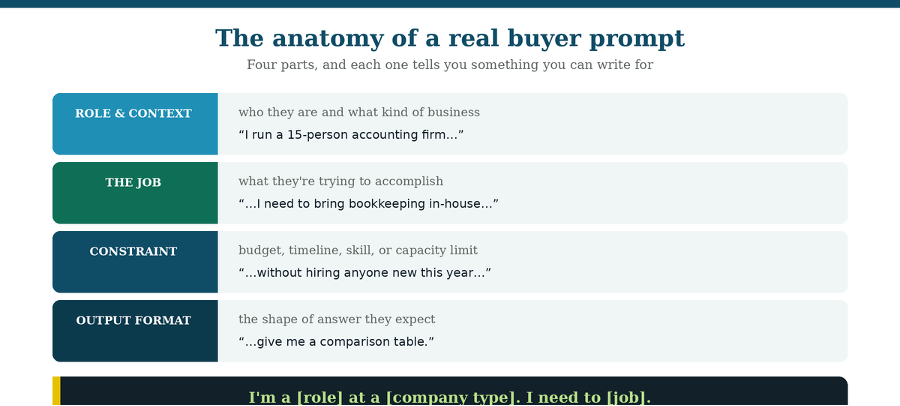
Four parts, each one something you can write for.
Each part does distinct work for you:
- Role and context tells you which persona is asking and at what scale. “A 15-person firm” and “a 400-person company” want different answers to the same question.
- The job is what they’re trying to accomplish, the underlying progress they want to make. This is the part that stays constant while their language changes across the journey.
- The constraint is often the most valuable and the most overlooked: budget, timeline, headcount, skill level. Constraints are what make an answer relevant rather than merely correct, and they’re almost never captured in keyword tools.
- The output format tells you what shape the answer should take: a comparison table, a prioritized list, a step-by-step. Match it and your content is far easier to extract and cite.
Written as a fill-in structure, it looks like this:

You’ll write dozens of these. The structure keeps them consistent enough to compare and specific enough to be useful.
Five prompt examples, from different service businesses
Prompts get more useful the more specific they are, so here’s what real ones look like across different kinds of service business. Notice how much each one tells you about what the answering page would need to contain.
Accounting firm
“I run a 15-person accounting practice and we’re losing junior staff to burnout during tax season. I want to automate the routine bookkeeping work without hiring anyone new this year. What should I look at first, and roughly what does it cost?”
Commercial cleaning company
“We manage cleaning for six office buildings and just lost a contract to a cheaper competitor. How do other commercial cleaning companies compete without dropping their prices? Give me practical examples, not general advice.”
IT managed services provider
“I’m the owner of a small MSP serving dental practices. A client asked whether we’re HIPAA compliant and I’m not confident in my answer. What do I actually need in place, and how do I explain it to a non-technical client?”
Architecture studio
“We’re a six-person architecture studio that has always won work through referrals, and referrals have slowed. What are the realistic ways a small studio gets found by commercial clients, ranked by effort versus payoff?”
Recruiting agency
“I run a boutique recruiting firm placing finance roles. Clients keep asking why they should use us instead of posting on LinkedIn themselves. How do recruiters position against that, and what proof actually convinces people?”
Read those again and notice what they’re doing. Each contains a trigger (something changed), a constraint (money, headcount, time, confidence), and an implied output format. Each also contains objections you’d need to handle, and language you could use verbatim in a heading. None of that survives compression into a keyword.
Map prompts to the buyer search journey
Write prompts for each stage of the buyer’s search journey, because the prompt types change as the buyer moves. The job stays the same; only the language evolves.
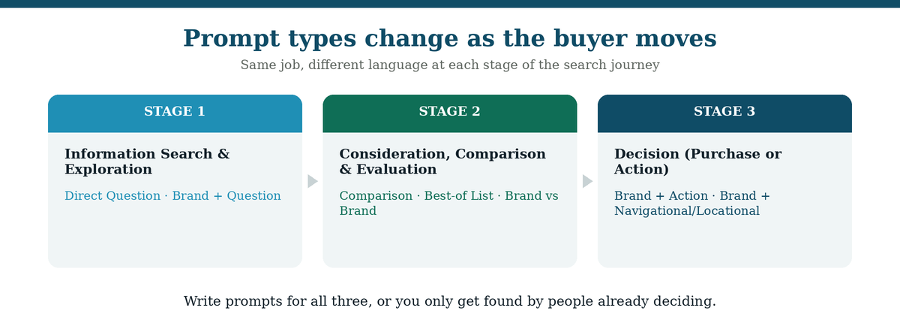
Same job-to-be-done, different AI prompt types at each stage.
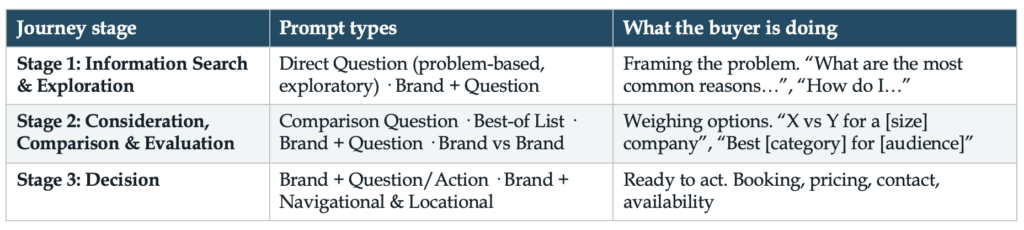
This mapping exposes a gap most service businesses share. It’s natural to write prompts for stage three, because that’s where the money is, and to assume the earlier stages are too vague to bother with. But stage one is where your buyer builds the shortlist you’re either on or not on. If all your content answers decision-stage prompts, you only get found by people who already know who you are.
A note on brand prompts specifically: they appear at all three stages and they’re worth writing down even if your brand is small. “What do clients say about [Brand]” and “[Brand A] vs [Brand B]” are real prompts, and if you have nothing published that answers them, the assistant answers from whatever it can find, which may be a stale directory listing or a competitor’s comparison page.
Using AI to generate and pressure-test your prompts
Once you understand the structure, AI assistants are useful for expanding and stress-testing your prompt list, as long as you drive and they draft. The failure mode is asking an assistant to invent your buyers for you.
Three ways it genuinely helps:
Expansion. Give an assistant one prompt you’re confident about, plus a description of your buyer, and ask for variations at different stages, constraints, and company sizes. You’re using it to multiply something real, not to generate something from nothing.
Reversal. Paste an existing page and ask what prompts it would be a good answer to. This is uncomfortable and useful in equal measure, because the answer is often “none of the ones you care about.”
Reality check. Take a prompt you’ve written and actually run it. Ask ChatGPT, Perplexity, and Gemini and see who gets cited. This is the fastest way to find out whether the prompt is realistic and where you currently stand on it.
Two cautions. First, an assistant asked to generate buyer prompts will produce plausible, generic ones, they read fine and describe nobody. Ground it with real detail from customer calls, sales objections, and support questions, and it becomes genuinely useful. Second, verify anything factual it produces. Prompt lists are safe; claims about your market are not.
What to do with the prompts once you have them
Prompts are input, not output. Group them, map them to pages, and use their language directly. A list of prompts sitting in a document changes nothing.
- Group by the question they answer, not by wording. Several prompts that circle the same underlying concern belong on one page.
- Assign each group to a page in your topic cluster: pillar, cluster, or supporting. Some groups become a whole page; smaller ones become a section within one.
- Turn prompts into headings. The prompt, lightly edited, often makes a better H2 than anything you’d write from scratch, because it’s phrased the way the reader thinks.
- Match the output format the prompt asked for. If people are asking for comparisons, build a comparison table. If they’re asking what to do first, write a prioritized list. Format mismatch loses citations regardless of how good the writing is.
- Answer the constraint explicitly. If the prompt says “without hiring anyone,” your page should address doing it without hiring. This is where most content quietly fails: it answers the topic and ignores the condition.
One more habit worth building: cover the sub-questions, not just the headline. Because models fan a single prompt out into several searches, a page that answers one aspect well and ignores the rest gets passed over for one that covers the whole thing. Depth on a narrow question beats breadth across a vague one.
Prompts produce better output when the surrounding process is defined. The AI SEO Content Optimization Roadmap is that process, and these prompts slot into its research stage. OpenAI publishes documentation on its crawlers, which is worth reading alongside any prompt work, since what a model can retrieve shapes what it can tell you.
Frequently asked questions
What are AI prompts in keyword research?
They’re the full, natural-language questions your buyers type into assistants like ChatGPT, Perplexity, or Gemini, complete with their situation and constraints. Unlike keywords, which strip a search down to a topic, prompts preserve context you can write for, and they’re what AI systems actually retrieve content to answer.
How are AI prompts different from search keywords?
Mainly in length and specificity. Research puts the average ChatGPT prompt at roughly 23 words against about 3.4 for a Google search. Prompts include role, situation, constraints, and often a requested output format, none of which survives in a keyword.
How do I find the prompts my customers use?
Start from what you already know: sales calls, discovery questions, support tickets, and objections are prompts in disguise. Write them in the buyer’s own words using a consistent structure, expand them across journey stages, then verify by running them through AI assistants to see what comes back.
What is query fan-out?
It’s when an AI model breaks a single user prompt into several shorter searches and runs each one before composing its answer. Practically, it means you need to answer the sub-questions inside a topic, not just the headline question, because appearing in only one of those searches means losing the other citation opportunities.
Should I still do traditional keyword research?
Yes, you should start with traditional keyword research. Plenty of search still happens as short queries, and keyword data tells you about volume and competition in ways prompts don’t. Prompt research is an addition: keywords tell you what people search for, prompts tell you what they’re actually trying to solve.
Can I use ChatGPT to write my prompt list for me?
Use it to expand and pressure-test, not to invent. An assistant asked to generate buyer prompts with no input produces plausible, generic ones that describe nobody. Feed it real detail from customer conversations and it becomes a genuinely useful multiplier.
Want the structured version of this? The Prompt Builder lives inside the Keywords, Topics & Prompts Discovery Workbook, part of the Website Strategic Foundation Toolkit for SEO & AI Search. It walks you from a persona and a job statement through prompt composition at every journey stage, so the prompts you end up with are grounded in a real buyer rather than guesswork.