SEO-nergy Methodology Toolkit Edition
Website Redesign SEO Toolkit for AI Search
The Website Redesign Toolkit is the blueprint that keeps your hard-won search equity intact during a rebuild. It is a 13-workbook system designed to overhaul a B2B website without losing organic rankings. Built with AI search readiness from day one, it ensures your new site is found by humans, indexed and cited by search engines, and AI models alike. This is the exact toolkit WorkMatix uses on client redesigns, packaged so you can run it yourself.
A redesign is the single biggest threat to your search performance
A new site that nobody can find is just an expensive brochure
A redesign changes your URLs, your content, your structure, and your internal links at the same moment, which is exactly why so many sites launch beautiful and rank worse. Rankings you built over years live in URLs, structure and content that are all about to change at once, and most of the damage happens in decisions made weeks before launch, when nobody is thinking about search yet. The decision that costs nothing today and a fortune later.
The damage is rarely visible on launch day. It shows up six weeks later in a traffic report, by which time the team has moved on and nobody can say precisely what went wrong.
The second problem makes the first one worse. Four groups are about to work on the same website holding different pictures of who it is for. Your CEO has one. The developer has another. Content writes to a third. An agency brings its own. Nobody is wrong, and nobody is aligned.
This edition is the Strategic Foundation plus everything a redesign specifically needs: alignment, inventory, architecture, migration and redirects, launch audits, and the implementation roadmap.
Website Redesign SEO Toolkit Edidtion
What makes this different: one aligned system, built right once
A website has to satisfy three audiences at the same time: the humans who read it, the search engines that rank it, and the AI systems that now summarize and cite it. Design for one and you lose the other two. Most redesigns optimize for the humans in the room and quietly fail the two that drive discovery.
The SEO-nergy methodology aligns all three before a single wireframe exists. It’s the four-part alignment system Julia Gordeeva built over 18 years of B2B search marketing: user search behavior, website architecture, content strategy, and AI search readiness, locked together so the new site is coherent to every audience at once.
A website redesign is the one moment when SEO and AI readiness are cheap to build in. Architecture, URL structure and intent mapping are decisions, not tasks, and they cost nothing extra while they are still decisions. Once the site is built they become a second project, running while you are already down the traffic.
What is this website redesign SEO toolkit?
The Website Redesign SEO Toolkit delivers a proven, fill-in-the-blank framework to rebuild a website without risk. It guides you seamlessly from initial concept to a successful launch, ensuring search optimization and AI visibility are built in from day one.
Every workbook feeds the next, so you are never starting at a blank page. A website redesign SEO toolkit is only useful if it covers the whole project rather than one stage of it.
It opens by settling who the buyer is, what they search for and what the redesign has to achieve, before a wireframe exists, so disagreements happen on paper rather than in week nine. Then the redesign work itself: every existing page inventoried and decided on, new architecture and URLs mapped, each page briefed, redirects captured in a format a developer can deploy, one timeline everyone works to, and audits that run before and after go-live.
What you are buying is the whole sequence, already worked out. Thirteen workbooks that hold the order, so you are never sitting down to figure out what should happen next. You open the next one and it tells you what is due.
Why build it right once instead of fixing it later?
Because a redesign completely resets your foundation. New URLs, a new structure, new internal links, and new content all launch simultaneously.
Integrating SEO post-launch is a reactive strategy that costs months of effort simply to reclaim your original search authority. Integrating your search strategy directly into the architecture from the start ensures your new site inherits its hard-won domain equity instead of forfeiting it.
This edition leverages the Smart Start SEO Framework. The goal is simple: build it right once, allowing you to compound your growth from the moment you launch, rather than scrambling to recover from a ranking crash.
rEADY FOR RESULTS?
Redesign Your B2B Website Without Losing the Rankings You Already Earned
Your domain equity survives the move
Inventory, migration master, and a developer-ready 301 map, so nothing quietly disappears.
Architecture built from search behavior
The site structure comes from how buyers look for you, not from your org chart.
A brief for every new page
Each page specified before it goes to design, so nothing gets built without a reason to exist.
Something to show your CEO
Documented goals, measurable targets, and a before-and-after audit you can present.
A better agency brief
If someone else is building it, this is what you hand them and hold them to.
Reusable on every project
One purchase, used on every redesign you run, for your own site or for clients.
Your Investment – $149
One-time. Yours to keep and reuse across every project and client. Applies as credit toward a website redesign SEO consulting engagement within 90 days. Instant download. Word, Excel and PDF guides.
What’s inside Website Redesign Bundle: 2 Layers
Layer one: Website Strategic Foundation Toolkit (SEO +AI) included
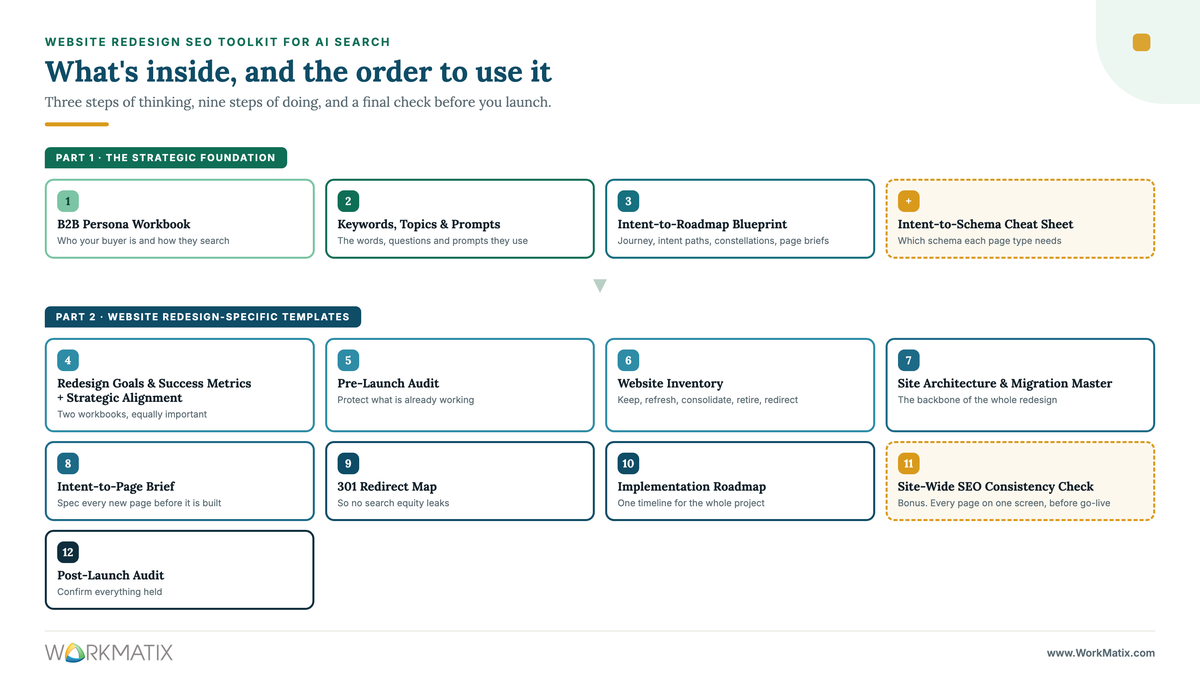
Before you touch a wireframe, you need to know who you’re building for and what they search. The foundation is a three-step sequence, each step feeding the next.
- Step 1. B2B Persona Workbook for SEO & AI Search. Decodes your buyer: their search triggers, their language, the fears that stall a decision. Defines who you serve and how they search, so the rebuild aims at real buyers.
- Step 2. Keywords, Topics & Prompts Discovery Workbook. Turns persona insight into the keywords, topics and AI prompts your buyers actually use.
- Step 3. Intent-to-Roadmap Blueprint. Synthesizes it into a content strategy where every page has a reason to exist, with a built-in coverage check.
- Bonus, Intent-to-Schema Cheat Sheet. Maps each page type to the markup it needs to surface in AI search.
- Walkthrough guides for every workbook, plus a Start Here guide.
This is the same foundation that anchors every SEO-nergy edition. It’s what makes the redesign strategic instead of cosmetic.
Layer two: 9 Website Redesign-Specific Templates
The website redesign stack is what is specific to this toolkit: the templates that carry your strategy through the actual rebuild.
- Strategic Alignment Workbook. Align stakeholders and business goals before a single wireframe exists, so everyone agrees on what the redesign must achieve.
- Website Inventory Workbook. Every existing page scored on traffic, value and links, with a keep, rewrite, retire, merge or redirect decision.
- Redesign Goals & Success Metrics. Sets measurable targets across business, SEO, AI search and technical metrics, so success is defined rather than felt.
- Site Architecture & Migration Master. The spine of the project: one row per new page carrying strategy, structure, navigation, page briefs, image plan and launch checklists.
- 301-redirect map. Every changing, merging or retiring URL mapped to its new home, in a format a developer can deploy, with QA that catches chains and loops before launch.
- Pre + Post-Launch Audit Template. Baselines every metric before go-live and measures the delta after, so you can prove it worked or catch a regression early.
- Implementation Roadmap. Sequences the whole build with owners and phases: architecture, content (pillars then clusters), linking, technical SEO, launch, and optimize.
- Intent-to-Page Brief (standalone). Every new page specified and structured around real intent rather than guesswork.
- Site-Wide SEO Consistency Check. Your last pass before go-live. Every page on one screen, catching duplicate titles, duplicate keywords, missing schema which no page-by-page brief can surface.
| A note on how this works This toolkit produces the strategy and the documents: the audits, the roadmap, the SEO briefs, the redirect map, the checklists. You and your developers implement. The 301-redirect map, for example, is composed for you as a clean, developer-ready document; your dev team ships it. That’s the point. You get a documented, defensible plan your team executes, not a black box. Instant download. Word, Excel and PDF guides. What you need Microsoft Excel or Google Sheets, and Microsoft Word or Google Docs. A site crawler and access to Google Search Console and Google Analytics for the performance data. To test AI visibility, access to the AI tools your buyers use. No special software, no subscriptions. |
Who this is for
You are an in-house marketing leader at a B2B company facing a redesign or replatform, and you are the one who will answer for the traffic afterward. You do not need to be technical. You make the strategic decisions, the templates structure them, and your developers handle implementation.
Or you run SEO-led redesigns and want a documented system instead of reinventing the process on every project.
Either way, you treat a website redesign as a strategic event, not a coat of paint.
One document, four teams, and the reason it saves you weeks
A redesign may be a handover problem before it is a search problem. Designers, developers, writers and often an agency all need the same answer to who this is for and what each page has to do. Right now that answer lives in your head and gets re-explained, slightly differently, in every kickoff call.
The filled workbooks end that. They are the source of truth everyone works from, which is why alignment sits at the front of the sequence rather than somewhere in the middle.
There is a second payoff people do not expect. The same documents that make the work clear to a person are what make an AI assistant useful on it. Hand an AI assistant a filled persona and a page brief and it stops producing the average of everything ever written about your industry, because it finally has your specifics to work from.
Clear documentation does more than guide your team; it provides the structural context an AI assistant needs to execute flawlessly. During a major redesign, leverage matters most in the middle tiers where volume peaks. Tasks like briefing dozens of new pages, generating metadata, and drafting first-pass alt text can move at unprecedented speeds, simply because the core strategy has already been established. Systemized order drives this efficiency: human thinking dictates the logic, while AI accelerates the execution.
Which edition do you need?
The right edition depends on the state of your site. The Strategic Foundation Toolkit (SEO + AI) is the core three-step methodology, and it’s the foundation inside every other edition. If you’re rebuilding or migrating your whole site, the Website Redesign SEO toolkit adds the full redesign and migration-specific templates on top of the strategic foundation. If your structure is fine but your existing content has gone stale, the Website Content Refresh Edition adds the audit-and-refresh stack.
Take the toolkit if you or your team will do the work, and what you want is the structure, the sequence and the decisions framed properly. You keep control, and you keep the documents.
Take 1:1 coaching if you would rather have someone check your thinking as you go, and answer the questions that come up mid-project.
Take the website redesign SEO consulting engagement if the redesign is too visible to run yourself, or nobody on the team has time to own it.
None of these if you want the work taken away and handed back finished. The workbooks only work if they get filled in.
| Quick guide Want the core three-step methodology → Website Strategic Foundation Toolkit (SEO + AI) Rebuilding or migrating the whole site → Website Redesign Edition (this one) Structure’s fine, content needs to come back to life → Website Content Refresh Edition |
Would you rather have this run for you?
Some redesigns are too visible to run solo, and there is no shame in that. The Smart Start SEO redesign engagement is the done-with-you version of this exact system, and the full price of this edition applies as credit toward it if you upgrade within 90 days.
From students and coaching clients…
About Julia
Julia Gordeeva has spent eighteen years in B2B search and has watched enough redesigns go sideways to know exactly where the damage starts.
It is almost never the design. It is the decisions made before design begins, about URLs, architecture, and which pages survive, taken by people who had no reason to know what they would cost.
Several of these templates exist because of problems that only show up on a real project. This Website redesign SEO toolkit is those decisions, written down in the order they need to be made. The consistency check exists because four problems only appear across pages, and no page-by-page review can see them.
Questions Marketing Leaders Actually Ask Before They Buy
The ones that come up in every conversation about a redesign…
Will a redesign hurt my current SEO?
A redesign can hurt your SEO, and that’s exactly the risk this toolkit exists to manage. The danger isn’t the redesign itself; it’s changing URLs, structure, and content without a plan to carry your rankings across. A botched migration can erase years of authority in a single launch. The Website Inventory, Site Architecture & Migration Master, and 301-redirect map are built to move your equity intact, so the new site inherits your rankings instead of dropping them. Some short-term fluctuations are normal while search engines re-crawl the new site, and it generally settles within four to eight weeks. What causes permanent loss is a page that disappears without a redirect, or a new structure that no longer matches what people search for. Both are decided early, which is where this toolkit puts them.
I’m strong on marketing but not technical. Can I actually use this?
Yes, because it’s built for a marketing leader, not a developer. You make the strategic decisions; the templates structure them; your developers handle implementation from the documents you hand them. You don’t configure servers or write redirects. You compose the plan and guide the team, which is exactly the position you’re in already. Every workbook asks you questions about your business and your buyer, not about code. Where something technical is needed, like deploying a redirect map or adding schema, the toolkit produces the document and your developer implements it. You’re the one deciding what should happen.
We might hire an agency for the redesign. Do I still need this?
You need it more, not less. An agency will build what you ask for. This is what tells them what to build, and it gives you a documented position to hold them to, rather than approving decisions you have no way to evaluate. An agency rarely owns your search strategy or protects your domain equity unless you make that a requirement. This toolkit gives you the blueprint, the inventory, the redirect map, and the success metrics to brief the agency, hold it accountable, and verify the migration was done right, rather than finding out from a traffic report three months later.
How is this different from just giving my developers an SEO checklist?
A checklist tells you what to verify; this tells you what to build. The toolkit is a sequenced system: who you serve, what they search, how the new architecture should be shaped around that, and how to migrate without loss. A checklist at the end can’t recover strategy that wasn’t built in at the start. This builds it in from Step 1.
What do I actually have to show my CEO?
A documented strategy, measurable goals, and a launch you can defend. The Redesign Goals & Success Metrics Workbook ties the project to business outcomes, and the Pre + Post-Launch Audit measures against them. You walk into the check-in with a plan and a scoreboard, not a shrug. It’s the difference between “we redesigned the site” and “here’s what we protected and what we expect to gain.”
Is $149 worth it against a redesign that costs far more?
The toolkit costs a fraction of one botched migration’s recovery. A redesign is a five figures + investment and a high visibility bet. The risk you’re insuring against isn’t the $149; it’s the lost traffic, the flat pipeline, and the credibility hit if the launch goes quiet. The cost of getting the SEO wrong isn’t the toolkit price, it’s the months of traffic you spend rebuilding what you already had.