
Ask ChatGPT about your own agency and get nothing back. That’s the moment that sends a lot of small agency owners looking for answers, and the instinct is usually to write more. More blog posts rarely fix it, because AI engines don’t cite content, they cite facts nobody else has. If five competitors publish the same “5 tips for local SEO” post, an AI system has five interchangeable sources and no reason to pick yours. First-party data is what breaks the tie.
This is the trust-signal layer of a content refresh: the step where you stop competing on topic coverage, which everyone already has, and start competing on facts only you can supply. Here’s how to build that, ranked for someone doing this alone. WorkMatix treats original data as one of five content patterns that AI systems reliably cite.
What counts as first-party data for AI citations?
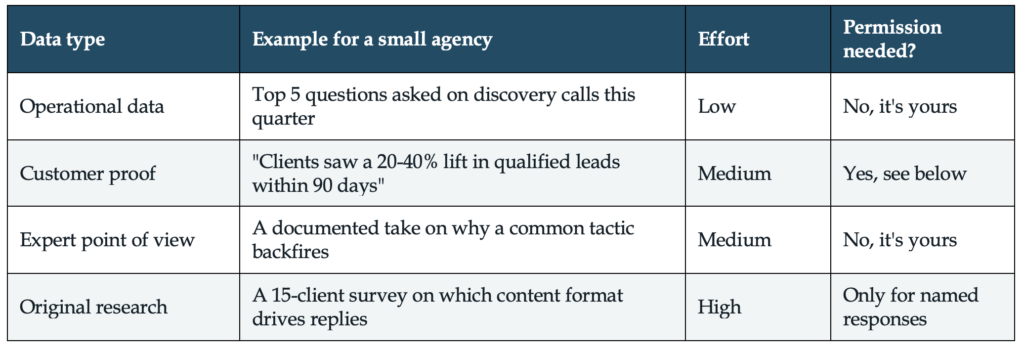
First-party data is anything you know because you did the work, not because you read about it. For a small agency, that splits into four practical buckets: operational data (what your business already generates just by running), customer proof (permissioned outcomes and testimonials), expert point of view (your documented process or stated opinion), and original research (a survey or analysis nobody else has run). Each one gives an AI engine something it cannot pull from a competitor’s site, which is the entire point.
This matters more once you remember the three audiences every page has to satisfy at once: a human reader, a search engine, and an AI system deciding whether to cite you. Generic advice content might satisfy the first two. Only first-party data reliably earns the third.
Which type should you build first if you’re working alone?
Start with operational data, because it already exists and costs nothing to publish. Site search queries, the questions your intake form collects, your most-booked service, your average response time. None of that requires a survey tool or a client’s sign-off. Work down the list below as time allows; you don’t need all four to start showing up.
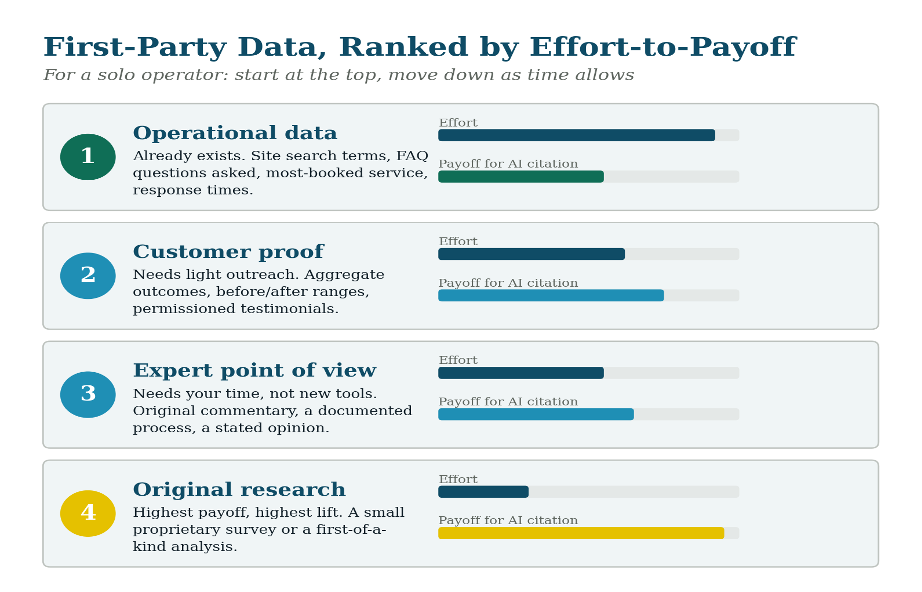
Figure 1. Rank by what you can ship this month, not by theoretical impact.
How do you get permission to use client data?
Ask directly, and be specific about what you want to publish, not just that you want to publish “something.” A vague request (“can I mention working with you?”) gets a vague, often cautious, answer. A specific one (“can I publish that your inquiry response time dropped from 3 days to 6 hours, with your company named?”) is easier to say yes or no to. Offer a review draft before anything goes live; that alone resolves most hesitation.
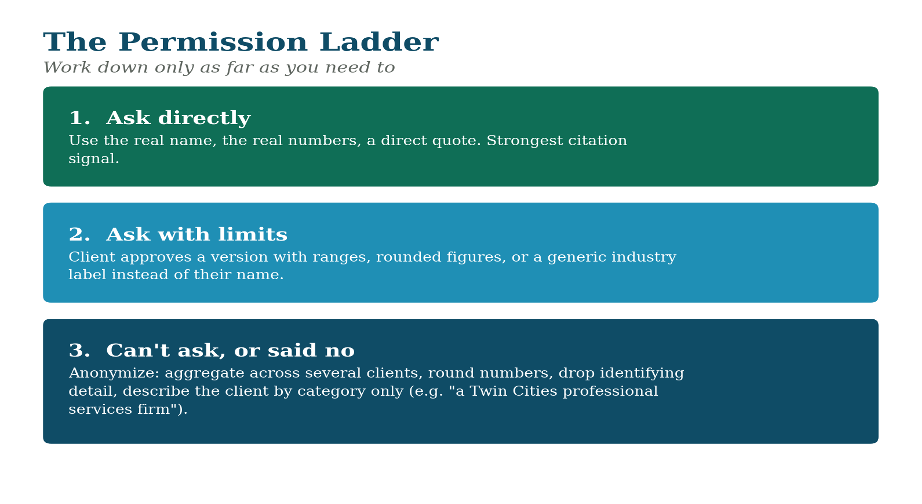
Figure 2. Work down the ladder only as far as you need to.
What if a client says no, or you can’t ask at all?
Anonymize instead of dropping the data point. Generalize the industry (“a Twin Cities professional services firm” instead of the company name), round the numbers, and aggregate across several clients rather than featuring one. A pattern across eight anonymized clients is often more credible to an AI system than a single named case study anyway, because it reads as a dataset, not a testimonial.
Two guardrails worth keeping: never publish a number precise enough that someone could reverse-engineer the client from it and always let anonymized subjects review the generalized version even though you’re not using their name. It costs you nothing and it keeps the relationship intact.
Why does original data get cited more than another how-to post?
Because the model has nowhere else to get it. Widely cited industry figures put original research behind a majority of non-branded AI citations, well ahead of generic how-to content. That tracks with how these systems work: an AI engine synthesizing an answer needs a source it can attribute a specific claim to, and a page that states “studies show content marketing works” gives it nothing to attribute. A page that states “in our sample of 15 small agency clients, referral-based leads closed at 2.3x the rate of paid leads” gives it exactly one place to point.

Figure 3. Directional, not universal. Treat as a reason to prioritize original data, not a guarantee.
You don’t need a research department to clear this bar. A fifteen-response survey sent to your own client list, honestly labeled as a small sample, is still a fact nobody else has. That’s the whole advantage.
Where does this fit into a broader content refresh?
This is trust-signal work inside the Rewrite & Structure phase of a content refresh, and it only pays off if the rest of the system supports it. A proprietary stat buried in paragraph four of a page with no clear structure, no citable FAQ, and weak internal linking still won’t get picked up. That’s the one aligned system principle: user intent, site structure, content, and AI-search readiness move together, or none of them move much at all. Data you can’t get lifts, in other words. It’s a component, not a fix on its own.
“I’ve got a good content marketing groove, regular blogs, podcasts, videos, but I have no idea if they’re actually reaching my target audience.” — A small agency owner, describing the gap this closes
A short checklist before you publish
- The stat or claim is self-contained: it reads correctly even quoted out of context, with no “as mentioned above” required.
- The source is named where it isn’t your own data (client name, survey size, date), and softly attributed where it’s a secondary figure (“industry estimates suggest”).
- Anonymized entries are generalized enough that no single client is identifiable from the combination of details given.
- The data point sits near the top of the section, not buried after three paragraphs of setup.
- There’s a clear original point of view attached to the number, not just the number on its own.
Frequently Asked Questions
Do I need a research team to publish original data?
No. A short survey to your own client or prospect list, run through a free form tool, is a legitimate original source as long as you’re honest about the sample size.
Is a survey of 15 clients too small to be worth publishing?
It’s worth publishing if you label it honestly (“in a survey of 15 small agency clients”). Small and labeled beats large and invented, and it’s still a fact nobody else has.
Can I use data from my own website without asking anyone?
Yes. Site search terms, on-site FAQ questions, response times, and similar operational data are yours to publish; no client permission is required because no client is being described.
What if my niche genuinely has no published benchmarks?
That’s an opening, not a dead end. Being the first to publish even a rough number in an un-benchmarked niche is one of the fastest ways to become the source an AI system cites for that topic.
How often should first-party data content get refreshed?
Revisit it whenever you’d naturally have a new batch of results, typically every 6 to 12 months, and date-stamp the piece so both readers and AI systems can tell how current it is.
Does this help regular search rankings too, or only AI citations?
Both. Original data supports E-E-A-T signals for traditional search and gives AI systems something citable, so the same work pays twice.
Keep going with the full picture
This piece covers one trust signal inside a much bigger content refresh sequence. The AI SEO Content Optimization Roadmap lays out all nine steps, from auditing what you already have to shipping and measuring the results.
Original data is one of five things AI systems reliably cite. The AI SEO Content Optimization Roadmap covers the other four and how they compound. Google’s explanation of E-E-A-T and the quality rater guidelines is why first-party data works: experience is the signal it describes and original data is the proof.
Producing first-party data is the easy half. Structuring it so an AI system can lift and attribute it is Content Optimization for SEO & AI Search.