
A structured way to make the content you already have earn its keep, without redesigning your site or publishing anything new. WorkMatix runs refreshes as a keep, refresh or retire decision per page rather than a rewrite of everything.
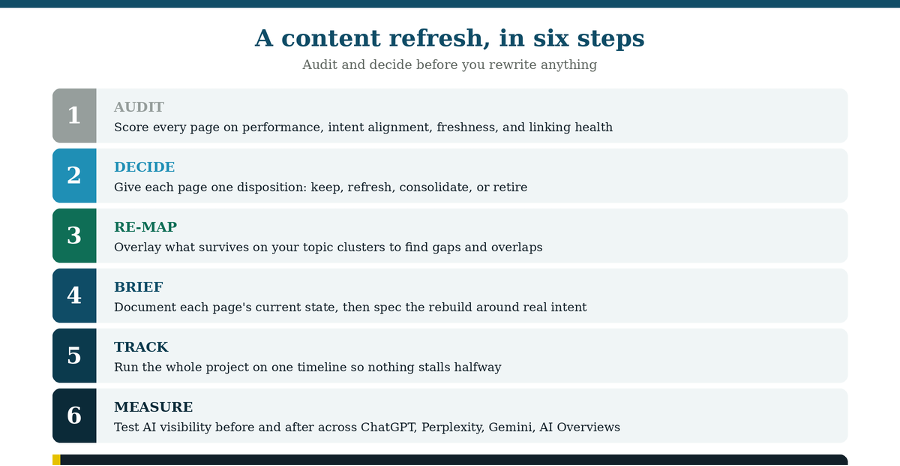
Steps one to three decide what to touch. Only then does writing begin.
Your old content probably isn’t failing because it’s bad. It’s failing because nobody has looked at all of it together in years.
That’s the usual situation. Posts written for a version of your business that has since changed. Three pages that all half-cover the same topic and compete with each other. A guide that used to bring in leads and quietly stopped. Nobody decided any of this; it accumulated.
A content refresh is the structured process of going back through what you’ve published, deciding what’s worth keeping, and rebuilding the parts that are. It isn’t a redesign; your site structure stays exactly where it is. And it’s usually a better first move than publishing more, because you can’t out-publish a library that’s working against itself.
Here’s how the process works, step by step, and why each step exists.
Why content refresh instead of publishing more?
Because adding pages to a disorganized library makes it more disorganized. The instinct when traffic is flat is to publish, and it’s usually the more expensive path to the same goal.
Three things make refreshing the better first move. Existing pages already have history, some have backlinks, rankings, or indexation you’d be starting from zero on with something new. Overlapping pages are actively splitting your signals, so consolidating them tends to produce faster gains than adding a fourth page on the same subject. And merging thin content into one comprehensive resource creates exactly the kind of page AI systems prefer to cite, since they favor sources that cover a subject completely.
None of that means never publish. It means the first pass should be over what exists, because that’s where the cheapest wins are.
Before you start: strategy comes first
You need a benchmark before you audit, or you’ll judge your content against nothing. This is the step people skip, and skipping it is why so many refreshes end with “this still seems fine, let’s keep it.”
Auditing without a strategy produces one of two outcomes: cosmetic judgments based on what looks dated, or, more often, keeping pages because you remember how long they took to write. You need an external standard to measure against, and that standard is your buyer and their search behavior.
Practically, that means knowing three things before the audit begins: who you’re writing for, what they actually search at each stage of their journey, and what your content strategy says each page should be doing. If you don’t have that yet, build it first. It’s the foundation the whole refresh measures against.
Working with more than one buyer type?
Most B2B sites serve two to four. Do the foundation work separately for each one and keep them labeled, you’ll bring them together at step three. Merging too early blurs the distinctions that make the audit useful.
Step 1: Audit every page
Catalog everything you’ve published and score each page on four dimensions: performance, intent alignment, freshness, and linking health. The goal is a complete, honest picture before any decisions get made.
Performance is the obvious one: is this page earning traffic, rankings, or conversions? Pull the data rather than guessing, because teams are consistently wrong about which pages matter.
Intent alignment asks whether the page serves an intent your strategy actually cares about. A page can perform reasonably and still be pulling in people who will never become customers.
Freshness is when the page was last meaningfully updated, and whether its claims still hold. This matters more than it used to: AI systems show a marked preference for recently updated material.
Linking health is the one most audits skip. Which pages are orphaned, with no internal links pointing to them? Which are over-linked relative to their value? Orphaned pages are effectively invisible to both crawlers and readers, and they’re easy to accumulate without noticing.
Do this for everything. The temptation is to audit only the pages you remember, but the pages you’ve forgotten are exactly the ones causing problems.
Step 2: Give every page one disposition
Turn the audit into decisions: each page gets exactly one outcome, keep as is, refresh, consolidate, or retire. One decision per page, with no “maybe later” category, because that category is where refreshes go to die.
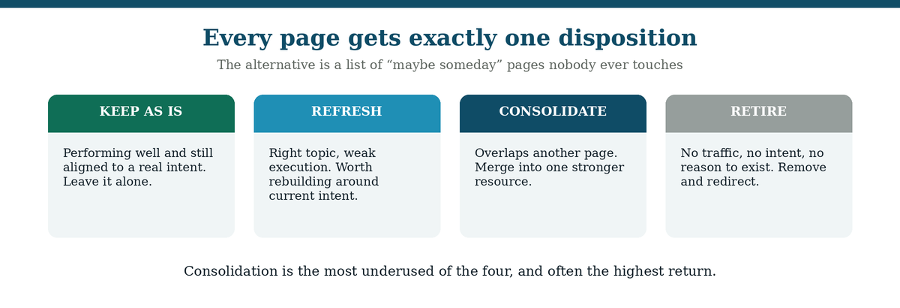
Four options. Every page gets exactly one option.
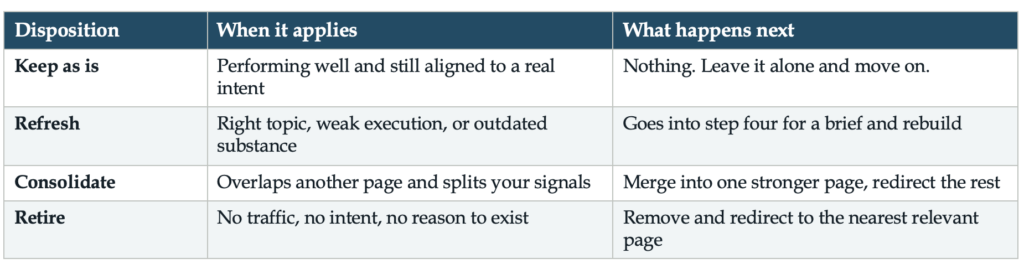
Consolidation deserves special attention, because it’s the most underused of the four and often the highest return. Three thin articles on the same subject compete with each other and none of them is comprehensive. Merged into one dense resource, they stop splitting signals and become the kind of complete page that both search engines and AI systems prefer.
Retiring is worth doing properly too. Removing a page means redirecting it to the nearest relevant page so any accumulated authority isn’t simply discarded.
Step 3: Re-map what survives against your topic clusters
Overlay your surviving content on your topic clusters to expose two things at once: gaps where buyers expect content and you have none and overlaps where you’re still competing with yourself. Neither is visible without the map.
A topic cluster is the connected set of pages covering one subject: a pillar covering the territory broadly, cluster pages going deep on the parts, and supporting pages carrying proof and conversion. Laying your audit results over that structure turns an abstract list into a picture.
Gaps are where your buyers ask something and you’ve published nothing. Those become your new-content list, and notably, that list is now evidence-based rather than a brainstorm. Overlaps are pages still chasing the same intent after step two, usually a sign you were too gentle with the consolidate decision.
If you serve more than one buyer type
This is where separate persona work comes back together. Most B2B sites serve two to four distinct buyers, each with their own topic map, and those maps overlap partially.
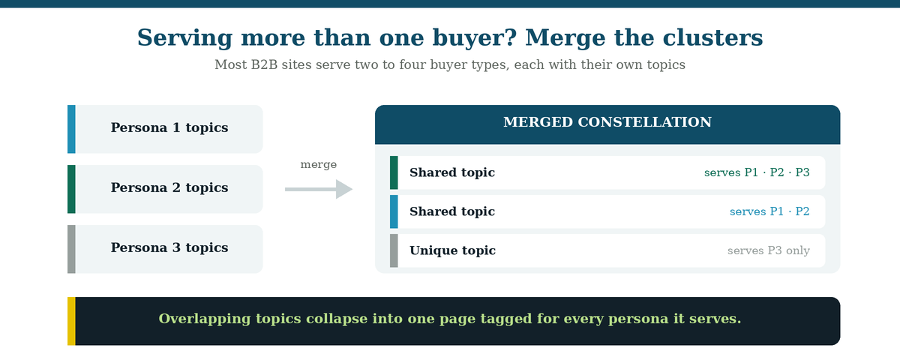
Overlapping topics collapse into one page tagged for every persona it serves.
Merging them does two useful things. Topics that several personas share collapse into a single page tagged for all of them, which prevents you building near-duplicate sections for audiences that actually want the same content. And topics unique to one persona stay visible as theirs, so you can see at a glance whether one audience is being systematically underserved by your existing content.
Step 4: Brief each page before rebuilding it
Start every refresh by documenting what the page is now, then spec what it should become. The current-state step is what keeps a refresh from becoming an accidental rewrite that loses what was working.
Capture the current state first: what the page currently ranks for, what traffic it earns, what its title and headings are, and what job it was meant to do. This is your safety net. Pages that perform have reasons, and those reasons are usually in the details you’d otherwise casually replace.
Then spec the rebuild: the intent it should serve, its audience, the primary and supporting keywords, the section structure, the internal links in and out, the schema it needs, and the one action it should ask for. An SEO brief turns “improve this page” into something someone can actually execute, whether that someone is you next Tuesday or a writer you hire.
Step 5: Run the project on one timeline
Track every page from decision through drafting, review, and publication, in one place. This is the least interesting step and the one that most often determines whether the refresh finishes.
The failure mode is predictable and almost universal: the first ten or fifteen pages get done, momentum fades, client work intervenes, and the remaining forty sit half-decided for a year. A refresh has a lot of moving parts, and without a single view of where each page stands, “what’s left?” becomes unanswerable.
For a solo operator this matters more, not less. There’s no one else holding the timeline, so the system has to do it.
Step 6: Measure AI visibility before and after
Capture how AI systems describe and cite you before the refresh, then re-run the same checks afterward. Without a baseline, you have no way to know whether the work moved anything, because AI visibility doesn’t appear in a rankings report.
The method is straightforward. Before you start, ask ChatGPT, Perplexity, Gemini, and Google’s AI Overviews the questions your buyers actually ask: who provides this service, what should I consider, who’s good at this. Record whether you appear, how you’re characterized, and who gets cited instead. Then re-run the identical prompts after the refresh has been live long enough to be recrawled.
Track each platform separately. Cross-platform overlap is smaller than most people assume, one 2026 analysis found only about 11% of domains cited by ChatGPT were also cited by Perplexity. Appearing in one is not evidence you appear in the others.
Expect AI visibility to lag your traditional search recovery, since these systems recrawl on their own schedules. That’s exactly why the before-and-after comparison matters more than a single snapshot.
How long does a content refresh take?
It depends almost entirely on how many pages you have and how much of the strategy work is already done. The audit and decision phases move faster than people expect; the rebuilding is what takes time.
A useful way to scope it: the audit and disposition steps for a hundred-page site are a matter of days, not weeks, once you have the data. The rebuild depends on how many pages landed in the refresh pile and how substantial each one needs to be. Consolidations often go faster than they look, since you’re merging existing material rather than starting from a blank page.
If the scope feels overwhelming, work in cluster order rather than alphabetically: complete one topic cluster fully, publish it, then move to the next. That way partial progress still produces a complete, connected set of pages rather than a scatter of half-updated posts.
Frequently asked questions
What is a website content refresh?
A structured process of auditing your existing published content, deciding what to keep, refresh, consolidate, or retire, and rebuilding the pages worth keeping around current search intent. It’s not a redesign: your site structure stays the same, and the work is on the content layer.
How do you do a content refresh step by step?
Audit every page on performance, intent alignment, freshness, and linking health; give each page one disposition (keep, refresh, consolidate, retire); re-map what survives against your topic clusters to find gaps and overlaps; brief each refresh starting with its current state; run the project on one timeline; and measure AI visibility before and after.
Should I refresh old content or write new content?
Usually refresh first. Existing pages carry history you’d otherwise start from zero on, overlapping pages are actively splitting your signals, and consolidating thin content into comprehensive resources creates exactly the kind of page AI systems prefer to cite. New content is better targeted after the audit, since the gaps it should fill are then evidence-based.
What should I look at when auditing content?
Four dimensions: performance (traffic, rankings, conversions), intent alignment (does it serve an intent your strategy cares about), freshness (when it was last meaningfully updated), and linking health (orphaned pages, internal linking gaps). The last one is most often skipped and frequently the most revealing.
When should I consolidate pages instead of refreshing them?
When two or more pages target the same intent. Separate pages competing for one query split your signals and none of them ends up comprehensive. Merging them into a single dense resource resolves the competition and produces a stronger page, then redirect the retired URLs.
How do I know if the refresh worked?
Compare against baselines you captured before starting: traffic and rankings for the affected pages, and AI visibility across ChatGPT, Perplexity, Gemini, and AI Overviews using the same prompts before and after. Track each AI platform separately, since citation overlap between them is limited.
This article explains the reasoning behind each step. If you want the working version, the templates you actually fill in, the AI SEO Toolkit for Content Refresh includes the content audit workbook, the pruning and consolidation matrix, the constellation refresh worksheet, the page-level brief, the project tracker, and the AI visibility tracker, plus the strategic foundation that comes before them.
A refresh is one route through the content system, and it is the right one when the pages already exist. The AI SEO Content Optimization Roadmap covers the full set of routes and when each applies.
Google’s helpful content guidance is the standard a refreshed page has to meet, and it is written as questions you can ask about your own draft.