
An objective, data-backed guide for marketing leaders weighing who should handle the SEO on a high-stakes B2B website redesign, without gambling years of organic pipeline.
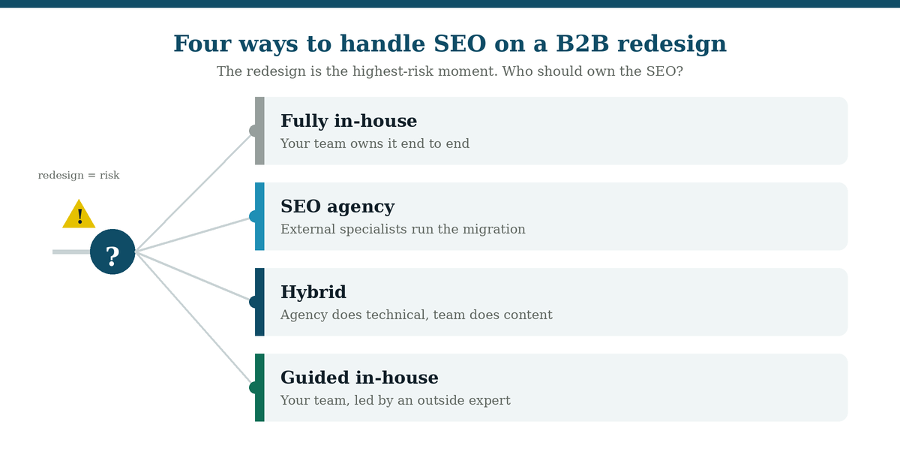
Four paths, not two. The right one depends on your complexity, bandwidth, timeline, and risk tolerance.
A website redesign is the single most dangerous moment for a B2B company’s organic pipeline. Not a slow decline you can catch in a quarterly review, an overnight drop. One missed redirect, one noindex tag shipped from staging, one unmapped URL structure, and years of hard-won organic traffic can vanish the week you launch.
The numbers are sobering. Industry analysts suggest most site migrations lose organic traffic, only about one in ten come out ahead, and the average recovery from a botched move stretches past a year. This is not a design decision with an SEO footnote. It’s an SEO decision wearing a design project’s clothes.
Which raises the question every marketing leader faces before a redesign: do you trust your in-house team, who knows your product and buyers cold, or bring in an external agency with specialized migration experience? This guide breaks down the real costs, the hidden risks, and a framework to choose the right path, objectively, for your specific situation. There are four paths, not two, and the honest answer is that the best one depends on you.
Key takeaways
- Migrations fail more often than they succeed. Studies suggest 60 to 80% of site migrations lose measurable traffic, only about 1 in 10 improve rankings, and botched moves take an average of roughly 523 days to recover.
- Migration SEO is a different skill than day-to-day SEO. Content creation and rank tracking are not the same discipline as 301 redirect mapping, staging audits, and JavaScript rendering, and most in-house teams are staffed for the former, not the latter.
- There are four paths, not two: fully in-house, fully agency, hybrid (co-sourced), and guided in-house (your team, led by an outside expert). Each is right for a different situation.
- Cost is real on both sides. A full in-house SEO team runs roughly $250,000 to $500,000+ a year fully loaded; mid-market agency retainers run about $60,000 to $180,000 a year, but the number that matters most is the cost of a 40% traffic drop.
- There’s a new scoreboard: AI-citation retention. As of 2026, leading guidance treats preserving your visibility in AI answers (ChatGPT, Perplexity, AI Overviews) as a migration KPI, not an afterthought.
Why does a B2B redesign need specialized SEO at all?
Because a redesign quietly changes the exact things search engines and AI systems use to find, rank, and cite you, and those changes are invisible from the front end. The site looks finished. The damage is underneath.
Here’s what actually happens during a redesign that puts your traffic at risk:
- URL architecture changes. New page structures mean old URLs, and the ranking authority attached to them, need to be mapped to new ones. Miss the mapping and you sever the connection between an old URL’s earned authority and its new home. That authority then has to be re-earned from close to zero.
- Content pruning. Redesigns often cut or consolidate pages. If a pruned page was earning backlinks or ranking, and no redirect points its authority somewhere relevant, that equity is simply thrown away.
- Technical rendering issues. Modern sites lean on JavaScript frameworks that can render beautifully for humans but poorly for crawlers, quietly hiding content from search engines and AI retrieval.
- Schema and structured data loss. This is the newest risk. AI answer engines lean on structured data to cite you. Lose your schema in the move and you can disappear from AI answers without it ever showing up in a rankings report.
Now the crucial distinction, and the one that reframes the whole “agency vs in-house” question. Day-to-day B2B SEO and technical migration SEO are two different skillsets. The work your team does every week, publishing content, tracking rankings, refining keywords, is a genuine discipline, but it is not the same as migration SEO: mapping hundreds or thousands of 301 redirects, auditing a staging environment before launch, preserving crawlability through a platform change. A team can be excellent at the first and have never done the second. That’s not a competence gap. It’s a specialization gap and naming it correctly is the key to choosing the right path.
Option A: Keep it fully in-house
Fully in-house means your existing marketing or SEO team owns the redesign’s search strategy and execution end to end. It’s the right call in specific conditions, and the wrong one in others.
Please note: by “in-house marketing team” we mean your salaried internal staff, who carry deep product and buyer knowledge but a variable level of technical-migration experience.
The genuine pros. Nobody understands your complex B2B buyer journeys, your product nuances, or your internal politics like your own team. They’re aligned with product and sales by default, decisions don’t wait on agency approval cycles, and whatever they learn stays in the building. That institutional knowledge compounds over time and doesn’t walk out the door when a contract ends.
The honest cons. Bandwidth is the first casualty: a redesign is a major project, and when the team pivots to it, day-to-day marketing stalls, exactly when you can least afford lost momentum. Then there’s the specialization gap: most in-house teams haven’t run many migrations, and the tooling for enterprise-grade migration audits may not be in their stack. Finding one person who covers technical SEO, content, and the newer AEO/GEO skills is genuinely hard in 2026; those generalists are rare and command premium salaries. And a team that only sees your data can have blind spots that someone who’s run dozens of migrations would catch instantly.
Best for: established firms that already have a dedicated technical SEO specialist in-house, a straightforward redesign (a UI refresh on the same domain, same CMS, same URLs), and the bandwidth to pause other work. If the migration is genuinely simple and your team has done one before, in-house can be both the safest and most cost-effective path.
Option B: Hire an SEO agency
Fully outsourced means an external agency owns the redesign’s SEO, from pre-launch audit through redirect mapping to post-launch monitoring. It trades product intimacy for migration specialization.
Please note: by “enterprise B2B SEO agency” we mean an external firm with dedicated technical specialists and experience across many historical migrations.
The genuine pros. An agency that has run dozens of migrations brings pattern recognition your team can’t have, they know what breaks, because they’ve seen it break. They come with dedicated technical resources and enterprise-grade diagnostic tools already in place, and they can move on an aggressive timeline without pulling your team off its daily work. For complex moves, domain changes, CMS migrations, thousands of URLs, that specialized experience is exactly the risk insurance a redesign needs.
The honest cons. Onboarding takes time; an agency has to learn your complex B2B product before it can be fully effective, and that ramp is real. Costs are higher and more variable upfront, and there can be genuine friction between an external SEO team and your internal developers over priorities and process. And when the engagement ends, the deep knowledge of your migration can leave with them unless it’s documented.
Best for: complex migrations (new domain, new CMS, large URL counts), aggressive timelines, or in-house teams already at maximum bandwidth. When the downside risk is a catastrophic traffic loss and your team hasn’t done this before, specialized experience is the rational hedge.
Option C: Hybrid (co-sourced)
Hybrid splits the work along the skillset line: an external specialist handles the technical migration, while your in-house team keeps ownership of content, strategy, and buyer knowledge. It’s designed to put each kind of work with whoever does it best.
The genuine pros. You get specialized migration expertise exactly where the risk concentrates (redirects, audits, architecture) while keeping the product and content knowledge in-house where it belongs. It’s often more cost-efficient than full outsourcing, and it keeps your team involved and learning rather than sidelined.
The honest cons. It requires clear ownership boundaries; ambiguity about who owns redirects across internal and external systems is itself a documented cause of migration failure. It takes active coordination, and two teams mean two sets of priorities to align.
Best for: mid-market B2B firms with a strong content team but no migration specialists, who want risk coverage on the technical side without handing off the whole project.
Option D: Guided in-house (your team, led by an expert)
Guided in-house keeps your team executing the redesign but brings in an outside expert to lead them through it with a proven methodology, so the team builds capability while an experienced hand keeps the strategy sound. It’s the least-discussed option and often the best fit for a specific, common situation.
The genuine pros. You keep control and institutional knowledge, your team learns a repeatable system they’ll own for future projects, and you get expert judgment on the high-stakes strategic decisions (intent mapping, architecture, content strategy, AI-search readiness) without fully outsourcing. For a marketing leader who needs to stay close to a high-visibility project, and be able to speak to it credibly internally, this path keeps you in the driver’s seat.
The honest cons. Your team still has to do the work, so bandwidth is still a factor. And it works only if the guiding expert brings a genuine methodology, not just opinions. The hands-on technical migration execution, the actual redirect implementation and staging plumbing, still needs to sit with your developers or a technical vendor; a strategic guide makes the plan sound but doesn’t replace the technical doers.
Best for: marketing leaders who want their team to own the redesign and grow from it, who value staying in control of a high-stakes project, and whose main gap is strategic direction and AI-search readiness rather than raw technical execution.
At a glance: hire SEO agency vs in-house execution comparison
Here’s how the four paths line up across the vectors that actually drive the decision.
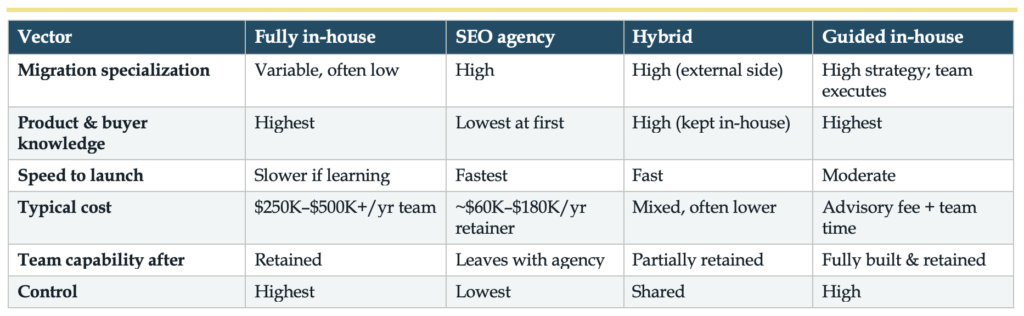
A note on reading the cost row: the in-house figure is the fully loaded annual cost of building and running a complete team (salaries, benefits, tools, training), while the agency figure is a mid-market annual retainer. For a one-time redesign, you’re rarely comparing a full year of either, but the ratio illustrates why “just do it in-house” is rarely the cheap option it looks like. As one 2026 analysis put it, the DIY-versus-outside decision is fundamentally an opportunity-cost calculation, not a capability question.
Four questions to choose your path
Match your answers to the framework below. Your specific situation, not a general rule, determines the right path.
- Complexity: Are you changing domains or CMS platforms, or just updating the UI? A same-domain, same-URL UI refresh is low-risk and in-house-friendly. A domain change or migration is where specialized migration experience earns its cost.
- Bandwidth: Can your team realistically drop daily marketing to audit hundreds or thousands of URLs and monitor a launch daily for weeks? If not, something has to give, either the daily work or the migration quality.
- Timeline: How fast does the new site need to launch? Aggressive timelines favor teams that have done this before and won’t be learning on your project.
Budget vs. risk: Is the cost of expert help lower than the financial loss of a 40%-plus traffic drop? For most B2B firms where organic drives a large share of pipeline, the math favors paying to de-risk the move.
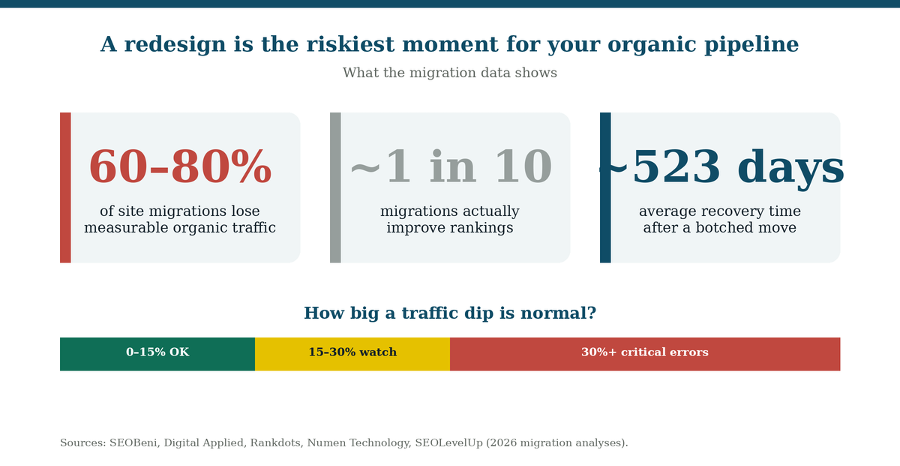
Why the decision matters: the downside of getting it wrong is large and slow to recover from.
So which path wins?
There’s no universal winner, and any guide that declares one is selling you something. But the patterns are clear: most mid-market B2B firms land on either hybrid or guided in-house, because both put specialized help exactly where the risk is while keeping product knowledge and (for guided in-house) team capability inside the company. Fully in-house wins when the migration is genuinely simple and you have a technical specialist on staff. Fully agency wins when the migration is complex, the timeline is tight, and your team is tapped out.
Here’s the honest way to choose between the two most common answers. If your gap is technical execution (you have strategy covered but no one to run the redirect-and-audit machinery), lean hybrid, bring in technical migration help. If your gap is strategic direction and AI-search readiness (your team can execute but you’re not confident the redesign is being built right for search and AI from the start), lean guided in-house, bring in methodology and expert guidance while your team drives.
That second gap is worth dwelling on, because it’s the one that quietly sinks redesigns that were technically fine. A redesign can have perfect redirects and still fail to serve the three audiences that matter now, human visitors, search engines, and AI systems, because no one architected the content and structure around real search intent before the build began. Getting that right once, before a single page is built, is far cheaper than retrofitting it after launch.
This is where WorkMatix fits: the SEO-nergy methodology helps your team make the redesign strategically sound and SEO and AI-ready, and teaches them to drive it, while the hands-on technical migration stays with your developers or technical vendor. It’s the guided-in-house path, not a replacement for your technical doers.
As one marketing leader facing exactly this decision put it: “I need someone who not only does the work but also shows us how to do it.” That instinct, keep the capability in-house, but get expert guidance to do it right, is precisely what the guided path is built for.
Frequently asked questions
Should I hire an SEO agency or use my in-house team for a B2B site migration?
It depends on complexity, bandwidth, timeline, and budget-versus-risk. Use in-house if the migration is simple (same domain and URLs) and you have a technical SEO specialist on staff. Use an agency for complex migrations, tight timelines, or a tapped-out team. Many mid-market B2B firms choose a middle path: hybrid (external technical migration help plus in-house content) or guided in-house (an expert leads your team through it).
How much organic traffic can you lose in a botched redesign?
Industry data suggests 20 to 50% overnight is common in mishandled migrations, with some cases far worse, and recovery averaging well over a year. Well-executed migrations typically see only a 5 to 15% temporary dip; drops beyond 30 to 40% signal critical implementation errors.
Is migration SEO different from regular SEO?
Yes, migration SEO is different from regular SEO. Day-to-day SEO (content, rank tracking, keyword work) is a different discipline from technical migration SEO (301 redirect mapping, staging audits, crawlability and JavaScript rendering, schema preservation). A team can be strong at one and inexperienced at the other.
What does an in-house SEO team actually cost?
A full in-house SEO team runs roughly $250,000 to $500,000+ per year fully loaded (salaries, benefits, tools, training), while mid-market agency retainers run about $60,000 to $180,000 per year. For a one-time redesign, the relevant comparison is the cost of expert help versus the potential revenue loss from a traffic drop.
How do I protect AI search visibility during a redesign?
Treat structured data (schema) as launch-day non-negotiable, since AI answer engines rely on it to cite you, and plan the content and architecture around real search intent before building. Leading 2026 guidance now treats AI-citation retention as an explicit migration KPI, alongside traditional traffic and rankings.
Planning a B2B redesign and want to know where your real risk sits before you choose a path? WorkMatix offers a Paid Search Readiness Audit that maps your site’s readiness for search and AI, a practical first step for any marketing leader weighing this decision. You can also download the Master Website Checklist for AI Readiness to pressure-test your redesign plan against what search engines and AI systems need.