
What belongs in a content brief, what separates a strong field from a weak one, and why the brief is the difference between a page that works and a page that merely exists. An SEO brief at WorkMatix carries the persona, the journey stage and the schema, so the writer is not guessing at any of the three. It is a productive bridge between marketing strategy and application implementation.
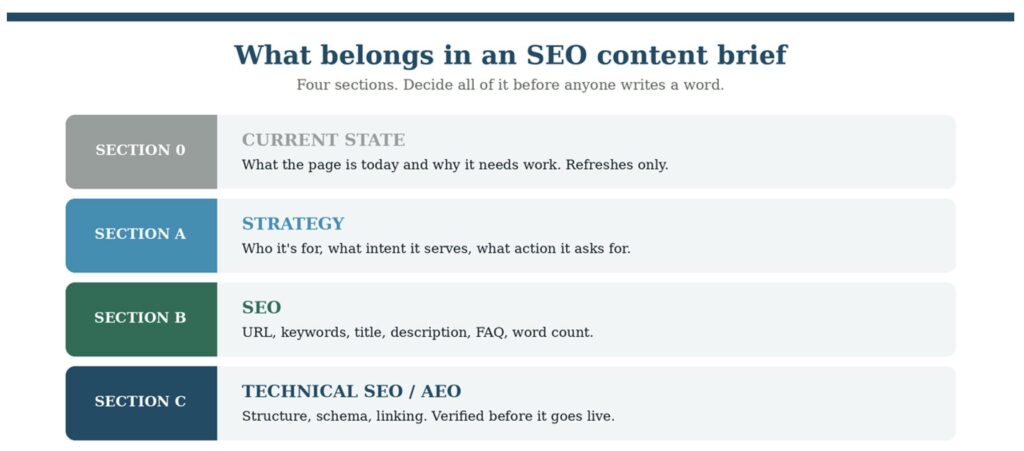
Four sections, all decided before anyone writes a word.
Most content gets briefed in a sentence: “write something about topic X.”
Then someone writes it, and the result is technically about topic X and does nothing else. It doesn’t target an intent, because none was named. It doesn’t ask for a specific action, because none was chosen. It sits in no cluster and connects to nothing. The page exists. That’s the whole of its achievement.
An SEO content brief is the document that prevents this. It specifies what a page is for, who it serves, what it must contain, and how it will be measured, before anyone starts writing. It’s the least glamorous artifact in content strategy and probably the highest-leverage one.
Here’s what belongs in one, and what separates a strong field from a weak one.
What is an SEO content brief?
An SEO content brief is a short specification for a single page, capturing its audience, intent, keywords, structure, technical requirements, and business goal before the page is created. One brief, one page.
It’s not a content calendar, which says what gets published when. It’s not an outline, which is only the structure. A brief covers the strategic decisions (who and why), the SEO requirements (what it must target), and the technical checks (what must be true before it goes live), so that whoever executes has everything they need and nothing is left to interpretation.
The test of a good brief is simple: could someone who wasn’t in the strategy conversation build the right page from it? If they’d have to guess at the audience, the intent, or the point, the brief isn’t finished.
When to write one
A brief is most useful after the upstream work is done: after you know the persona, after you have the keyword and prompt universe, and after you know where the page sits in your topic cluster. Without those inputs a brief is harder to fill in well, and the page built from it will be less strategic. The brief translates strategy into instructions; it doesn’t replace the strategy.
Why briefs matter more now than they used to
Because AI systems retrieve content by structure, and structure is a briefing decision, not a writing decision. A page’s headings, its answer placement, its FAQ, and its schema all get decided in the brief or not at all.
When content only had to rank, a strong writer could produce a good page from a loose instruction. Now the same page also has to be parseable: retrieval systems chunk it, extract passages, and decide whether a section answers a specific question well enough to quote. Content with clear structure, direct answers near the top of each section, and clean question-and-answer blocks is materially more likely to be cited than the same information written as continuous prose. Those are all specifications. They belong in a brief, decided deliberately, rather than emerging by luck from whoever happened to write the draft.
Section A: Strategy
The strategy section answers who the page is for and why it exists. It’s the section most often skipped and the one that determines whether the rest of the brief is worth filling in.
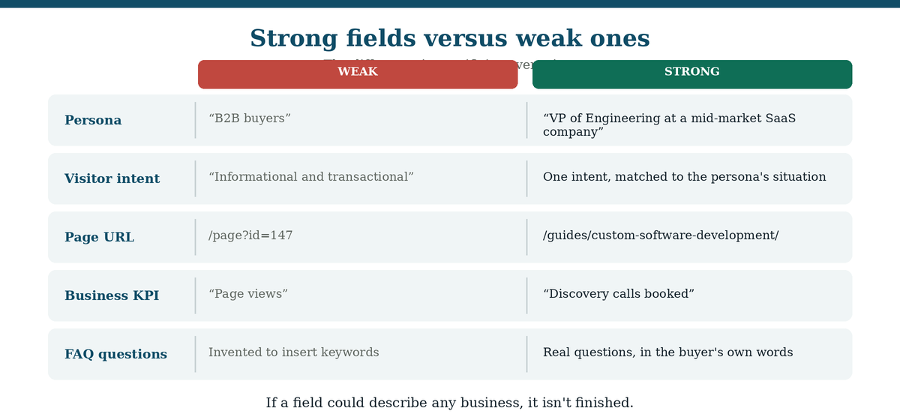
The difference between weak and strong is specificity, every time.
Page title (H1)
The visible heading a visitor sees on arrival. Distinct from the SEO title that appears in search results and browser tabs.
Weak: Generic, jargon-heavy, or written for the company rather than the visitor. “Welcome to Our Services Page.”
Strong: Specific, benefit-led, aligned with the visitor’s intent, and containing the primary topic naturally.
SEO Persona
Which audience this page serves. Should point back to a documented persona, not a vague category.
Weak: “B2B buyers” or “business owners,” which describes everyone and therefore nobody.
Strong: A specific persona with role context, for example “VP of Engineering at a mid-market B2B SaaS company.”
Visitor intent
What the visitor is trying to achieve when they land: informational, comparative and evaluative, transactional, or navigational and locational.
Weak: Mixed intent. “This page is informational and transactional” is usually a sign it should be two pages.
Strong: A single clear intent matched to the persona’s situation. The page does one thing well.
Search journey stage
Where in the buyer’s journey this page meets the visitor: information search and exploration, consideration and comparison, or decision.
Weak: Trying to span all three stages on one page, which typically produces a page that serves none of them.
Strong: One stage, chosen deliberately, with the depth and tone that stage calls for.
Call to action
The primary action the page asks for. Match it to the journey stage: earlier stages take softer asks, later stages can ask for the meeting.
Weak: Several competing CTAs of equal weight, leaving the visitor unsure what to do.
Strong: One primary action, optionally one secondary, with a specific verb and a specific outcome.
Page type
Pillar, cluster, or supporting. This should come from your topic cluster map rather than being decided in isolation.
Weak: A mismatch between the label and the substance, such as a “pillar” that runs 800 words.
Strong: A type that aligns with the page’s depth, word count, and linking strategy.
Business KPI
The measurable outcome this page connects to. This is what makes the page accountable to something other than existing.
Weak: Vanity metrics like page views or time on page, with no link to conversion.Strong: A concrete metric tied to pipeline or revenue, such as discovery calls booked or qualified leads generated.
Section B: SEO
The SEO section specifies what the page targets and how it will appear in search. These are the fields most people think of as “the brief,” and they’re only useful once Section A is settled.
Page URL
The full URL or planned slug. Lowercase, hyphens rather than underscores, primary keyword present, kept short.
Weak: Unreadable or keyword-less paths: /page?id=147 or /our_services_page_for_clients/.
Strong: Short, descriptive, hyphenated, and topically meaningful: /guides/custom-software-development/.
Target keywords
One primary keyword plus roughly three to five supporting terms, drawn from your keyword and prompt research rather than invented here.
Weak: A long list of loosely related terms, or no keyword strategy at all.
Strong: An unambiguous primary term with natural-language supporting variants that reflect how people actually ask.
SEO title
The title tag shown in browser tabs and search results. Maximum 60 characters, with the primary keyword naturally near the front.
Weak: Generic (“Home | Company”) or stuffed past the point of readability.
Strong: Specific, keyword-bearing, and clear about what the page delivers.
SEO description
The meta description beneath the title in search results. Maximum 155 characters. Not a ranking factor, but a significant lever on whether a ranking earns a click.
Weak: Generic, a repeat of the title, or omitted entirely, in which case search engines generate one and it’s usually worse.
Strong: A specific value proposition including the primary keyword once, ending with a reason to click.
Common questions (FAQ)
Three to six questions the page should answer. These often become FAQ schema and are central to AI retrieval, since clean question-and-answer pairs are among the most citable structures on a page.
Weak: Marketing-speak questions invented to insert keywords, like “What is the best custom software development?”
Strong: Real questions the persona actually asks, in their own words, answered concisely on the page.
Word count target
An approximate body length, calibrated to page type and how much depth the intent genuinely requires.
Weak: An arbitrary number with no rationale: “write at least 2,000 words.”
Strong: A target that matches both the page type and the depth the intent calls for.
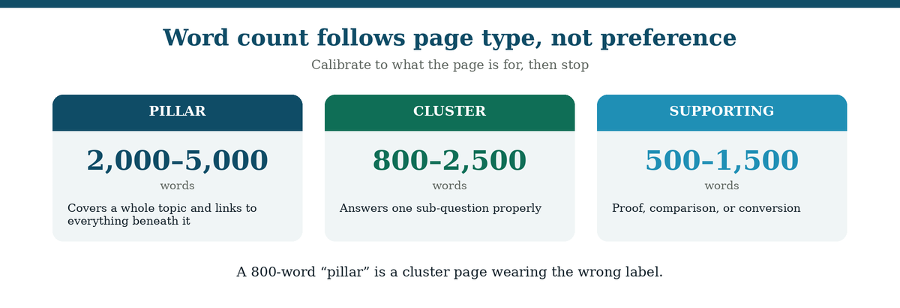
Calibrate to what the page is for, then stop.
As a starting calibration: pillar pages generally run 2,000 to 5,000 words, cluster pages 800 to 2,500, and supporting content 500 to 1,500. Transactional pages are usually shorter still, because clarity matters more than depth when someone is ready to act. Treat these as ranges to reason from, not quotas to hit.
Section C: Technical SEO and AEO
The technical section is a checklist verified before the page goes live, covering structure, machine-readability, and linking. AEO, answer engine optimization, is the newer half: structuring content so AI systems can extract and quote it.
Three groups of checks belong here:
Information architecture, URL, and imagery. Does the page sit where the site map says it should? Is the URL as specified? Are images planned, compressed, and given meaningful alt text?
Search and AI readiness. Is there a single H1 and a clean heading hierarchy? Does each section open with a direct answer rather than a wind-up? Are paragraphs short enough to scan, roughly three to five sentences? Is there schema appropriate to the page type, matching the content actually on the page?
Linking and discoverability. Which pages link to this one, and which does it link to? Are those links real, crawlable anchors with descriptive text? Is the page reachable within a few clicks of the homepage?
There’s a useful plain-language test for the AEO half. Look at the page: can you see distinct headings breaking it into sections? Are paragraphs short? Is there at least one list or table where the content allows? Pages that pass that test are easier for people to read, and they’re also what AI systems retrieve and quote.
Section 0: Current state, for pages you’re refreshing
When you’re refreshing an existing page rather than creating a new one, document what the page is today before you specify what it should become. This is the section that separates a refresh from an accidental rewrite.
Capture what the page currently ranks for, what traffic and conversions it earns, what its title and headings are, and what job it was originally meant to do. It takes ten minutes and it functions as a safety net.
Why it matters? pages that perform have reasons, and those reasons usually live in details you’d casually replace. A heading that happens to match how people ask the question. A section that answers something you’d have cut as tangential. Without a record of the starting point, a refresh can quietly remove the exact things that were working, and you won’t know until the traffic goes.
The one structural difference
A brief for a new page starts at strategy. A brief for an existing page starts one step earlier, with what’s already there. Everything after that, strategy, SEO, technical, is the same. In the SEO-nergy toolkit this is the difference between the Intent-to-Page Brief and the Page-Level AI SEO Content Brief: same specification, with a current-state section added for refreshes.
When you’re briefing yourself
A brief still earns its keep when you’re the strategist, the writer, and the developer. It looks like unnecessary process when there’s no handoff, and that’s exactly when it does its quietest work.
Three reasons it survives the solo test.
It separates deciding from writing. These are different modes and doing them simultaneously produces worse versions of both. Deciding intent, audience, and structure while also choosing sentences means the strategy gets made in service of whatever paragraph you’re stuck on.
It makes the work resumable. Solo work gets interrupted. A page you brief today and write in three weeks is fine if the brief exists; if it doesn’t, you spend the first hour reconstructing what you meant.
It’s the thing you can hand over later. The first time you bring in a freelance writer, a VA, or a contractor, the brief is what makes that possible. Without it, delegating means explaining everything from scratch, which is why so many people conclude it’s faster to do it themselves.
For a solo operator the brief can be shorter than a team brief. It cannot be absent, because you’re still handing work to someone: yourself, later, with less context than you have right now.
Three ways briefs go wrong
Most brief failures are the same three mistakes. All are visible before writing starts.
- The brief is written after the page. Filling in a brief to document what you already wrote is paperwork. The value is entirely in the deciding, which has to happen first.
- The fields are filled in but generic. “B2B buyers,” “informational,” “generate leads.” Technically complete, strategically empty. If a field could describe any business, it isn’t finished.
- There’s no upstream work behind it. A brief assembled without persona research, keyword and prompt discovery, or a cluster map is guesswork in a nice format. The brief translates strategy; it can’t manufacture it.
Frequently asked questions
What is an SEO content brief?
A specification for a single page, written before the page is created, covering its audience, search intent, journey stage, primary and supporting keywords, title and description, required structure, technical and schema requirements, internal links, call to action, and the business metric it’s accountable to.
What should an SEO content brief include?
Four things: strategy (persona, intent, journey stage, CTA, page type, business KPI), SEO (URL, keywords, title, description, FAQ questions, word count), technical requirements (structure, schema, internal links, images), and, when refreshing an existing page, the page’s current state.
How long should a page be?
Calibrate to page type and intent rather than a fixed rule. Pillar pages generally run 2,000 to 5,000 words, cluster pages 800 to 2,500, and supporting content 500 to 1,500. Transactional pages are usually shorter, since clarity beats depth when someone is ready to act.
Who writes the content brief?
Usually the person holding the strategy: an SEO consultant, content strategist, or marketing lead. The completed brief is handed to whoever executes the page, typically a copywriter, designer, or developer. When you’re a solo operator, you’re both, and the brief still separates deciding from writing.
Do I need a brief if I’m writing the page myself?
Yes, though it can be shorter. It separates strategic decisions from drafting, it makes interrupted work resumable, and it’s the artifact that makes delegation possible later. You’re still handing work to someone: yourself, with less context than you have now.
How is a content brief different from an outline?
An outline is only structure, the sections and their order. A brief includes the outline plus the decisions behind it: who the page serves, what intent it satisfies, what it targets in search, what technical requirements apply, and what business outcome it’s accountable to.
Refreshing existing pages rather than creating new ones? The AI SEO Toolkit for Content Refresh includes the Page-Level AI SEO Content Brief as a standalone template, the version built for refreshes, with the current-state section and field-by-field guidance on what strong and weak entries look like. It sits alongside the content audit, pruning matrix, and tracking tools that surround it.
A brief is the handoff point between strategy and writing. The AI SEO Content Optimization Roadmap covers the strategy that has to exist before a brief is worth writing.
Google’s guidance on creating helpful content is worth keeping open while writing a brief, because it names what the finished page has to do.