Website Redesign SEO & AI Search Readiness Roadmap
The Smart Start SEO Framework
The definitive phase-by-phase guide to redesigning a B2B website that keeps the organic traffic you’ve earned and gets cited in AI answers, for marketing leaders who can’t afford to get this wrong.
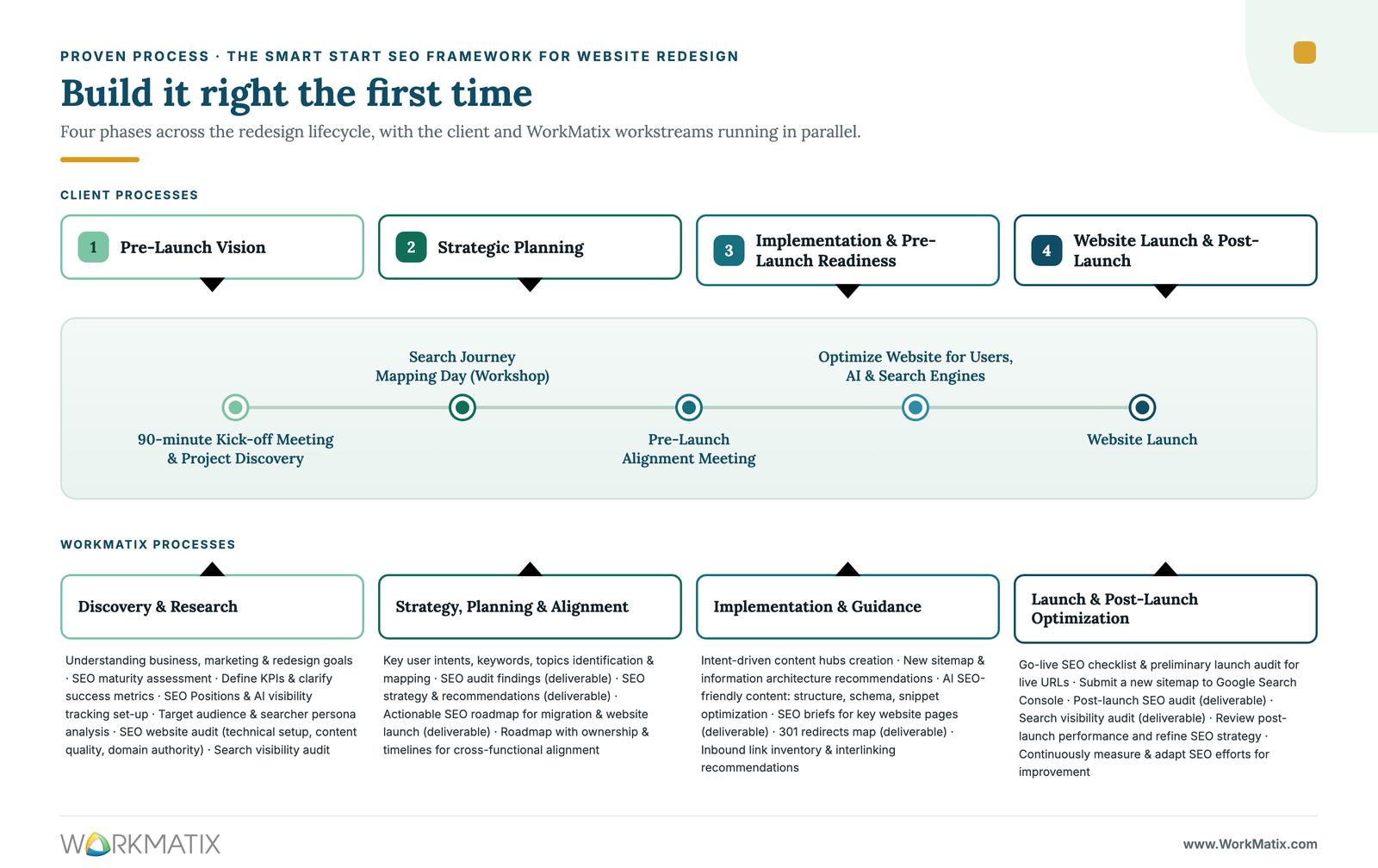
The Website Redesign SEO and AI Search Readiness Roadmap is a four-phase method for rebuilding a website without losing the search visibility the old one earned, and leaving it readable by AI systems as well as search engines. It runs discovery and research, strategy and alignment, implementation and guidance, then launch and post-launch optimization.
It exists because the decisions that determine whether a new site gets found are made weeks before launch, while architecture and URLs are still decisions rather than rebuilds. Handled at the end, the same work becomes a second project running while the traffic is already down.
Written by Julia Gordeeva, founder of WorkMatix and creator of the SEO-nergy methodology, with 18 years in B2B search marketing.
The traditional website redesign is obsolete, and most teams haven’t noticed yet.
For twenty years the playbook was stable: refresh the design, keep the keywords, map the redirects, launch. That playbook still protects you from half the risk. The other half didn’t exist three years ago.
Today your redesign is being evaluated by two very different kinds of visitors. Human buyers, who judge you in seconds. And AI systems, ChatGPT, Perplexity, Google’s AI Overviews, Gemini, that decide whether to cite you at all when your buyer asks them for a recommendation. Those systems read your site differently than Google’s ranking algorithm does, and a site can survive a migration perfectly on rankings while quietly disappearing from AI answers.
That’s why a modern redesign runs on two parallel tracks: technical SEO safeguarding (protecting the authority you’ve already earned) and AI search readiness (making sure machines can retrieve, parse, and cite you). Miss either one or the redesign underdelivers. Miss both and you’re rebuilding your pipeline from scratch.
| What a bad launch actually costs. Redesigns launched without an SEO blueprint routinely lose 30 to 70 percent of their organic traffic on launch day, and recovery takes months the project never budgeted for. The work in this roadmap is cheap by comparison, and almost all of it happens before anyone opens a design tool. |
This is the complete roadmap, phase by phase, for running a B2B redesign that does both.
The 4-phase roadmap at a glance
Phase 1 – Discovery & Research (before anything is designed).
- Inventory every live URL, its traffic, backlinks, and rankings
- Run an SEO maturity assessment and a full technical, content, and authority audit
- Establish an AI visibility baseline: test how ChatGPT, Perplexity, and Gemini describe you today
- Define KPIs and success metrics before the project starts
- Analyze your target audience and searcher personas
- Decide who’s running the SEO on this project
Phase 2 – Strategy, Planning & Alignment (the blueprint).
- Identify and map key user intents, keywords, and topics
- Design the information architecture and URL hierarchy around buyer’s search intent
- Produce the SEO audit findings and strategy recommendations
- Build the actionable SEO roadmap for migration and launch
- Assign ownership and timelines for cross-functional alignment
Phase 3 – Implementation & Guidance (the build, including pre-launch readiness).
- Create intent-driven content hubs
- Deliver the new sitemap and information architecture
- Structure content for AI: semantic hierarchy, schema, snippet optimization
- Write SEO briefs for key pages
- Compose the 301-redirect map (your developers implement it)
One row of a redirect map looks like this:
| Old URL | New URL | Type | Note |
| /services/seo-audit/ | /website-seo-ai-search-readiness-audit/ | 301 | Direct equivalent. Highest-traffic service page, verify first |
| /blog/old-keyword-post/ | /how-to-identify-and-select-your-target-keywords/ | 301 | Closest genuine match, not the homepage |
- Inventory inbound links and plan interlinking
- Pre-launch readiness: lock down staging, verify rendering, check Core Web Vitals, run the pre-launch audit
Phase 4 – Launch & Post-Launch Optimization (protecting the landing).
- Run the go-live SEO checklist and preliminary audit on live URLs
- Submit the new sitemap to Google Search Console and Bing Webmaster Tools
- Run the post-launch SEO audit and search visibility audit
- Monitor indexation, 404s, and redirect health daily for the first weeks
Glossary: the terms this roadmap uses
Generative Engine Optimization (GEO) is the practice of making your content visible and citable in AI-generated answers. Where traditional SEO earns rankings, GEO earns citations.
Answer Engine Optimization (AEO) is the practice of structuring content so answer engines can extract a clean, direct response to a specific question. GEO and AEO overlap heavily and are used together throughout this guide.
Retrieval-Augmented Generation (RAG) is the mechanism behind most AI answers. Rather than recalling facts from memory, the system retrieves live sources at answer time and generates a response from them. If your content isn’t retrievable and cleanly parseable, it cannot be cited.
Schema markup (structured data). Code, usually JSON-LD, that labels your content so machines can parse it without guessing: this is the organization, this is the service, this is the FAQ. It removes ambiguity for both search engines and AI systems.
Core Web Vitals. Google’s page-experience metrics, chiefly Largest Contentful Paint (loading), Interaction to Next Paint (responsiveness), and Cumulative Layout Shift (visual stability). They affect user experience and crawl efficiency.
What AI search readiness actually requires
AI search readiness is the set of structural conditions that let a generative system find your page, understand what it is about, extract a complete answer from it, and attribute that answer to you. It rests on three foundations, and a redesign is the cheapest moment to build all three.
• An entity foundation. The system needs to know who you are, what you do and how you relate to the subjects you write about. That comes from consistent naming, a single Organization identity, and one page that is unambiguously about you.
• Content that answers. Pages built around real questions, with the answer in the first two sentences under each heading, and claims that stay accurate when quoted out of context.
• Structured data coverage. Schema that tells a machine what each page type is, applied consistently rather than on the pages somebody remembered.
None of those is exotic. All three are difficult to retrofit, because each one is a consequence of decisions made about structure, and structure is what a redesign changes.
Phase 1: Discovery & Research
The goal of Phase 1 is to know exactly what you have before you change any of it. Every decision later in the project depends on this baseline, and it is the single phase teams most often rush.
Build the inventory. Crawl the current site and export every URL with its status code, title, meta description, canonical tag, and internal links. Then layer on performance: pull twelve months of clicks, impressions, and positions from Google Search Console, and identify which pages carry backlinks. This matters more than it sounds, because most sites earn the majority of their organic traffic from a small handful of pages, and the pages that hold backlinks are disproportionately valuable. Those are the assets a migration can destroy in an afternoon.
Assess maturity and audit the site. A structured SEO maturity assessment tells you what your organization can realistically execute. Alongside it, run the full audit: technical setup, content quality, domain authority, and current search visibility. You’re looking for problems to fix in the redesign, not to carry into it.
Establish your AI visibility baseline. This is the step almost nobody takes, and it’s the one that separates an AI-ready redesign from a conventional one. Before you change anything, document how AI systems currently describe your business. Ask ChatGPT, Perplexity, and Gemini the questions your buyers would ask: who are the leading providers in your category, what does your company do, who should I consider for this problem. Record what comes back, whether you appear, how you’re characterized, and which sources get cited. Without this baseline you’ll have no way to tell whether the redesign helped or hurt your AI visibility, because it won’t show up in a rankings report.
Define KPIs before you start. Agree with stakeholders on what success means: traffic retention thresholds, ranking retention, conversion targets, and, increasingly, AI citation retention. Leading 2026 migration guidance now treats AI-citation preservation as an explicit KPI alongside traffic, with targets like retaining at least 95% of AI citations and 90% of organic traffic within 60 days of launch. Setting these numbers up front turns a subjective post-launch argument into an objective check.
Analyze your audience and searcher personas. The redesign’s architecture should reflect how your buyers actually search and decide, which means you need that documented before anyone draws a wireframe.
Decide who’s running this. Migration SEO is a genuinely different discipline from day-to-day SEO, and staffing it wrong is a common root cause of failure. Before Phase 2 begins, settle the team question.
For a full breakdown of the four options and how to choose, see our guide on SEO Agency vs In-House for a B2B Redesign. If you’re at the earlier stage of simply deciding whether and how to approach a redesign, start with Undertaking a Website Redesign with SEO Considerations in Mind.
Use this to decide, rather than defaulting to whoever has capacity:
| Option | Best when | The risk you are taking |
| In-house SEO | Your team has run a migration before and can drop routine work for six weeks | Bandwidth. Migration SEO is a full-time job during launch weeks |
| Design or dev agency | The agency has named migration SEO in scope and can show past examples | SEO is usually a line item, not an owner. Nobody is accountable for traffic afterwards |
| Specialist consultant | The site carries real pipeline, and the redesign is high visibility | Cost, and the need to brief them properly. Cheaper than one botched migration |
Phase 2: Strategy, Planning & Alignment
Phase 2 turns your baseline into a blueprint. This is where the redesign stops being a design project and becomes a search strategy, and it’s the phase with the highest leverage, because decisions made here are expensive to reverse after the build starts.
What to say to your CEO: “The new architecture is built from how our buyers actually search, and we can show the mapping that produced it.”
Map intents, keywords, and topics. Start from what your buyers are actually trying to accomplish, then group those intents into the pages and hubs that will serve them. This is the difference between a site organized around your org chart and a site organized around your buyers’ decisions. Every page should be traceable to a real intent; if you can’t name the intent a page serves, the page probably shouldn’t exist.
Design the information architecture and URL hierarchy. Clean, logical folder structures help search engines and AI systems map your topical authority. Consistent hierarchy signals which content belongs together, and shallow, sensible depth keeps important pages reachable, a common practical guideline is keeping key pages within roughly three clicks of the homepage.
Getting this right in Phase 2 is dramatically cheaper than restructuring after launch. For a deeper treatment of architecture decisions, see Website Architecture Ideas for an SEO and
How to Avoid Ruining SEO During a Website Redesign.
Produce the strategy deliverables. Phase 2 should end with documents, not opinions: the SEO audit findings, the SEO strategy and recommendations, and the actionable SEO roadmap covering both migration and launch. These are what let you defend the plan internally and hand it to a developer without ambiguity.
Assign ownership and timelines. Fragmented ownership, especially of redirects, is a documented cause of migration failure. The roadmap should name who owns each work stream and when it happens, across marketing, design, development, and content. Cross-functional alignment isn’t a soft nicety here; it’s the mechanism that prevents the redirect map from becoming everyone’s job and therefore nobody’s.
A note on the architecture and AI. This phase is where “build it right once” pays off most. A site whose structure and content were architected around real search intent, before the build, will serve all three audiences (humans, search engines, AI systems) as one aligned system. A site where SEO was consulted after the wireframes were approved will spend years retrofitting.
Phase 3: Implementation & Guidance
Phase 3 is where the blueprint becomes a website, and where the technical and AI tracks run in parallel. The strategy work produces documents; this phase produces pages, markup, and the redirect map that protects your domain equity.
What to say to your CEO: “Every page has a brief, every redirect has a destination, and both are documented before anything ships.”
Create intent-driven content hubs. Build the hubs and clusters your Phase 2 mapping defined, so related content reinforces itself rather than competing with itself.
Deliver the new sitemap and information architecture. The IA recommendations become the actual structure, with the sitemap that tells search engines how the new site is organized.
Structure content so machines can parse it. This is the AI-readiness core of the build, and it has three parts:
- Semantic hierarchy. Use strict, meaningful H1 to H2 to H3 structure. RAG systems parse hierarchy to understand which answer belongs to which question. A page with one H1 and clean nesting is far easier to extract from than a page where headings were chosen for visual size.
- Schema markup. Deploy JSON-LD for the entities that matter: Organization, Service or Product, Article, FAQ. Schema is how you explicitly feed structured facts into the knowledge graphs AI systems draw on. It has moved from nice-to-have to migration-critical, because losing schema in a move can stop AI engines from citing you without ever showing up as a ranking drop.
- Snippet and answer optimization. Lead sections with direct, self-contained answers. Content that answers a question cleanly in two or three sentences is what gets extracted and cited.
For the deeper mechanics of why AI systems do or don’t surface a business, including crawler configuration and structured data, see Why Isn’t My Business Showing Up in ChatGPT? For page-level execution, see SEO Website Redesign for B2B: How to Create SEO-Friendly Pages.
Make crawler access a deliberate choice, not an accident. This is one of the most misunderstood areas in 2026 and getting it wrong silently costs visibility. AI providers now run different crawlers for different jobs, and one blanket rule cannot make all those decisions correctly:
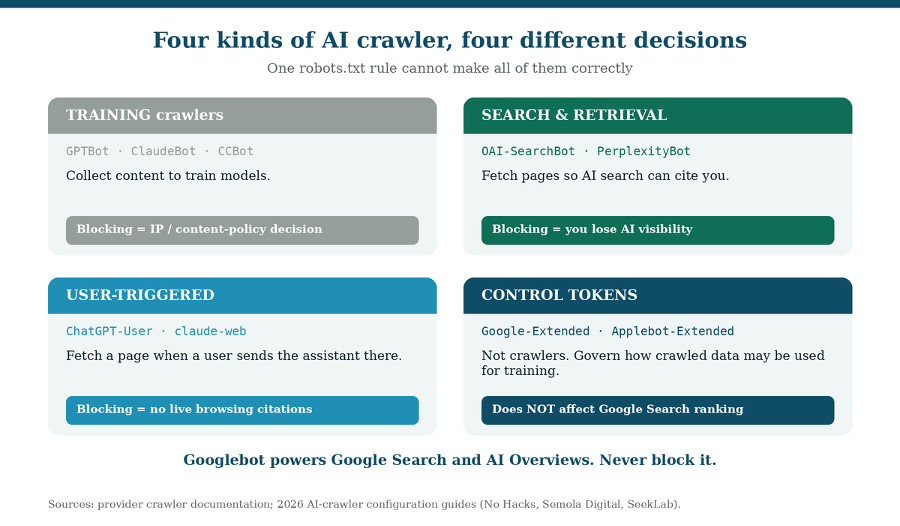
- Training crawlers (for example GPTBot, ClaudeBot, CCBot) collect content that may be used to train models. Blocking them is an intellectual-property decision.
- Search and retrieval crawlers (for example OAI-SearchBot, PerplexityBot) fetch pages so AI search can cite you. Blocking these is a visibility decision, and blocking OAI-SearchBot removes you from ChatGPT search answers.
- User-triggered fetchers (for example ChatGPT-User) retrieve a page when a user’s action sends the assistant there. Blocking these prevents live AI browsing citations.
- Control tokens are a separate category. Google-Extended is not a crawler at all; it’s a robots.txt token that governs whether Google may use your content for Gemini and Vertex generative training. Per Google’s documentation, it does not affect Google Search inclusion or ranking. Googlebot, which powers Google Search and AI Overviews, is a completely separate agent and should not be blocked.
The practical upshot for most B2B firms: you can allow the search and retrieval crawlers so you stay eligible for AI citations, while making an independent, deliberate decision about training crawlers. Two more cautions. CMS and CDN updates can silently overwrite your robots.txt, so re-verify after any platform change. And robots.txt is a set of instructions, not a lock; genuinely sensitive material needs authentication or server-side controls, not a Disallow line.
Compose the 301-redirect map. Every old URL needs a destination: ideally its direct new equivalent, otherwise the closest genuinely relevant page. No loops, no chains longer than necessary, no lazy redirects to the homepage. Prioritize the pages carrying traffic and backlinks. The map is a document; implementation belongs to your developers, and the handoff format should be clean enough that they can execute it without interpretation.
Inventory inbound links and plan interlinking. Know which external pages point where, so you can protect that equity, and plan internal links so authority flows to the pages that matter.
Pre-launch readiness (the last gate before go-live)
Before anything ships, three checks stand between you and a bad Monday:
Lock down staging. Staging environments must be blocked from indexing, and, critically, those controls must not ship to production. A noindex tag accidentally carried from staging to live is one of the most common and most damaging migration failures.
Verify rendering. Modern JavaScript frameworks can render beautifully for humans and poorly for crawlers. Test that your actual content, not just the shell, is visible to search bots and retrievable by AI systems.
Check Core Web Vitals. Optimize LCP, INP, and CLS. Beyond the user-experience benefit, efficient pages are cheaper to crawl, which matters when both search engines and AI crawlers are working through your site.
Then run the full pre-launch audit against the checklist before you flip the switch. For the complete pre-launch and launch checklist, see The B2B Website Redesign SEO Checklist.
Phase 4: Launch & Post-Launch Optimization
Phase 4 is where most of the damage happens, and where most teams stop paying attention. Launch is the beginning of the risk window, not the end of the project.
What to say to your CEO: “We set the thresholds before launch, we are monitoring daily, and we will know within a week if something needs intervention.”
Run the go-live sequence and preliminary audit. Execute in a deliberate order: DNS, redirects, robots.txt, sitemap submission, indexing requests. Then immediately spot-check your highest-traffic redirects on the live site rather than assuming they behaved.
Submit the new sitemap to Google Search Console and Bing Webmaster Tools so both begin re-crawling the new structure promptly.
Run the post-launch SEO audit and search visibility audit as formal deliverables, not informal glances. You want a documented picture of what the new site looks like to search engines in its first days.
Monitor daily, with thresholds set in advance. Track organic traffic, rankings for your priority keywords, index coverage, new 404s, and redirect errors. Set alerts rather than relying on someone remembering to check. Know your numbers going in: a well-executed migration typically shows only a modest temporary dip, while drops beyond roughly 30% signal implementation errors that need immediate troubleshooting, and a severe drop in the first 48 hours may warrant rolling back while you diagnose.
Set your thresholds before launch, so nobody has to argue about what counts as a problem while it is happening. A workable starting point:
| Signal | Healthy | Watch | Intervene |
| Organic traffic, week 1 | Down under 15% | Down 15 to 30% | Down over 30% |
| Recovery to baseline | 4 to 6 weeks | 8 to 12 weeks | No recovery by week 12 |
| Priority keyword rankings | Within 3 positions | 4 to 10 positions | Outside the top 20 |
| 404s from old URLs | Near zero | Under 5% of URLs | Over 5% of URLs |
| AI citation retention | Same or better | Some prompts lost | Absent from prompts you held |
Audit AI citation retention. Return to the baseline you captured in Phase 1 and re-run the same prompts across ChatGPT, Perplexity, and Gemini. Are you still cited? Has your description changed? Did competitors replace you? Because AI systems re-crawl and re-index on their own timelines, expect this to lag your search recovery, which is exactly why you need the baseline to compare against. For the failure modes to watch for and how to avoid them, see How to Avoid Ruining SEO During a Website Redesign.
Review, refine, repeat. Post-launch is where a redesign either compounds or decays. Feed what you learn back into the strategy and keep adapting.
How to score where you stand before you start
Readiness is easier to argue about than to measure, so measure it. Four questions produce a usable picture in an afternoon.
• Can AI crawlers reach your pages? Check that GPTBot, OAI-SearchBot, ClaudeBot and PerplexityBot are not blocked, and that nothing returns a different response to them than to a browser.
• Does every page carry the right schema, with an Organization identity behind it? A page with no schema type emits nothing at all in some setups, which is easy to miss.
• Does the first paragraph under each heading answer that heading on its own? Read three at random with the surrounding text covered.
• Are you cited today? Ask the assistants your buyers use the questions your content answers, and record who gets named. That is your baseline, and it takes twenty minutes.
Do this before the redesign starts, because it is also the comparison you will want afterwards.
What “done right” looks like
A redesign that succeeds on both tracks has a specific signature. Traffic dips modestly and recovers quickly rather than falling off a cliff. Your priority pages keep their rankings because their authority was mapped, not abandoned. Your schema survived the move, so AI engines still recognize and cite you. And your team can explain, page by page, why each one exists and which buyer intent it serves.
That last point is the quiet one. A redesign can be technically flawless and still fail commercially, because nobody architected the content around how buyers actually search before the build began. The technical track protects what you had. The strategy track determines whether the new site is worth having.
As one marketing leader put it while planning exactly this kind of project: “I need someone who not only does the work but also shows us how to do it.” That’s the instinct worth protecting. A redesign is a rare chance to build the capability alongside the website. This roadmap is the public version of the Smart Start SEO Framework, the methodology WorkMatix uses to guide B2B redesigns.
WorkMatix produces the strategy and the documents, the audits, the roadmap, the SEO briefs, the 301-redirect map, the launch checklists, and guides your team through applying them, while your developers handle implementation. The goal is a site that’s built right once, for humans, search engines, and AI systems together.
Questions People Ask
What is an SEO website redesign roadmap?
It’s a phase-by-phase plan for redesigning a website without losing search visibility, covering discovery and auditing, strategy and architecture, implementation and pre-launch readiness, and launch with post-launch monitoring. A modern roadmap runs two parallel tracks: protecting existing SEO equity and building AI search readiness.
In what order should you do SEO work during a redesign?
Baseline first (inventory, audits, AI visibility benchmark, KPIs), then strategy and architecture, then implementation with schema and the redirect map, then pre-launch readiness checks, then launch and continuous post-launch monitoring. Doing these out of order, for example optimizing content before the architecture is settled, is a common and expensive mistake.
How do you make a website redesign AI-search ready?
Establish an AI visibility baseline before you start, architect content around real search intent, use strict semantic heading hierarchy, deploy schema markup and preserve it through the migration, make crawler access a deliberate choice (allowing search and retrieval crawlers), and audit AI citation retention after launch alongside traditional rankings.
Does blocking AI crawlers hurt my Google rankings?
Blocking Google-Extended, which is a robots.txt control token governing Gemini and Vertex training, does not affect Google Search inclusion or ranking. Googlebot is a separate agent that powers Google Search and AI Overviews and should not be blocked. Blocking OpenAI’s OAI-SearchBot, however, removes you from ChatGPT search answers, so training and visibility decisions should be made independently.
How long should you monitor a site after a redesign launch?
Plan for daily monitoring in the first weeks and structured review over roughly the first quarter. Set alert thresholds in advance so you catch a problem in hours rather than discovering it in a monthly report.
What’s the difference between SEO and AEO for a redesign?
SEO focuses on ranking in search engine results. AEO (Answer Engine Optimization) focuses on being retrieved and cited in AI-generated answers, which weighs crawler access, structured data, semantic clarity, and third-party corroboration more heavily. A modern redesign has to serve both, plus the humans who’ll actually read the site.
What is AI search readiness, and how is it different from SEO?
AI search readiness is whether a generative system can find your page, understand it, lift a complete answer from it and name you as the source. It overlaps with SEO on crawlability, structure and clarity, and differs on the finish line: SEO asks whether you rank, readiness asks whether you get quoted. Most of the work serves both, which is why it belongs in the same project rather than a separate one.
How long does it take to start appearing in AI search results?
Longer than a ranking change and less predictably. Systems refresh their sources on their own schedules, and citation depends on whether your page is the clearest answer available rather than on a position you can watch move. Track it with a baseline before the work and repeat checks afterwards, rather than expecting a date.
Where do you want to start?
Find Your Situation
Live Group SEO Trainings for Business
Owners & Marketing Teams
Website Redesign SEO Consulting
Customized SEO Coaching Program
DIY SEO Templates & Workbooks
“Redesign your B2B website without losing your rankings. sets the new site up to get found by humans, search engines, and AI Systems.”
SEO-nergy Methodology Toolkit
Website Redesign SEO Toolkit for AI Search
A complete, fill-in-the-blanks system that takes you from “we need to redesign” to a launched, measured site, without guessing.
Every workbook feeds the next, so you are never staring at a blank page. Built on the proprietary SEO-nergy methodology: optimizing for how people search, how your site is built, how search engines and AI work, and how it all connects.
– Most Popular SEO + AI Search Resources –
-
DIY SEO Toolkit vs 1:1 SEO Coaching: Which SEO-nergy Path Fits You?
Four ways to use the same SEO-nergy methodology, from fully self-directed to fully guided. A practical guide to picking the one that fits your budget, your time, and how you…