
What is search intent?
Search intent is the underlying goal a person is trying to accomplish when they search: to understand something, to compare options, to take an action, or to reach a specific destination. Search is active and goal-driven, not passive browsing.
Why search intent matters in SEO?
Google’s job is to match content to the user’s underlying goal as accurately as possible; when it fails, users bounce and rankings suffer. AI answers work the same way, they surface and cite the content that best matches the intent. So intent is the foundation of both SEO and GEO.
Why search intent matters more than search volume?
Search volume tells you how many people search a term. Intent tells you whether any of them want what you sell.
Chasing volume without intent is how sites end up with traffic that never converts. A term with 8,000 monthly searches and purely informational intent will not produce customers; a term with 90 searches and clear buying intent might produce several.
You need both numbers, and in that order. Search intent decides whether a keyword is worth targeting at all. Search volume decides which of the worthwhile ones to build first.
How Consumers Think When They Search Online
Let’s start with a simple truth.
The internet is no longer just a place to browse.
It’s an information acquisition system.
Almost everything people do online, scrolling, searching, clicking, comparing, is about:
- finding information
- evaluating it
- deciding whether it helps them move forward
This shift has massive implications for SEO and GEO marketing.
Search Is Active and Goal-Driven
Here’s the key mindset shift you need to make as a marketer:
Search is not passive.
People don’t “consume content.” They use content to accomplish something.
When someone searches on Google or an AI platform:
- they have a goal
- they are actively trying to get somewhere
- they are evaluating everything they see through that lens
Every page they land on is silently asked one question:
“Can you help me achieve what I came here to do?”
How Users Scan and Evaluate Pages
People don’t read websites the way they read books.
They scan with intent.
Depending on their goal, they will:
- skim headlines
- jump to sections
- ignore large parts of the page
- focus only on what feels relevant
Research consistently shows:
- information aligned with the user’s goal gets attention
- irrelevant or distracting information gets ignored
This is why “more content” does not automatically mean “better content.”
Website Effectiveness Is Relative, Not Absolute
This part is crucial and often misunderstood.
A webpage has no objective effectiveness.
A page is:
- effective for a specific goal
- ineffective for a different goal
The same page can:
- convert one user
- frustrate another
As a marketer, you must ask this for every page:
“What task is this page designed to help the user complete?”
If you can’t answer that clearly, you can’t measure performance meaningfully.
Why Users Get Frustrated Online
We’ve all felt this.
You click a result expecting one thing and get something else.
That frustration usually comes from:
- misaligned copy
- unclear structure
- content that doesn’t match the user’s goal
In other words: the page failed to deliver on the promise implied by the search.
This misalignment is one of the biggest silent killers of SEO performance.
Jobs-To-Be-Done-Driven Goals → Intent → Search Query
Let’s connect the dots.
User Goals Come First
A goal is the desired outcome:
- learn something
- fix something
- choose something
- buy something
Search Intent Comes Second
Search intent is how that goal gets translated into:
- a keyword
- a search query
- an AI prompt
Intent answers the question:
“What does this user actually want to do right now?”
Search Queries/Keywords Are Just the Expression
Keywords are not the goal. They are the language users use to move toward the goal. The SEO-nergy methodology treats intent as the master variable, so every page at WorkMatix is specified with one stage and one job before a word is written.
Why Search Engines & AI Systems Care So Much About Intent
Google’s main job is simple:
Match content to the user’s underlying goal as accurately as possible.
If it fails:
- users bounce
- engagement drops
- rankings suffer
Classic example:
- Search: “how to tie a tie”
- Bad result: a history of neckties
- Good result: a step-by-step video or guide
Google watches how users react and learns quickly.
What This Means for SEO & GEO
1. Content Must Match the Goal
If the user wants to do something, give them:
- steps
- visuals
- tools
If they want to compare, give them:
- side-by-side comparisons
- pros and cons
- decision frameworks
2. UX Is Part of SEO
When intent is met:
- users stay longer
- bounce rates drop
- trust increases
These are all positive signals.
3. SERPs Reflect Intent
Search results change based on the goal:
- shopping intent → product carousels
- local intent → map packs
- informational intent → featured snippets
The SERP is a mirror of user intent, not just an algorithmic choice.
The Cause-and-Effect Relationship
Here’s the simplest way to remember it:
- User goal = the cause
- Search intent = the effect
- Search query = the expression
- Search results = the response to the query
Search engines classify intent so they can deliver content that helps users reach their goal faster.
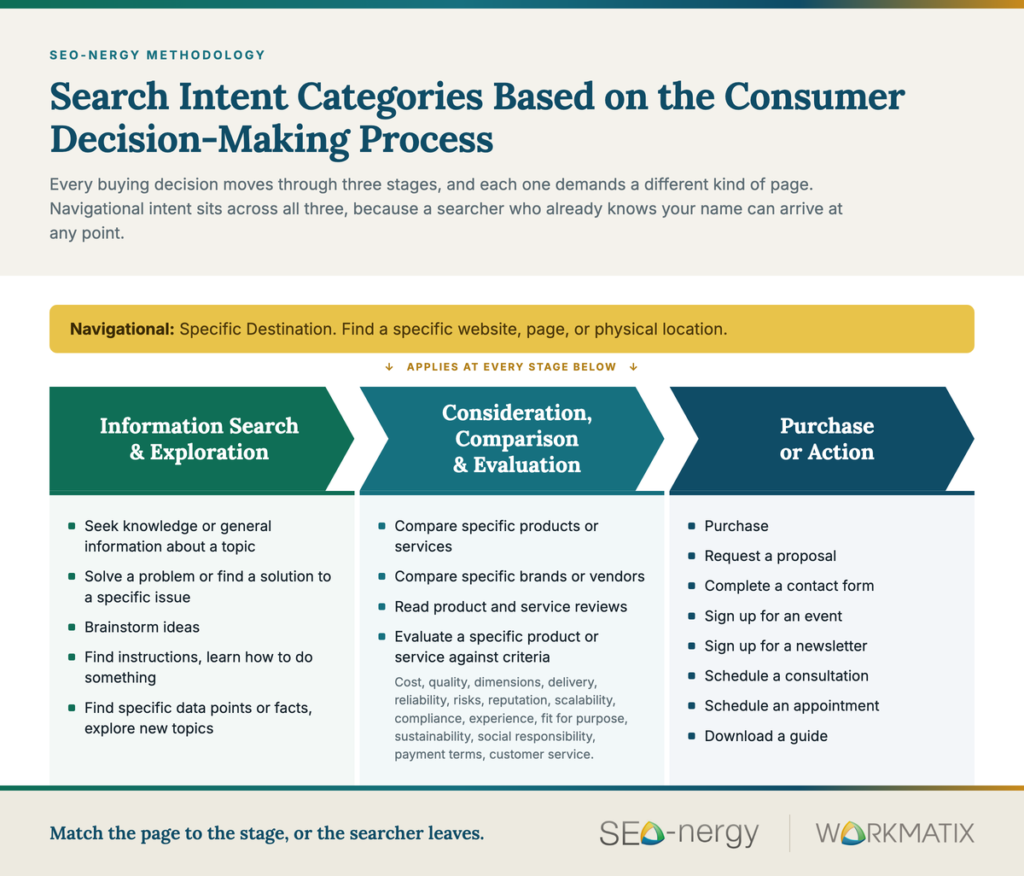
The 4 Main Search Intent Types Based on Consumer Decision-Making Process
Think of search intent as progressive clarity.
Each stage answers a different question in the user’s mind.
“When I’m in this situation, I want to do this thing ->so I can get this outcome” frame initiates the decision-making process.
This one isn’t a stage, it’s the foundation.
Jobs-To-Be-Done framework describes:
- the situation
- the motivation
- the desired outcome
Jobs-To-Be-Done-Driven Search Query Examples
- “best CRM for freelancers to track clients”
- “quiet coworking space near me to focus”
- “SEO checklist for website redesign to avoid traffic loss”
- “fast healthy dinner ideas for busy parents”
All other search intents are expressions of this job at different moments. The job stays constant. The search query wording evolves.
1. Informational Intent
“Help me understand what’s going on”
This is where most journeys start.
The user:
- knows something isn’t right or something is possible
- doesn’t yet know what to do
- is gathering context, language, and mental models
What’s happening mentally
“I need to understand this before I can decide anything.”
Typical query patterns
- how, what, why
- guide, tutorial, examples, tips
Examples
- “what is search intent in SEO”
- “how website redesign affects SEO”
- “why my website traffic dropped”
- “examples of good landing pages”
Your role as a marketer
- Educate without selling
- Help them name the problem correctly
- Reduce confusion and anxiety
This is top-of-funnel, but it sets everything else up.
2. Comparative & Evaluative Intent
“Help me choose the right option”
Now the user understands the problem and is actively weighing options.
They’re comparing:
- approaches
- providers
- trade-offs
“I know what I need. Now I need to pick the best way to do it.”
- best, top, vs, review, comparison
- alternatives
- “SEO consultant vs SEO agency”
- “best website redesign SEO checklist”
- “Ahrefs vs Semrush for SEO tracking”
- “Webflow vs WordPress for SEO”
- Clarify differences
- Frame decision criteria
- Make the choice feel safe and justified
This is mid-funnel, where preference is formed.
3. Transactional Intent
“Let me do the thing”
At this stage, the user is ready to act.
They’ve:
- decided what they want
- chosen an approach
- are now looking for execution
“I’m ready. I just need to complete the action.”
- buy, book, hire, sign up, download, quote
- “hire SEO consultant for website redesign”
- “book SEO strategy session”
- “download keyword research template”
- “SEO coaching pricing Minneapolis mn”
- Remove friction
- Be clear, fast, and reassuring
- Make the next step obvious
This is bottom-of-funnel and conversion-focused.
4. Navigational / Locational Intent
“Take me exactly where I want to go”
Now the user knows where they want to go online or offline. Search becomes a shortcut.
“I already decided. Just take me there.”
Navigational Examples (Digital Destination)
- “Ahrefs login”
- “HubSpot academy”
Locational Examples (Physical or Local Service)
- “SEO consultant near me”
- “marketing workshop Minneapolis”
- “coffee shop open now”
- Be easy to find
- Be consistent with branding
- Remove any barriers to access
This is often the final step before action.
Turning intent into a content plan
Group your keywords by intent before you group them by topic. Topic tells you which page a term belongs near; intent tells you whether it belongs on that page at all.
Then assign one intent per page. If two pages target the same intent for the same topic, they compete, split the signal, and neither ranks. That is the most common self-inflicted problem in content SEO, and it is invisible until you map it.
Finally, let the intent choose the format. Informational terms need structure and completeness. Commercial terms need an honest comparison. Transactional terms need price, terms and a way to act without another click.
How to identify keyword intent
Keyword intent is identified by matching the query’s modifier to a stage in the buyer’s search journey. Words like how, what and guide mark Stage 1 exploration. Words like vs, best and reviews mark Stage 2 comparison. Words like buy, book and request a quote mark Stage 3 decision. A brand name in the query marks Brand Authority, which runs across all three stages. When the language is ambiguous, the page-one results settle it, because they show what Google already concluded the query means.
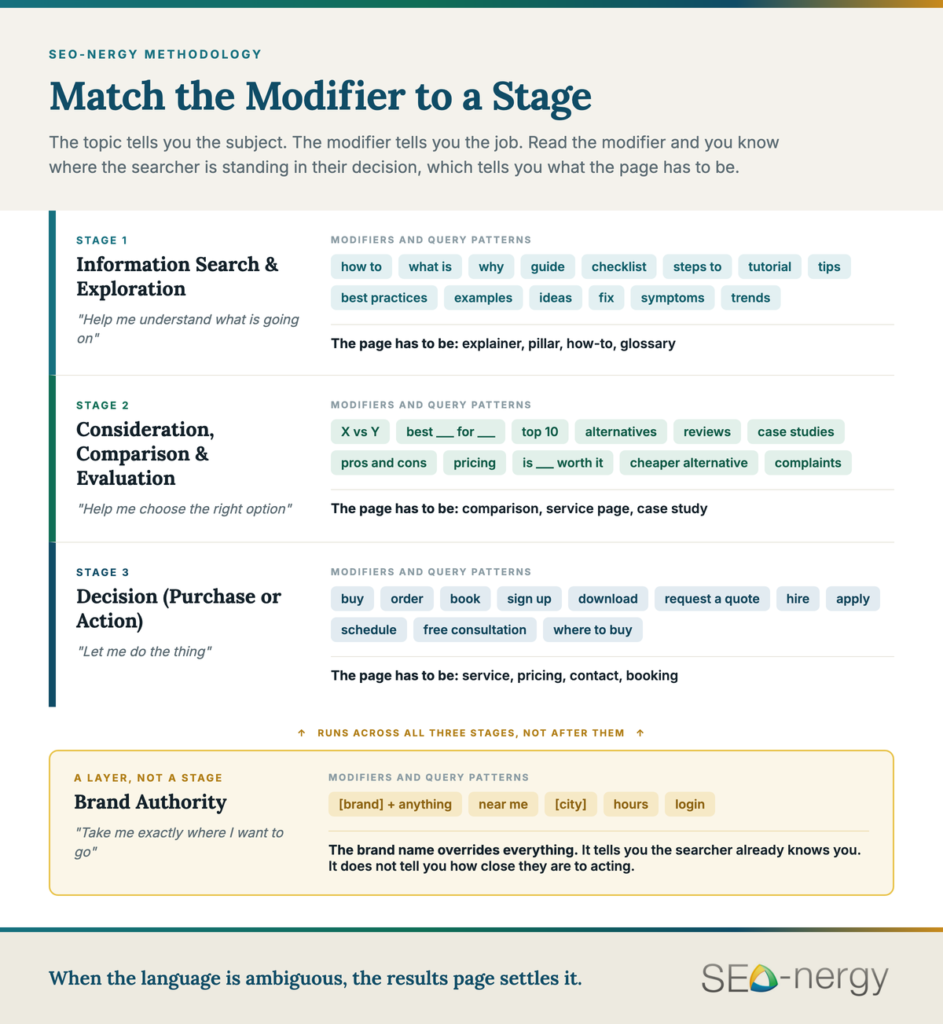
Say the stage’s question out loud against the query. Each stage has one internal question, and it is a fast test. If “help me choose the right option” does not describe what the searcher wants, Stage 2 is the wrong stage, whatever the modifier looked like.
Check the brand name first, because it overrides everything. Brand Authority is a layer rather than a stage, so a branded query can appear at any point in the journey. Someone searching “[your brand] vs [competitor]” is comparing, and someone searching “[your brand] pricing” is deciding. The brand name tells you the person already knows you. It does not tell you how close they are to acting.
When a keyword has no modifier at all, read the noun. “SEO agency Minneapolis” carries no verb and no qualifier, yet a category noun plus a location is a person shortlisting vendors, which puts it in Stage 2 heading into Stage 3.
When the language and the results page disagree, it is tricky. Google has already decided what a query means, and page one is that decision made visible. Language analysis tells you what the searcher meant. The SERP tells you what Google concluded other searchers meant, and you are competing inside Google’s conclusion.
One note on prompts. AI prompts carry the same stage markers as queries, just in sentence form rather than keyword form. “What are the tradeoffs between hiring in-house and using an agency for our redesign” is a Stage 2 query wearing a longer coat. The modifier vocabulary changes; the stage does not.
Frequently Asked Questions
What are the 3 C’s of search intent?
Content type, content format, and content angle, the three things the top-ranking results reveal about what searchers expect for a query.
What are the 4 main types of search intent?
The 4 main formats are (1) Informational, (2) comparative & evaluative, (3) transactional, (4) navigational/locational. This classification is based on the consumer cognitive decision-making patterns.
What is an example of search intent modifier?
Here are the examples of a search intent modifier: “How to” signals informational intent; “buy” or “book” signals transactional; “best” or “vs” signals comparative. The wording reveals the goal.
Key Takeaways
- Search intent reflects where someone is in their decision process
- Informational intent builds understanding
- Comparative intent builds preference
- Transactional intent drives action
- Navigational intent removes friction
- Jobs-To-Be-Done explains why the search exists at all
- Online search is active, not passive
- Users evaluate pages based on how well they help them achieve a goal
- Website effectiveness is always goal-dependent
- Misalignment between intent and content causes frustration and poor SEO results
- User goals drive search intent, and intent drives rankings
Great SEO starts with understanding what the user is trying to accomplish.
Read next: The Ultimate SEO Guide to Discover Keywords and Topics in the AI Era and AI SEO Content Optimization Roadmap. Google’s guidance on creating helpful content asks whether a page satisfies the reason someone searched, which is intent stated as a quality question.