
A practical look at when paying for SEO guidance pays off, and when your money is better kept, for consultants, agency owners, and service-based businesses.
You’ve read the blog posts. You’ve watched the videos. Maybe you’ve asked ChatGPT to explain keyword research three different ways. You understand SEO, at least in theory.
Then you sit down to apply it to your own website, and nothing moves.
That gap, between knowing and doing, is the real subject of this article. Because the question “is SEO coaching worth it?” isn’t really about information. Almost everything a coach knows exists for free somewhere. The honest question is whether paying someone closes the distance between understanding SEO and actually shipping it, faster than you’d close it alone. And whether that speed is worth the price.
Let’s answer that with data, not sales copy, including the cases where the answer is a clear no.
Key takeaways
- The median online course completion rate is about 12.6%, and studies find a majority of enrollees never meaningfully engage with the material. The problem usually isn’t the information. It’s finishing.
- Making real SEO progress takes an estimated 10 to 25 hours a week, according to multiple 2026 industry analyses, with results often lagging 6 to 18 months. For anyone who bills by the hour, that time is the true cost, not the fee.
- Coaching prices range widely, from roughly $150 to $400 an hour for sessions, with structured programs running into the low thousands. The number that matters is not the fee but the fee plus your billable hours.
- What you’re actually buying is compression and accountability, not secret facts. Formats with feedback and cohort structure complete at dramatically higher rates than solo study.
- Coaching is genuinely not for everyone. If you have time, curiosity, and discipline, a structured DIY approach can serve you better. The deciding factors are your time, your learning style, and your honest completion odds.
Why do I feel like I understand SEO but still not do it?
Because understanding and finishing are different skills, and the data on self-directed learning is brutal about the gap.
Across large studies of online courses, the median completion rate sits around 12.6%, with rates ranging from under 1% to just over 52%. It gets starker: analyses of online-course engagement have found that a majority of people who register never meaningfully engage with the material, in some studies more than half never access the course content at all. These aren’t lazy people. They’re motivated professionals who paid, showed up with real goals, and still didn’t finish.
The reason matters for your decision. Research on why people abandon self-paced learning points repeatedly to the same culprits: lack of time, and isolation. As one analysis put it plainly, when you learn alone, you fail alone. There’s no one expecting you next week, no one to ask when you get stuck, nothing external holding the work in place against the pull of everything else on your plate.
And the flip side is measurable. When researchers compared the same material with and without personalized feedback, completion jumped from 29.4% without feedback to 40.9% with it, they concluded the feedback itself was the main driver. Cohort and accountability structures push completion higher still.
Here’s the honest translation. If you’ve ever thought “I know roughly what to do, I just can’t seem to actually do it,” you are not undisciplined. You’re experiencing the single most documented failure mode in self-directed learning. That gap is exactly what coaching, or any structured, accountable format, is built to close.
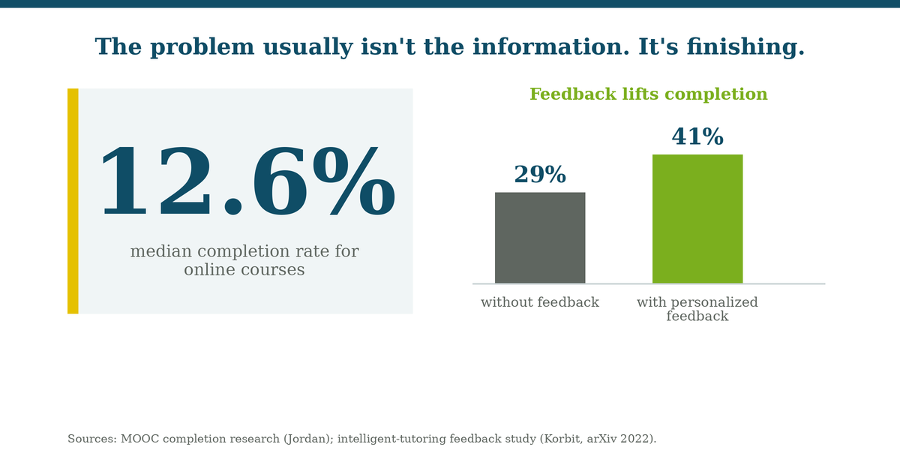
Completion is low alone and rises with feedback and accountability.
What does SEO actually cost you to learn yourself?
More than “free.” The real price of DIY SEO is time, and for a consultant or agency owner, time is inventory. The 2026 industry consensus is remarkably consistent on this. Multiple independent analysts estimate that seeing meaningful SEO progress takes serious weekly hours:
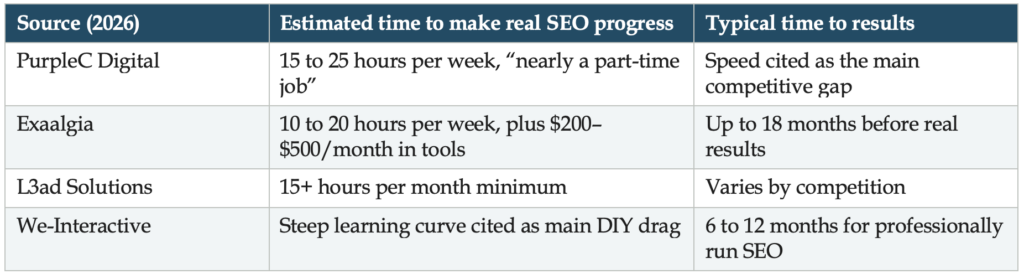
Notice the pattern. Nobody credible says DIY SEO is quick, and the sources converge on a steep learning curve plus a long lag before results appear. As one 2026 guide put it, the cost of a business owner’s time almost always outweighs the cost of a professional retainer.
Now do the math for your own situation. If your billable rate is, say, $100 an hour and you spend even 10 hours figuring out what you could have been shown in two, that’s $800 of your time to save a few hundred dollars. The fee was never the real number. There’s also a moving target underneath all this. Widely cited industry figures put the share of Google searches that end without a click to any website at around 60%, and AI search is reshaping how people find answers at all. The rules you learn from a video made 18 months ago may already be out of date, which quietly extends the DIY timeline further. (More on that shift in a moment.)
How much does SEO coaching cost?
Session-based coaching typically runs $150 to $400 an hour, and structured programs run higher because they bundle a methodology, templates, and ongoing support. For market context, here’s roughly where the common options land in 2026:
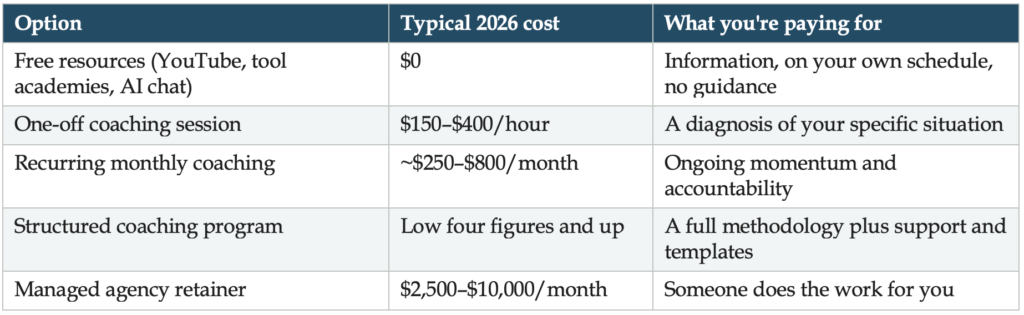
The entry point for coaching is genuinely accessible; a single session won’t break a consultant’s budget. But the useful way to read this table isn’t “cheapest wins.” It’s “which cost structure matches how I actually work and learn.” A busy owner who’ll never finish a free course may get more real value from one focused paid session than from 40 free hours that end unfinished.
What actually happens in a coaching session?
A good session looks less like a lecture and more like a working diagnosis of your specific site. That’s the whole point, and it’s the thing free content structurally cannot do.
The shape is usually: you bring a real, specific problem, a stalled content strategy, a Search Console report you can’t read, a content cluster you don’t know how to structure. The coach gives you situation-specific answers: what to do next, why it matters for your context, and how you’ll know it’s working. You leave with a plan you can act on, not a folder of theory.
This connects to a shift worth holding onto as search changes: you’re now building for three audiences at once, human visitors, traditional search engines, and AI systems like ChatGPT, Perplexity, and Google’s AI Overviews. A generic tutorial optimizes for a general case. Situation-specific guidance is what tells you how your pages should be structured so all three can find, understand, and cite them. That one-aligned-system view, where content, structure, and search behavior reinforce each other instead of being separate chores, is hard to get from scattered free content precisely because the pieces never connect.
The catch nobody selling coaching wants to admit
You might not need one.
If you’re comfortable with technology, you genuinely enjoy learning new systems, and you have the time and discipline to work through material alone, you can absolutely learn SEO without a coach. The free tool academies (Semrush, Ahrefs, HubSpot) are well made. A structured DIY course or toolkit compresses the learning curve further. Nobody’s guidance is magic; it’s just faster and more accountable.
Coaching earns its cost in specific, honest situations:
- You’re too busy to research what’s working now. Not what worked three years ago, what works in the current AI-search landscape, which shifts constantly.
- You want to compress months of trial and error into a fraction of the time by having someone point at what matters for your site.
- You learn better through dialogue. Being asked the right diagnostic questions surfaces what you didn’t know you didn’t know.
- You know your own completion odds. If free courses tend to die in your downloads folder, the accountability is the product.
Before hiring anyone, coach, consultant, or agency, it’s worth being honest with yourself: What are your real business goals, and how does SEO serve them? Is your problem technical, or a lack of strategic direction? What specifically do you need help with? What’s your budget, and what’s your time worth? Sometimes the right answer is a workshop. Sometimes it’s a DIY toolkit. Sometimes it’s coaching. Sometimes it’s a different provider entirely.
So, is SEO coaching worth it?
It’s worth it when the value of your time is high, your patience for trial and error is low, and you need momentum more than you need information. For a consultant or agency owner whose own website is permanently last on the list, behind every client deliverable, that’s often the exact situation.
It’s not worth it when you have time, curiosity, and the discipline to finish a system alone. In that case, keep your money and use free resources or a DIY toolkit.
One consultant described the underlying frustration this way: “I’ve got a good content marketing groove, regular blogs, podcasts, videos, but I have no idea if they’re actually reaching my target audience.” That’s the real problem coaching addresses. Not “I don’t know what a blog is,” but “I’m doing the work and can’t tell if any of it is landing.” If that’s your situation, guidance that connects your effort to actual search behavior is worth more than another free tutorial on how to write a blog post you’re already writing. WorkMatix offers coaching along these lines, from single sessions to a structured, methodology-based program, but the point of this article isn’t which provider you pick. It’s that you should pick based on your time, your learning style, and your honest completion odds, not on whichever option sounds most impressive.
Frequently asked questions
How much does SEO coaching cost?
Session-based coaching typically runs $150 to $400 an hour. Structured programs cost more because they bundle a methodology, templates, and ongoing support. Managed agency retainers, a different thing entirely, commonly run $2,500 to $10,000 a month in 2026.
Is SEO coaching worth it compared to free YouTube and ChatGPT?
Free resources give you information; coaching gives you a diagnosis of your specific site and the accountability to act on it. Since the median online course completion rate is only about 12.6%, the deciding factor is usually whether you’ll actually finish alone, not whether the information is available.
How long does it take to learn SEO yourself?
Multiple 2026 analyses estimate 10 to 25 hours a week to make meaningful progress, with results often lagging 6 to 18 months. The learning curve is steep, and AI search is changing the rules faster than older tutorials can keep up.
What happens in an SEO coaching session?
You bring a specific problem, the coach gives situation-specific guidance based on your actual website, and you leave with an actionable plan. Reputable coaches screen your site beforehand so the session is tailored rather than generic.
Can I use what I learn with my own clients?
Often yes, and for consultants that’s a major reason to choose coaching or a methodology-based program over a generic course: you gain a repeatable framework you can apply across client work, not just a one-time fix for your own site.
Weighing coaching against a workshop or a DIY SEO toolkit? The right answer depends on your time, budget, and how you learn. If you want to see how 1:1 SEO coaching works and what it covers, or explore the SEO workshop offerings in Minneapolis.