
A practical guide for marketing leaders, business owners, and design agency teams trying to decide where to put their SEO budget
You’ve decided you need to do something about SEO.
Maybe your CEO is asking why pipeline is flat. Maybe you’re planning a website redesign, and you’ve heard horror stories about traffic disappearing overnight. Maybe ChatGPT has started answering questions your website used to get traffic for, and you’re not sure what to do about it.
Whatever the trigger, you’ve moved past the “should I invest in SEO?” question. You’re on the next one: how should I invest in SEO?
The three most common options: SEO coaching, SEO workshops, and SEO consulting sound similar from the outside. They all promise SEO results. They all involve working with someone who knows more than you do. And they all cost real money.
But they’re not interchangeable. Each one solves a different kind of problem, suits a different kind of buyer, and produces a different kind of outcome.
Pick the wrong one and you’ll either overspend on something you don’t need, or underspend on something that won’t get you across the finish line. Pick the right one and the investment compounds for years. Here’s how to tell them apart.
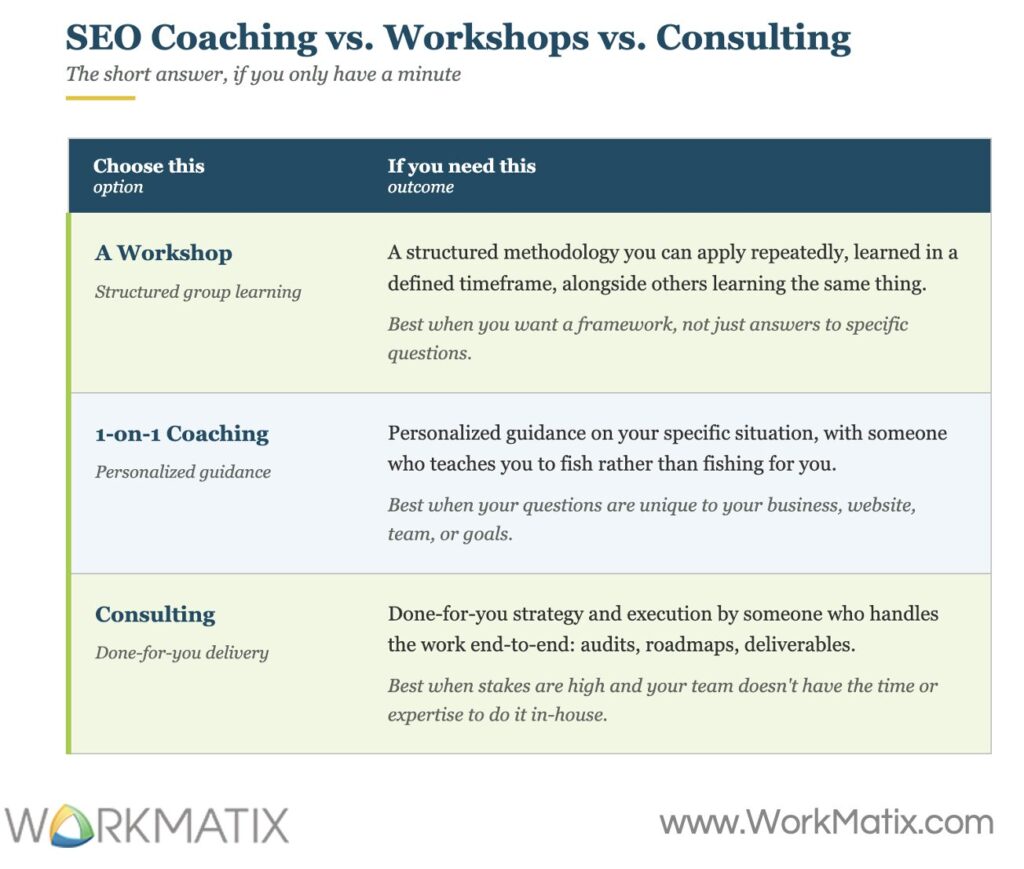
Each of these has its place. The right answer depends on how much you want to learn, how much time you have, and how much of the work you want to do yourself.
Now let’s get into the differences.
SEO Workshops: Structured Learning, Defined Timeframe
A workshop is the right starting point when you want to learn a system, not just answers to your specific questions.
The format works because it’s structured. There’s a defined curriculum, a clear beginning and end, exercises that move you from theory to practice, and (in good workshops) templates you walk away with. You leave with a methodology you can apply to your business repeatedly, long after the session ends.
Workshops are particularly powerful when you’re learning alongside others in similar situations. A small business owner watching another small business owner ask a question you didn’t know you had, that’s where a lot of the value happens. Peer learning compounds.
When to Choose a SEO Workshop
- You want a structured framework, not just a list of tactics
- You’re a beginner-to-intermediate marketer, business owner, or design agency team member
- You learn well in a defined timeframe with clear milestones
- You value learning alongside peers in similar situations
- You want repeatable templates you can apply on your own afterward
- You’re not yet ready to commit to ongoing 1-on-1 work
When a Workshop is Not the Right Fit
- You need answers to highly specific questions about your unique situation today
- You need someone to actually do the work, not teach you how to do it
- You don’t have the bandwidth to apply what you learn between sessions
- Your situation is too sensitive or proprietary to discuss in a group setting
What You Typically Pay
Workshop pricing varies widely. Short single-session workshops (60 minutes to half a day) typically run from $50 to a few hundred dollars per attendee. Multi-session structured programs, like the Intent-to-Roadmap Blueprint Group Cohort at WorkMatix, are higher investments because they include multiple sessions, templates, peer learning, and follow-up support.
1-on-1 SEO Coaching: Personalized Guidance for Your Situation
Coaching is the right choice when your questions are specific to you: your business, your website, your team, your goals. The defining quality of coaching is that it’s tailored. A good coach doesn’t deliver a curriculum to you; they listen to your situation, ask diagnostic questions, and help you figure out what to do next based on your specific context. The conversation goes wherever it needs to go.
Coaching is also flexible in pace. You can meet weekly during an intensive project, monthly during a slower stretch, or pause when you don’t need it. The structure adapts to your reality, not the other way around.
What coaching is not (and this is where people get confused) is “someone doing the work for me.” A coach helps you figure out what to do and gives you the framework to do it. They don’t ghostwrite your blog posts, audit your technical SEO end-to-end, or run your campaigns. That’s consulting.
When to Choose 1-on-1 SEO Coaching
- You have specific, situation-dependent questions that don’t fit a standardized curriculum
- You want personalized guidance on your real website, your real team, your real challenges
- You learn well through dialogue and being asked diagnostic questions
- You want flexibility in pacing — sometimes weekly, sometimes monthly, sometimes paused
- You want to build your own SEO expertise long-term, not just outsource it forever
- You’ve already done some learning (a workshop, online courses, books) and need help applying it to your situation
When Coaching is Not the Right Fit
- You don’t have time to do the implementation work yourself
- You need a structured curriculum with milestones rather than open-ended dialogue
- You don’t yet have enough baseline knowledge to ask the right questions
- You need a deliverable, a finished audit, a finished site map, a finished content calendar, not advice on how to make one yourself.
Coaching is usually billed by the session or by retainer. Hourly rates from experienced coaches typically range from $200 to $500. Retainer packages (e.g., 4 hours/month) are usually discounted from the hourly rate. WorkMatix coaching runs at $249/hour for SEO and $350/hour for SEO strategy, with custom retainers available.
SEO Consulting: Done-For-You Strategy and Execution
Consulting is the right choice when you need someone to handle the work, not just guide you through it.
The defining quality of consulting is delivery. You hire a consultant to produce specific outputs: a technical SEO audit, a competitor analysis, a content strategy, a redesign roadmap, an implementation plan. They do the work, hand it over, and (often) help you implement.
Consulting tends to be the highest-cost option per engagement, because you’re paying for someone else’s hours doing actual work. But for the right situation, it’s the most efficient route from problem to solution. If you don’t have time to learn SEO yourself, and your situation is high-stakes (a major redesign, a critical migration, a complex multi-site architecture), consulting often pays for itself by preventing expensive mistakes.
The trade-off: when the engagement ends, the expertise often leaves with the consultant. Unless they intentionally transfer knowledge to your team, you’ll be back in the same position the next time something changes.
When to Choose SEO Consulting
- You need a specific deliverable produced, not just advice on how to produce one
- Your situation is high-stakes (major redesign, migration, M&A, rebrand) and mistakes are expensive
- Your in-house team is small, busy, or doesn’t have SEO expertise
- You value speed-to-result over building internal capability
- You need an outside expert who can challenge internal assumptions with authority
- You want one accountable party owning the outcome
When Consulting is Not the Right Fit
- You want to build long-term internal SEO expertise on your team
- Your budget is constrained and you can do most of the work yourself with the right framework
- You’re early-stage and your strategy is still evolving, consultants work best when the brief is clear
- You’ll feel frustrated handing off work and waiting for deliverables instead of doing it yourself
Consulting pricing varies enormously based on scope. A focused project (a redesign SEO audit, a keyword research engagement) might be a few thousand dollars. A multi-month strategic engagement with implementation support typically runs from $10,000 to $50,000+. Ongoing retainers for in-house-style consulting can run from a few thousand per month upward.
The Hybrid That Often Works Best
In practice, the right answer for most organizations isn’t one of these three, it’s a combination over time.
Here’s a pattern that works well:
- Start with a workshop to build baseline understanding of the methodology
- Move to coaching for personalized application during a specific project (a redesign, a content overhaul, a migration)
- Hire consulting for the heavy-lift execution work that’s outside your team’s capacity, while keeping coaching active so the consultant’s work feeds your internal learning
This sequence costs more upfront than picking just one. But it builds internal expertise and delivers the high-stakes work and gives your team the framework to keep the system running after the engagement ends. It’s the difference between renting SEO and owning it.
The Intent-to-Roadmap Blueprint VIP (Company-Tailored) training at WorkMatix is intentionally designed as this kind of hybrid. It’s structured like a workshop (defined curriculum, templates, milestones), delivered with the customization of coaching (your live website, your real team, your specific journey), and produces the deliverables of consulting (a complete website roadmap and implementation plan). For organizations running a website content overhaul with an in-house or agency team, that combination is usually the most efficient path.
A Diagnostic to Help You Decide
If you’re still on the fence, here are five quick questions to clarify what you actually need:
1. Do you want to learn SEO, or do you want SEO done?
If “learn” –> workshop or coaching. If “done” –> consulting.
2. How much time can your team realistically spend on this?
A lot –> workshop or coaching is enough. Very little –> consulting is the only realistic option.
3. How specific is your situation?
Generic enough that a structured curriculum applies –> workshop. Highly unique to your business –> coaching or consulting.
4. What’s the cost of getting it wrong?
Low –> workshop. Medium –> coaching. High (major redesign, big migration, critical site) –> consulting, or VIP training that combines all three.
5. Are you building long-term internal capability, or solving a one-time problem?
Long-term capability –> workshop or coaching. One-time problem –> consulting.
The honest summary
There’s no universally “best” option. There’s only the option that best matches:
- How much you want to learn
- How much time you have
- How specific your situation is
- How high the stakes are
- Whether you want to build internal expertise or outsource the function
If you’re a marketing manager planning a website redesign with a small team and a CEO asking hard questions about SEO ROI, the Intent-to-Roadmap Blueprint VIP SEO training is usually the right fit.
If you’re a small business owner who wants to learn enough to drive your own visibility, start with an SEO workshop.
If you’re a design agency adding SEO as a service, invest in workshop training first to build your team’s capability, then layer in SEO coaching as you take on real client projects.
If you’re not sure where to start, book a free 15-minute discovery call and we’ll help you figure out which approach fits your situation. There’s no obligation to work with us, sometimes the right answer is a workshop, sometimes it’s coaching, and sometimes it’s a different agency entirely. We’d rather give you the right answer than the convenient one.