


At its heart, Jobs-to-Be-Done framework says people don’t just buy products or search online; they “hire” solutions to make progress in their lives.
In SEO Jobs-to-Be-Done explains why functional goals appear in search queries but higher-order goals determine which result gets chosen. The SEO-nergy methodology runs Job-to-be-done, then Intent, then Query, so the job statement is where WorkMatix starts every persona.
That progress always operates on two levels at the same time:
- Functional progress → what needs to be done
- Higher-order progress → how the person wants to feel or be after it’s done
Jobs-To-Be-Done Structure
When I’m in [situation], I want to [do this thing], so I can [achieve outcome].
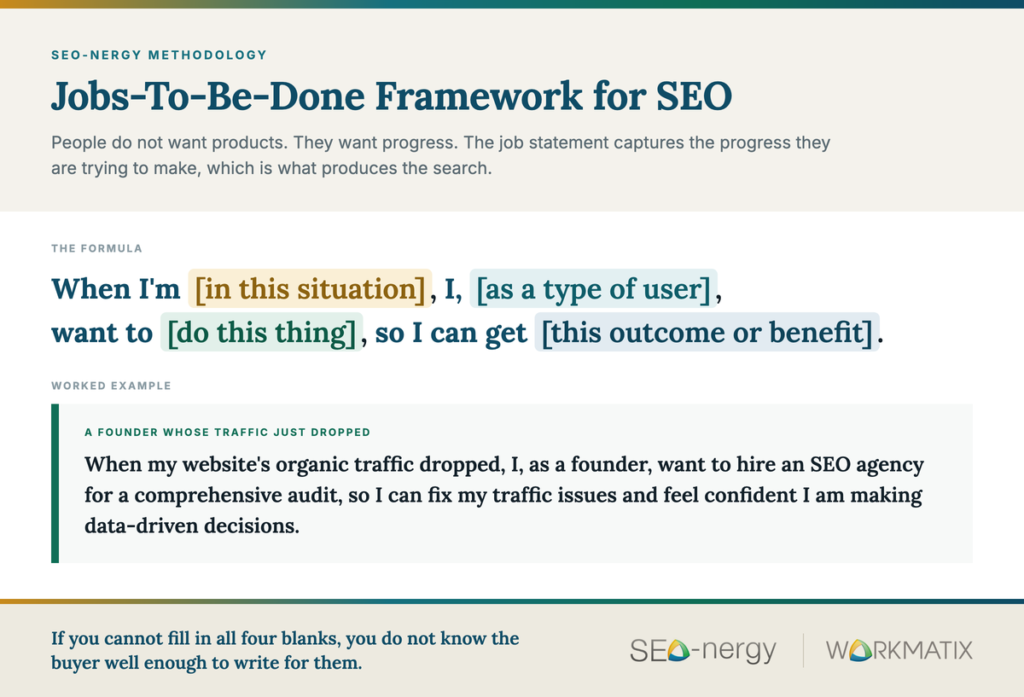
Functional Goals are the visible, rationalized version of the “job”. They are:
- Conscious
- Easy to articulate
- Task-focused
- Expressed clearly in search queries
They answer:
- What am I trying to accomplish right now?
- What action or task moves me forward?
What do I need to get done?
Examples (Jobs-To-Be-Done lens)
Functional goal: “Find an SEO agency”
Jobs-To-Be-Done statement:
When my traffic is flat, I want to find an SEO agency, so I can fix my website traffic issue.
This is the part users can say out loud — and the part that shows up in search:
- “best SEO agency for SaaS”
- “SEO consultant near me”
- “hire SEO expert”
This is why functional goals are easy to map out.
Higher-Order Goals are the actual reason the job exists.
- Why does this task matter to me?
- What kind of person do I want to be on the other side of this?
- What emotional or social risk am I trying to reduce?
This maps directly to your text: “What kind of outcome do I really want?”
- Aspirational
- Emotionally charged
- Identity-based
- Stronger motivators
Same example, continued:
Higher-order job:
“Feel confident running my business”
“Stop worrying about organic traffic growth”
“Be seen as competent in my role”
Full Jobs-To-Be-Done Statement:
When my website isn’t growing, I want to hire an SEO agency, so I can feel confident that my business is on the right track and that I’m making smart decisions as a founder.
This is the job behind the job.
Users rarely type this into Google — but it’s what determines:
- Which result they trust
- Which brand they choose
- Whether they convert or bounce
Why This Is a Spectrum and Not Two Separate Things
Think of it like this:
- Functional goals justify the decision
- Higher-order goals drive the decision
People explain their behavior using functional language, but they choose using higher-order motivation.
How This Shows Up in Search Behavior
Functional Goals → Search Query Language
These turn into:
- “how to…”
- “best tool for…”
- “hire / buy / compare”
Example:
“Fix my website traffic issue”
“why my website traffic dropped”
Higher-Order Goals → Help to Uncover Evaluation Criteria of Your Customers
These show up indirectly as:
- Trust signals
- Reviews
- Brand positioning
- Tone, clarity, authority
Same user, later search:
“best SEO agency for founders”
“SEO agency case studies”
“is [agency] worth it”
They’re not only solving a task — they’re also reducing anxiety.
Why Higher-Order Goals “Usually Win”
JTBD research shows that when there’s tension between a cheaper solution vs. a safer, confidence-boosting one.
People almost always choose the solution that:
- Reduces emotional risk
- Preserves identity
- Signals competence or control
That’s why:
- “Best” often beats “cheapest”
- Case studies beat feature lists
- Clear frameworks beat long checklists
What This Means for Marketing & SEO
Functional goals tell you:
- What content to create
- Which keywords to target
- What format is expected
Higher-order goals tell you:
- How to position the content
- What objections to remove
- What emotional reassurance to provide
Great SEO content does both at once.
- Functional: “SEO checklist”
- Higher-order framing: “A clear, proven SEO system you can trust”
What This Means for You as a Marketer
If you only speak to:
- Features
- Tasks
- Rational steps
…but ignore:
- Emotional outcomes
- Aspirational goals
You’ll lose attention, even if your solution is good. Once you start designing for goals instead of features, your marketing becomes a lot more persuasive without being pushy. Ready to decode your buyer persona? Get the B2B buyer persona template. Clayton Christensen’s Jobs to Be Done article in Harvard Business Review is the original statement of the idea this page applies to search.
Key Takeaways
- Goals drive attention, decisions, and purchases
- Goals exist because of a gap between now and desired future
- Functional goals = tasks and steps
- Higher-order goals = emotional outcomes
- Emotional goals usually win
- Consumers often act without consciously naming their goal
- High-converting pages mirror goal activation