
The SEO-nergy Methodology
SEO-nergy is a proprietary methodology that treats search performance as one connected system, aligning how people search, how your site is built, how search engines and AI read it, and how your marketing ties it all together. When those align, visibility compounds into growth.
Why most SEO quietly fails
Here’s a pattern that shows up again and again. A business invests in SEO. They publish more posts, chase more keywords, maybe even climb the rankings. And then nothing happens. Traffic arrives but doesn’t convert. Leads slow. Rankings rise while revenue sits still.
The reflex is to assume you’re doing SEO wrong. You’re usually not. What’s broken is the way SEO is sold: as a tactics game. More keywords, more backlinks, more content, more optimization. That worked when Google’s algorithm was simpler, results were less crowded, and AI was not in the picture.
Search has changed. Buyers have changed. AI has rewritten the rules. And businesses still treating SEO as a checklist of isolated tactics are paying for visibility that never compounds into anything.
Search performance isn’t created by individual actions. It’s created by alignment across the entire digital experience.

What SEO-nergy is
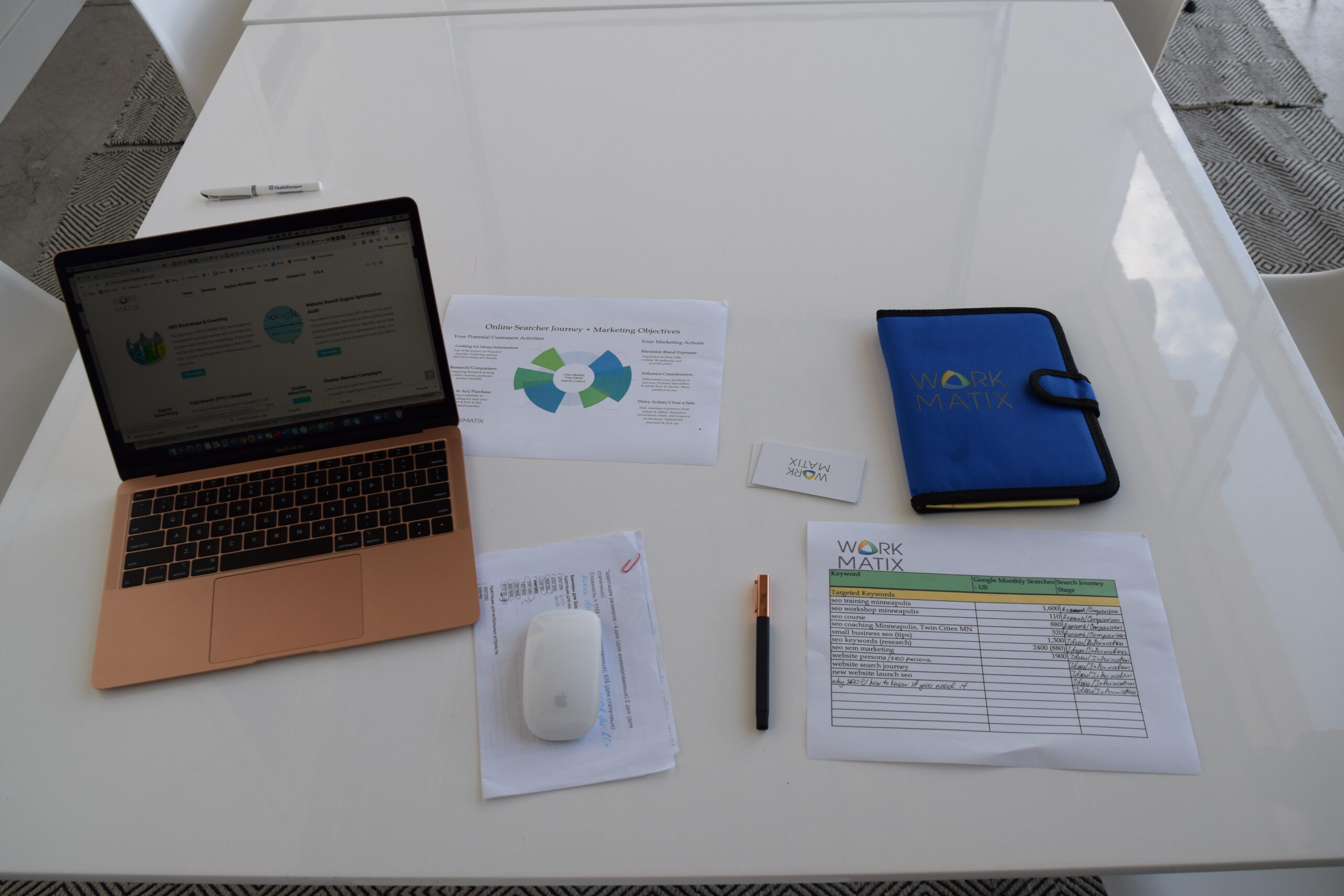
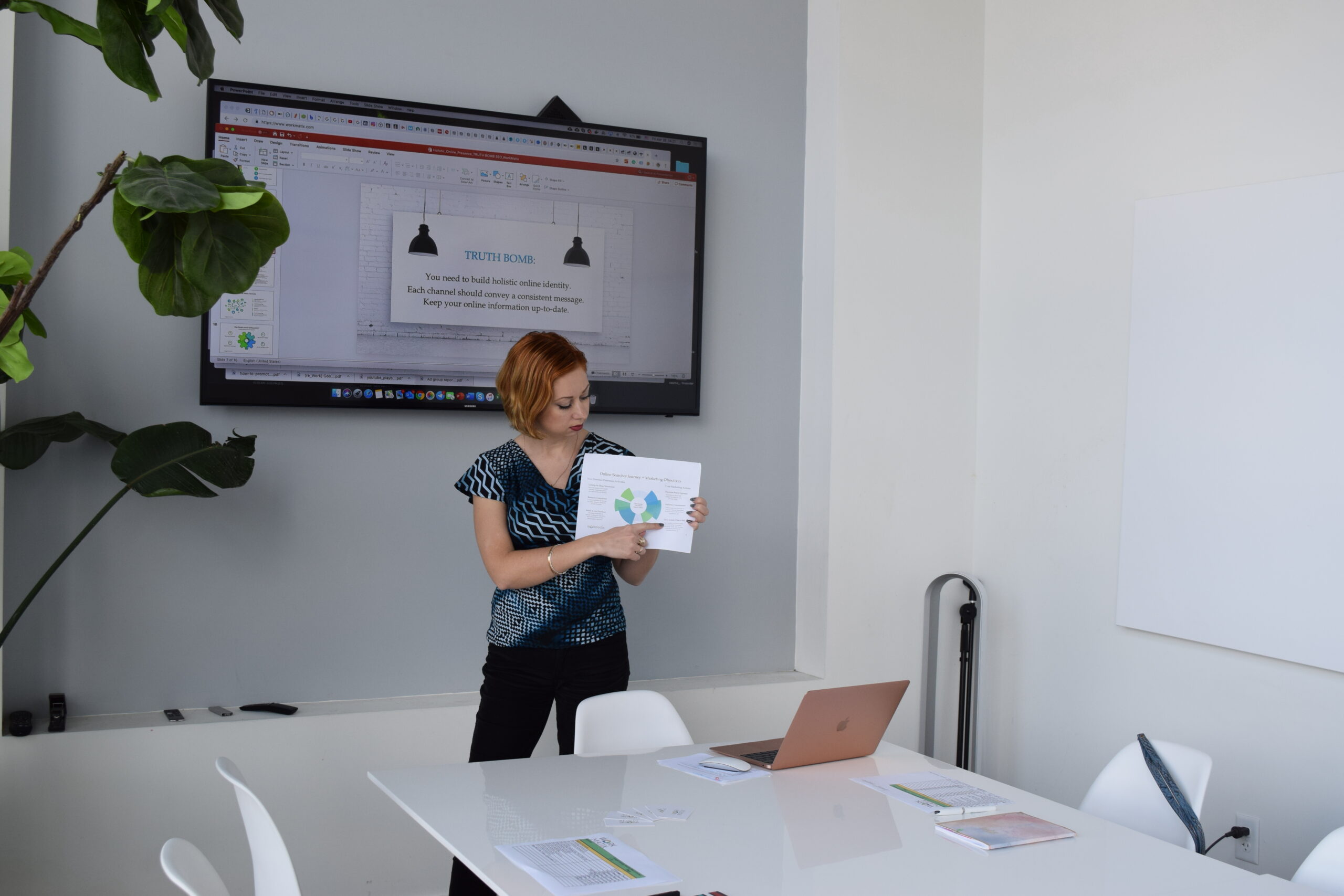
SEO-nergy is a proprietary search marketing methodology developed by Julia Gordeeva over eighteen years of B2B practice. It treats your search performance as one connected system, the way it actually behaves in the real world, instead of a stack of tactics optimized one at a time.
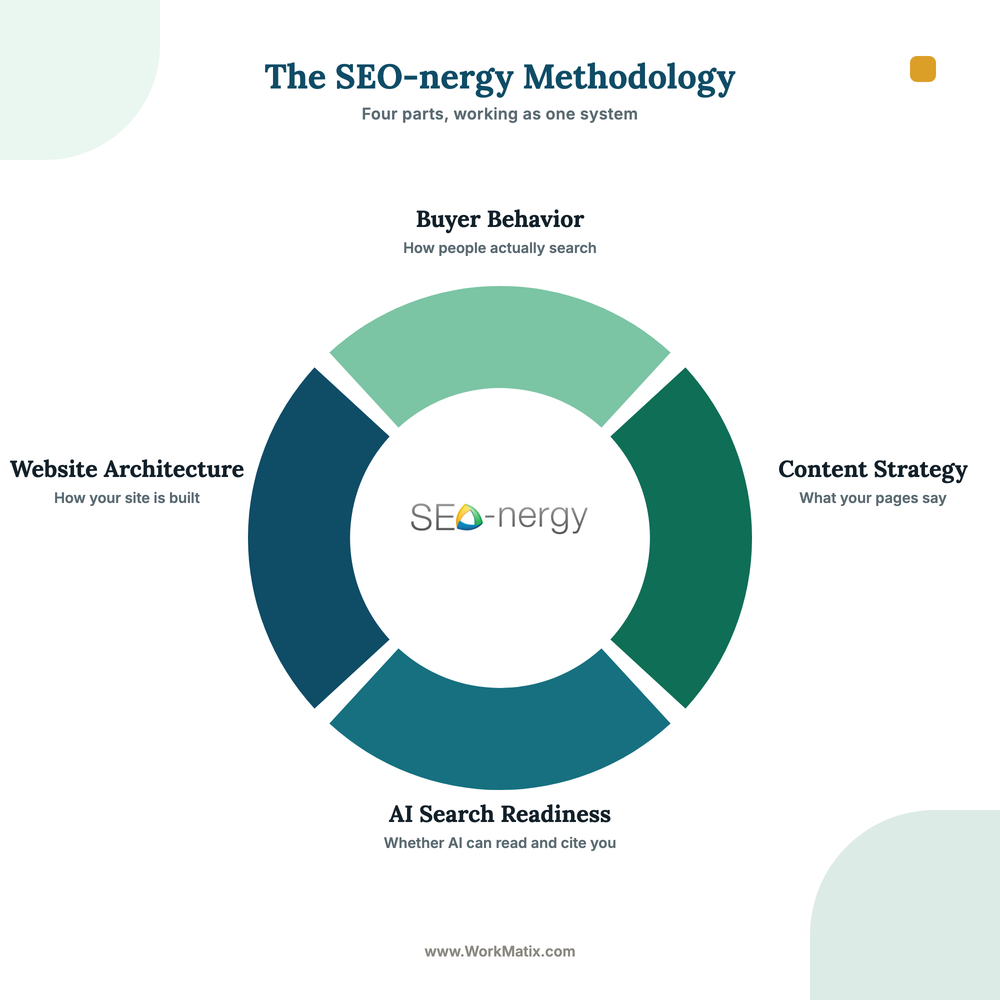
It aligns four moving parts so they reinforce each other:
- How people search. The psychology, intent, and decision-making behind every query, question, and prompt.
- How your website is built. Content, structure, navigation, and the conversion experience.
- How search engines and AI systems work. What gets evaluated, ranked, surfaced, and cited.
- How integrated marketing connects. Branding, online PR, SEO, SEM, and content marketing, woven into one coherent customer journey.
When the four align, search performance compounds. When they’re misaligned, you get the symptom every marketing team knows too well: traffic without business impact. That’s the shift SEO-nergy makes, and it’s what turns search from a cost center into a growth engine.
SEO-nergy aligns your website and marketing with how people actually search, think, and decide, so search visibility becomes measurable business growth.
Not more traffic. Better traffic. The kind that converts.
What powers SEO-nergy?
When you align user goals (the cause) with search intent (the effect), the search query/prompt becomes the expression and the search result becomes the answer.
Solve for the root cause, and everything downstream falls into place.
SEO personas built on search behavior, not just demographics
Most SEO personas are demographic theater: a 35-year-old manager at a mid-sized firm who drinks oat milk lattes. None of that helps you rank or convert. What helps is search-behavior modeling, the chain from a Job-to-Be-Done, to an intent, to an actual query.
A “job-to-be-done” statement reads like this: when I’m in this situation, I, as a type of user, want to do this thing, so I can get this outcome.
That sentence reveals the real motivation behind a search, the functional, emotional, and social goals a buyer is trying to accomplish by hiring your product or service. Once you know the job, you can predict every variant of how that buyer will search across their journey. The job stays the same; only the language evolves.
By understanding search behavior and the “why” behind the search, your team will be able to:
- improve both rankings and conversions
- create more effective content
- design better website experiences
- align messaging with user intent
The core concept behind SEO-nergy: search intent is the master variable
Here’s the mindset shift the whole methodology rests on. People don’t consume content. They use content to accomplish something.
Every query has a goal behind it, and that goal is intent, the thing Google and AI reward above almost anything else.
When a prospect lands on a page from a search, they’re silently asking one question: can you help me achieve what I came here to do? If the page answers it, the page wins. If it doesn’t, no amount of meta tag polish will save it.
So for every page on your site, two questions decide its fate: what task is this page designed to help the user complete, and what stage of the search journey are they in when they arrive?
If you can’t answer those clearly, you can’t measure the page performance meaningfully, and you can’t fix what’s broken.
How search intent evolves from question-to-purchase
In SEO, user intent, also known as search intent, refers to understanding the underlying goal or purpose behind a user’s search query.
Understanding search intents will help you map out your user search journeys and build out SEO-driven sales funnels effectively.
Every search query a buyer uses falls into one of five buckets. Each answers a different question in their mind.
- Informational. ‘Teach me, tell me more about it.’ Early-stage, problem-aware searching.
- Comparative and Evaluative. ‘Help me choose the right thing.’ Weighing options, reading reviews, comparing vendors.
- Transactional. ‘Let me do the thing.’ Ready to buy, book, request a quote, or sign up.
- Navigational and Locational. ‘Take me there.’ Looking for a specific brand, page, or place.
- Jobs-to-Be-Done driven. ‘When I’m in this situation, I want to do this thing, so I can get this outcome.’ The foundational layer beneath the rest.
Learn more about “What Is Search Intent and Why Is It Important For SEO?“
The three stages of a search journey
Every buying decision moves through three stages, and each one demands a different kind of content, a different intent, and a different call to action because search behavior changes depending on where the user is in their journey.
Stage 1: Information Search and Exploration
Your buyer is problem-aware. They know something’s wrong but haven’t identified the solution. Their intent is informational, and their internal question is: help me understand what’s going on. They’re searching how-tos, guides, checklists, and symptoms.
Stage 2: Consideration, Comparison and Evaluation
Now they’re solution-aware. They know what type of thing they need and are comparing options against criteria like cost, reliability, and fit. Their intent is comparative and evaluative, and their internal question is: help me choose the right option. They’re searching reviews, comparisons, case studies, and pricing.
Stage 3: Decision (Purchase or Action)
They’re ready to act. They’ve moved past research into specific, direct queries to finalize the decision, find a price, or contact a company. Their intent is transactional, and their internal question is: let me do the thing. They’re searching to buy, book, request a quote, or schedule.
What search journey mapping reveals
When you map the user journey from trigger →search → decision → action, you uncover things most teams miss.
It shows you:
- User pain points: confusing navigation, slow loads, difficult forms) that cause frustration, allowing proactive problem-solving.
- User understanding & empathy: gain insight into user actions, emotions, and goals, fostering empathy and ensuring the site meets real needs, not just assumptions.
- Insights: the why behind search behavior
- User intent mismatches: pages that rank but don’t actually help
- User actions: what they do at each stage
- Unexpected behavior: alternate paths users take that weren’t designed
- Opportunities: where to improve or innovate
The buyer’s search journey map becomes the connective tissue between your SEO Persona, optimization strategy and execution by aligning your website design with real user needs and behaviors.
What This Means for SEO & Marketing Strategy
Understanding search psychology helps you:
- Match content to real intent
- Show up in meaningful contexts
- Support decision-making at the right moment
You’re not just answering questions you’re meeting people where they already are mentally.
What SEO-nergy does differently
Each of the four parts produces the input for the next one. That’s the whole design.
1. Buyer behavior → produces the search language. The persona isn’t a demographic sketch; it captures how this buyer phrases the problem, at each stage, to Google and to AI tools. Its output is vocabulary and questions.
2. Website architecture → consumes that language. The structure is built from the questions, in the order a buyer needs them answered across the three stages of the search journey. Its output is a map of pages and how they link.
3. Content strategy → consumes the map. Each page gets a brief specifying which intent it serves and what it must answer. Nothing gets written because a calendar slot was empty.
4. AI search readiness → consumes the briefs. Answer-first structure and the schema that matches the page type, so the page is machine-readable. This is a property of every page from the start, not a retrofit.
Why it matters now
Five concrete reasons, each one solving a problem you’ve probably already lived through.
It builds long-term growth, not one-time wins. A self-reinforcing flywheel where each piece of work makes the next easier and more effective. That’s the difference between running an SEO program and building one.
It moves you past tactical SEO. Instead of chasing keywords and isolated fixes, you build on holistic systems and search-behavior insight, the things that compound. You stop chasing tactics and start building leverage.
It prevents costly redesign disasters. The scenario every team dreads: a beautiful new site launches and traffic tanks. Building SEO and AI-search fundamentals in from day one prevents the overnight loss of rankings and brand equity.
It improves visibility and conversion. Rankings alone don’t pay the bills. Connecting intent, UX, messaging, and architecture produces qualified traffic that actually does something on your site.
It gives you a clear roadmap. Clarity on priorities, a structured execution plan, and a clear understanding of who owns what. Every move has a reason, instead of ‘let’s redesign the homepage and see what happens.’