A Practical, Jobs-To-Be-Done Approach to Smarter Keyword Research
Most of the time keyword research starts with SEO tools.
The best keyword research starts with understanding why people search in the first place.
If you’ve ever exported thousands of keywords, sorted by volume, and still felt unsure what to prioritize, you’re not alone. Search data without context creates noise. What actually powers effective SEO is understanding the job someone is trying to accomplish when they open Google.
This ultimate guide walks you through a practical, structured method for discovering keywords and identifying the features your audience truly cares about. You’ll learn how the Jobs-To-Be-Done framework transforms keyword research, how to turn real-world scenarios into search clusters, how to identify high-intent opportunities, and how to systematically build a strategic keyword list that aligns with user intent, business goals, and website architecture.
This is not about chasing volume. It’s about uncovering search behavior that leads to meaningful action.
How the Jobs-To-Be-Done Framework Powers Keyword Research
If there’s one framework that really helps you uncover better keywords and more meaningful product features, it’s Jobs-to-Be-Done, popularized by Clayton Christensen.
Why?
Because it forces you to stop thinking like a marketer and start thinking like a human in a moment of need.
The Core Job-To-Be-Done-Driven Question:
“What job is the user trying to get done?”
This sounds simple but it’s powerful. People don’t want products. They want progress and reaching their goals.
Learn more about the connection between Jobs-To-Be-Done & Consumer Goals.
They “hire” products or services to help them move from:
- where they are now
- to where they want to be
How Users Actually Think About Solutions
JTBD looks at two things at the same time:
1. The Functional Job
What problem are they trying to solve?
This is the practical task.
Examples:
- “Redesign my website without losing SEO traffic”
- “Track leads without manually updating spreadsheets”
- “Learn SEO well enough to stop guessing”
These turn directly into:
- how-to keywords
- feature-driven searches
- process-oriented queries
2. The Emotional & Social Job
How do they want to feel and be seen while doing it?
This is where most keyword research falls short.
People don’t just ask:
“Does this work?”
They also ask (often subconsciously):
“What does this say about me?”
Examples:
- “I want to feel confident explaining this to my boss”
- “I don’t want to look unprepared in front of a client”
- “I want to be seen as strategic, not tactical”
These show up in search as:
- “best”
- “trusted”
- “for professionals”
- “used by agencies”
- “enterprise-ready”
- “beginner-friendly”
A Simple Jobs-To-Be-Done Structure You Can Use
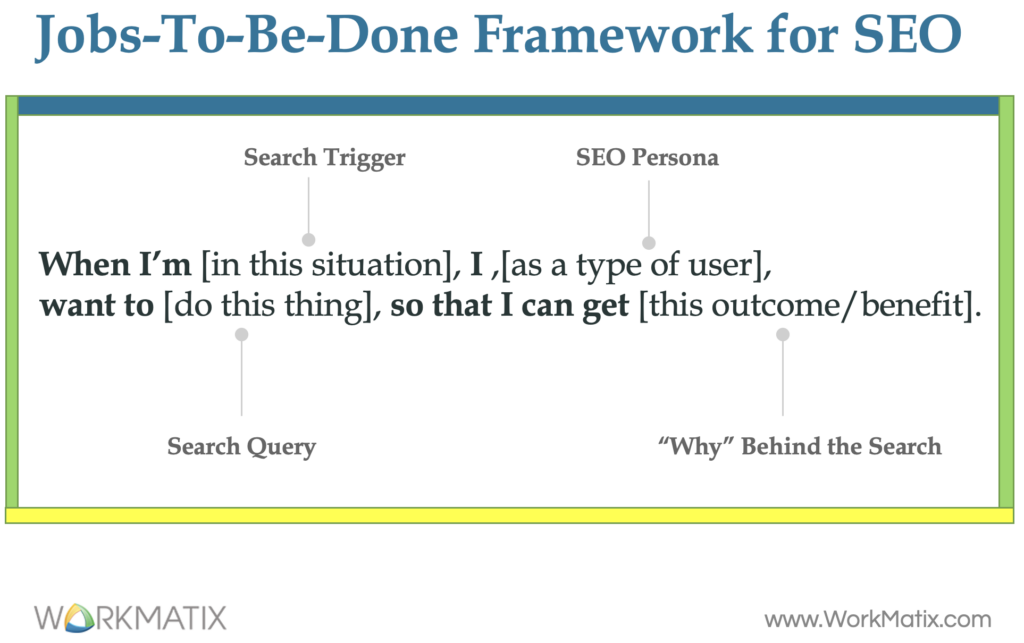
The key outcome of using JTBD framework is job statements. They consist of a verb, an object and context. When you’re identifying keywords or features, think in this format:
When I’m in this situation, I want to do this thing, so I can get this outcome.
Example (Marketing Context):
As a website manager planning a redesign, I need to identify potential SEO hazards and requirements early on, so I can launch the new site confidently, protecting existing search rankings, traffic, and brand authority.
Everything inside that sentence can become:
- keywords
- content angles
- landing page sections
- feature priorities
How This Helps You Discover Better Keywords
Instead of starting with SEO tools, you start with situation analysis.
You ask:
- What triggered this search?
- What failure are they trying to avoid?
- What success are they aiming for?
- Who else is affected if they get this wrong?
Keyword examples that fall out naturally:
- “SEO checklist for website redesign”
- “how to redesign a website without losing rankings”
- “SEO consultant for redesign project”
- “website migration SEO mistakes”
How This Becomes Keyword Research & Topic Clusters
Here’s the simple flow:
- Fill out one Use Case for one Persona
Here is a post about How to Develop and Refine B2B Buyer Personas for SEO.
Think of a use case as a specific situation where someone “hires” your company to accomplish a particular goal.
Not just: “Who is our customer?”
But: “In what moment does this product become the right answer for our target audience?” What is the problem we are solving?
Ask:
- What went wrong?
- What’s missing?
- What’s frustrating?
- What’s slowing them down?
- Extract:
- Problems → become core search queries
- Situation → search trigger
- Motivations & Constraints → keyword modifiers /query patterns
This maps to:
- Problem-based keywords
- “How do I…”
- “Why is…”
- “Best way to…”
Example
- “How to track leads from organic search”
- “Why my SEO traffic doesn’t convert”
These are usually informational and early consideration search queries.
- Differentiators (why you, not alternatives)→ feature-driven search queries, comparative search queries, value-driven phrasing.
What makes your product/service stand out? What are the benefits of your products or service? Why do they choose our product/service over alternatives?
Examples
- “Affordable”
- “For small teams”
- “No-code”
- “Enterprise-ready”
- “Fast setup”
- “Get SEO insights without complex dashboards”
- “Reduce risk with compliant, audit-ready tracking”
These types of keywords signal comparative & evaluative search intent.
- Turn each use case into SEO topic cluster which consists of:
- Pillar Page: A long-form, comprehensive guide covering a broad topic (e.g., “The Ultimate Guide to Content Marketing”).
- Cluster Content (Subtopics): Detailed articles addressing specific, long-tail questions related to the main topic (e.g., “Content Marketing Strategy,” “SEO Best Practices,” “Content Distribution Channels”).
- Internal Links: A network of hyperlinks connecting the pillar page to all cluster pages, allowing search engines to crawl and index content efficiently.
- Set of dedicated landing pages for each stage of the user search journey
- Write unique SEO titles and meta descriptions for each landing page
- Craft H1, H2, H3s titles that match search intent
- Shape landing page structure & CTR language matching the user journey stage.
(!) Take into consideration how long do they think before acting?
SEO & Content Impact
- Short cycle → comparison + CTA pages
- Long cycle → education, guides, frameworks
How This Changes Keyword Strategy
Once you understand the job, keywords become clearer.
Instead of: “web design agency”, you get clusters like:
Functional:
- “B2B website redesign agency”
- “improve SaaS website conversion rate”
Emotional:
- “is website redesign worth it”
- “how to justify website budget”
Social:
- “best SaaS website examples”
- “award-winning B2B websites”
Different jobs → different search intent → different page types.
How to Identify and Select Your Target Keywords
Your keywords are the foundation of your campaign. If potential customers are searching for your products or services, they will find you more quickly if you have selected the right keywords. It is important to think like your customers. How might your customers search for your product or service? Some of the best keywords tend to be two to three words long. There are many keyword research tool to help you with this process providing suggestions for new keywords based on real search data.
Think of the sequence of search terms that users use to tailor your targeting and messages within Google Ads.
Understanding Customer Search Behavior is So Important Since It Enables You to:
Understand customer behavior to see whether the products, services, and content you offer match customer behaviors
Set goals for how much reach and visits are possible within your market
Benchmark your performance against competitors (direct and publishers)
Diagnose problems at a keyword or keyword group level on performance through a gap analysis.
For this, to work, you need a keyword master file that you use to review and control performance through gap analysis.
Ensure you have good visibility of customer search behavior against results delivered.
Use Exact match to get realistic volumes of demand.
Build up a List of Qualifiers or Adjectives That Aligns with User Intent
Typical keyword variants used by search engines are:
Intended use/application
Vendor/Brand
Comparison/quality
Product type
Location
Adjective (price/product qualifiers)
You’re not going to be able to manage your keywords so well if you have a single long list of undifferentiated keyword, so check you’re grouping them in a logical order.
When identifying keywords, it’s essential not to simply have a long list but group them to make them manageable. Each keyword you identify as important should be placed in a group similar to the types above.
Group your keywords logically for analysis and management. The most common are groups of product or service categories and sub-categories.
Exploit the ‘Long Tail’ of Search
If you base your search marketing strategy on just 10 to 20 keywords, you will be limiting your exposure. There will be a large number of less popular keywords that won’t find you. To maximize visitor numbers, hundreds of keyword will be appropriate. To maximize quality, fewer more specific keywords will be needed.
For e-commerce sites, the sky’s the limit. Some banks have thousands of keyphrases, while some e-retailers have tens of thousands. All these depend on high volumes of traffic.
You should review the importance of the long tail within search and develop strategies to exploit it.
Copywriters for SEO need to know the qualifiers used so they can target the most important key phrases. The best way to summarize these is through writing out the semantics of a sentence like this: <qualifier> + <core term> + <post modifier>. Example: ‘children’s savings accounts in the USA’.
Your keywords should be organized by common themes or products. Think about and list all the keywords you want to use and then group similar keywords together. The next stage is to organize them into your account in a structured way.
Low Search Volume Keywords
Once you’ve added your keyword list to your Google Ads account, you may notice Google giving several keywords the status ‘Low Search Volume.’ Any keyword that is classified in this way will not be eligible to be entered into the auction. This is one of the most frustrating problems with Google Ads – Google simply won’t let you bid on a large part of the long tail. Instead, you need to make sure that higher volume terms are within the account on a broad enough match type to cover off any searches for these lower volume queries.
Having a list of metrics is helpful for initially estimating a keyword’s value. Try the SEMRush Keyword Overview tool for free to conduct initial keywords & topics analysis.
Key Takeaways
- People don’t buy products, they hire them to make progress
- JTBD helps you uncover real keyword intent, not just volume
- The best keywords reflect:
- the situation
- the job
- the desired outcome
- If you can answer “What job is the user trying to get done?”
you can:
- write better content
- design better features
- and convert with less friction
Keyword research becomes powerful when it shifts from “What words should we rank for?” to:
“What progress is our audience trying to make and how does that show up in search?”
By applying the Jobs-To-Be-Done framework, you move from generic keyword lists to intent-driven search modeling. You identify triggering situations, uncover consumers’ functional and emotional goals, translate them into real search queries, and group them into structured topic clusters. From there, selecting target keywords becomes a strategic decision based on relevance, stage of awareness, conversion potential, and business impact — not just search volume.
The practical path looks like this:
- Start with real scenarios, not tools.
- Define the job and the desired outcome.
- Translate that job into raw search language.
- Expand into clusters and supporting subtopics.
- Prioritize based on intent, opportunity, and strategic fit.
When done correctly, keyword research stops being a spreadsheet exercise and becomes a roadmap for building content, features, and pages that align with how humans search, evaluate, and decide.