
Search marketing is often split into two camps:
- SEO for long-term organic growth
- SEM (paid search) for immediate traffic and lead generation
But treating them as separate disciplines is one of the biggest strategic mistakes marketers and web design agency owners make.
SEO and SEM are not competitors. They are symbiotic systems built on the same foundation:
human psychology, search intent, and the progress someone is trying to make (Job-To-Be-Done).
When aligned strategically, they compound each other. When siloed, they compete for budget, attention, and clarity.
Search marketing only works when it mirrors how humans actually make decisions.
Let’s unpack how they actually work together and why Jobs-To-Be-Done thinking changes everything.
- Search Is Not About Keywords — It’s About a Problem
Before someone types anything into Google, something happens.
A search trigger.
- A KPI drops.
- A redesign fails.
- A competitor launches.
- A board meeting approaching.
- Leads slow down.
- A new service launches.
Search is a response to tension.
This is where the psychology of search begins.
People don’t search because they want information.
They search because they want:
- Certainty
- Progress
- Risk reduction
- Validation
- A solution
Understanding this tension is what connects SEO and SEM strategically.
- Jobs-To-Be-Done: The Missing Layer in Search Strategy
The Jobs-To-Be-Done (JTBD) framework reframes search behavior:
When X happens, I need to Y so I can Z.
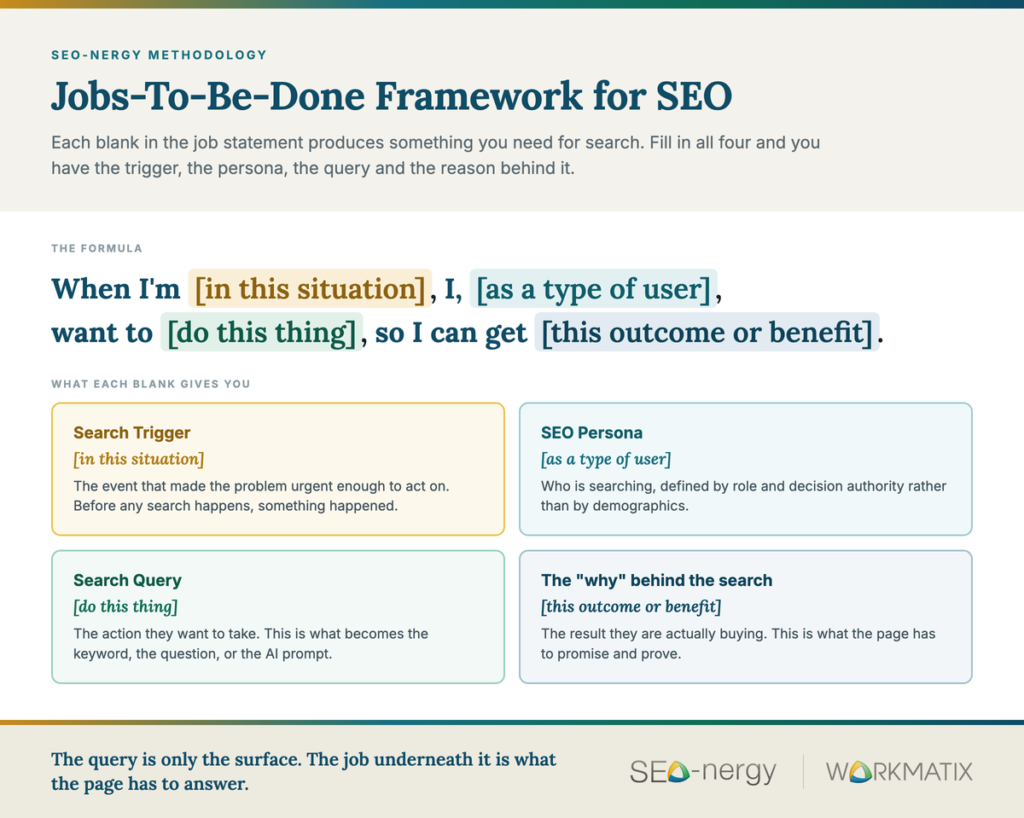
Example (B2B marketer): When demo bookings drop, I need to figure out why traffic isn’t converting, so I can fix pipeline performance before leadership questions marketing effectiveness.
That job will generate:
- Diagnostic searches
- Comparison searches
- Vendor evaluation searches
- ROI validation searches
Both SEO and SEM must support that progression.
If they don’t, you’re just buying and ranking for keywords, not supporting the entire decision-making process.
SEO = Long-Term Authority & SEM = Accelerated Intent Capture
They play different but complementary roles.
SEO does:
- Authority building
- Trust accumulation
- Organic discoverability
- Demand capture at scale
- Long-term cost efficiency
SEM does:
- Immediate visibility
- Controlled targeting
- Fast testing of messaging
- Demand generation for new services
- Short-term acceleration
But both rely on the same things:
- Intent mapping
- Keyword selection
- Message alignment
- Landing page CRO
The strategic mistake? Running them with different assumptions.
Why Strategic Planning Matters
Without strategy, this happens:
- SEO targets high-volume keywords with weak commercial intent.
- SEM targets bottom-funnel terms without supporting educational content.
- Landing pages aren’t built around user jobs.
- Budget gets wasted.
- Teams blame channels instead of architecture.
Strategic planning prevents this.
How Jobs-To-Be-Done Unifies SEO and SEM
Instead of starting with tools, start with:
- What triggered the search?
- What job is the user trying to get done?
- What outcome proves success?
- What risks are they trying to reduce?
From there:
- Build keyword clusters by Consumer Search Journey stage.
- Create SEO content for authority and long-tail intent.
- Deploy SEM to capture high-intent search queries and test messaging.
- Use PPC data to refine organic priorities.
- Use organic campaign insights to improve ad relevance.
Now both SEO & SEM channels inform each other.
The Strategic Framework
Here’s how to align everything:
Step 1: Map Jobs-To-Be-Done
Define trigger → goal → desired outcome.
Step 2: Cluster Keywords by Consumer Search Journey Stage
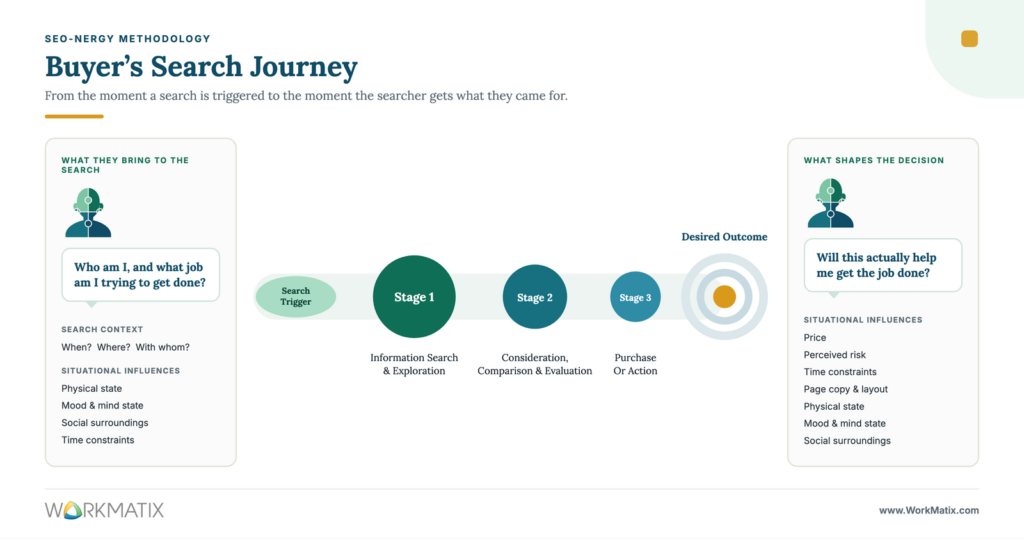
Match messaging to search intent and search journey stage:
- Information Search & Exploration
- Consideration, Comparison & Evaluation
- Purchase or Action
Information Search & Exploration Stage
This is where curiosity begins. The user senses friction, opportunity, or uncertainty.
Examples:
- “why website traffic not converting”
- “how to improve b2b website performance”
- “how SEO works for service providers”
Mind State at This Stage
- Seeking clarity
- Gathering knowledge
- Reducing uncertainty
- Framing the issue
Role of SEO
SEO dominates here:
- Educational blog posts
- Strategic guides
- Framework explanations
- Thought leadership
This is where Jobs-To-Be-Done research is critical.
If you understand:
What triggered this search?
What progress are they trying to make?
You create content that speaks directly to their internal dialogue.
Role of SEM
SEM can:
- Test messaging angles
- Promote high-value guides
- Accelerate exposure for new topics
But this stage is primarily about building authority and visibility organically.
Consideration, Comparison & Evaluation
Now the user understands the landscape.
They’re thinking:
- “What type of solution makes sense?”
Users are asking:
- “Who should I trust?”
- “What makes this different?”
- “Is this worth the investment?”
Search examples:
- “seo for web design agencies”
- “best b2b seo agency”
- “seo consultant vs agency”
- “white label seo for web design agency”
- “seo case studies b2b”
- Narrowing options
- Evaluating solution categories
- Defining criteria
- Proof seeking
- Value comparison
SEO provides:
- Case studies
- Comparison pages
- Objection-handling content
- Testimonials
Content must directly address:
- Fear of wasting budget
- Fear of choosing wrong partner
- Fear of implementation failure
SEM protects:
- Branded searches
- High-intent keywords
- Competitor terms
At this stage, paid search is defensive and offensive.
Purchase or Action-Readiness
Now the user is ready to act.
- “book seo strategy call”
- “hire b2b seo consultant near me”
- Final validation
- Low friction
- Clear next steps
- Confidence
SEO ensures:
- Optimized conversion pages
- Clear CTAs
- Strong internal linking to action
SEM ensures:
- Maximum visibility at decision stage
- Remarketing
- Branded keyword defense
- Immediate conversion capture
Step 3: Assign Channel Roles
SEO = authority + scalable capture
SEM = acceleration + validation
SEO builds the authority across the journey.
SEM accelerates visibility and validates messaging within the decision-making journey.
Together, they create:
- Higher conversion rates
- Lower acquisition cost
- Stronger positioning
- More predictable pipeline
The Big Insight
SEO and SEM are not just search marketing channels.
They are two mechanisms serving the same psychological process:
helping someone move from uncertainty to confident action.
When grounded in:
- The psychology of search
- Jobs-To-Be-Done thinking
- Strategic keyword clustering
- Intent-driven planning
Search marketing stops being fragmented. It becomes a coordinated growth system and a predictable engine for growth. Channels reinforce each other only when they run off the same intent model. The SEO-nergy Methodology is that shared model. Google’s helpful content guidance applies to landing pages as much as articles, which is what lets one intent model serve both channels.
Digital marketing is always changing and expanding, making it almost impossible for traditional marketers to know what works and what it the best strategy for their companies. That is where WorkMatix can come in. If you have questions, feel free to drop us a line or give us a call. Our discovery consultation is always free! Meanwhile check out our blog post on “Undertaking website redesign with SEO considerations in mind“.